Ways4eu WordPress.com Blog
SPA View of ways4eu.wordpress.com
When the Sun Wobbles: What the New Sharpest Solar Image Reveals about Instability
By Kinda Cool
on Fri Aug 21 2026
Quick Links
- Instability in Plain Sight
- How the Swirls Begin
- The Inouye Telescope Steps In
- What the Image Actually Shows
- Why the Physics Matters
- A Creative Kind of Solar Chaos
When the Sun Wobbles: What the New Sharpest Solar Image Reveals about Instability
Instability in Plain Sight
What does the new sharpest image of our Sun show? Instability. But not the dramatic, planet-threatening kind you might fear at a coffee-spot power outage. We’re talking about a very specific, very elegant dance of physics: the Kelvin-Helmholtz instability, or KHI for short.
How the Swirls Begin
Picture two streams flowing side by side, each with its own speed and color. When they rub past one another, they can start to slip, twist, and grow little waves. In the solar case, these streams are not water and air but corridors of solar magnetic plasma—hot, charged, and opinionated enough to wink at the laws of physics and say, “Let’s braid our edges and see what happens.” That braided edge is where the Kelvin-Helmholtz instability shows up on the Sun.
The Inouye Telescope Steps In
Long hypothesized to lurk on the star’s glittering surface, KHI has finally moved from theory into the frame. The latest high-resolution images, snapped with the Inouye Solar Telescope in Hawaii, put on a show that is equal parts science lecture and nature documentary. The figures are dramatic and precise, but what’s happening beneath the drama is even more intriguing: swirls and streaks that trace the interactions of solar plasma as it streams and shuffles past its neighbors.
What the Image Actually Shows
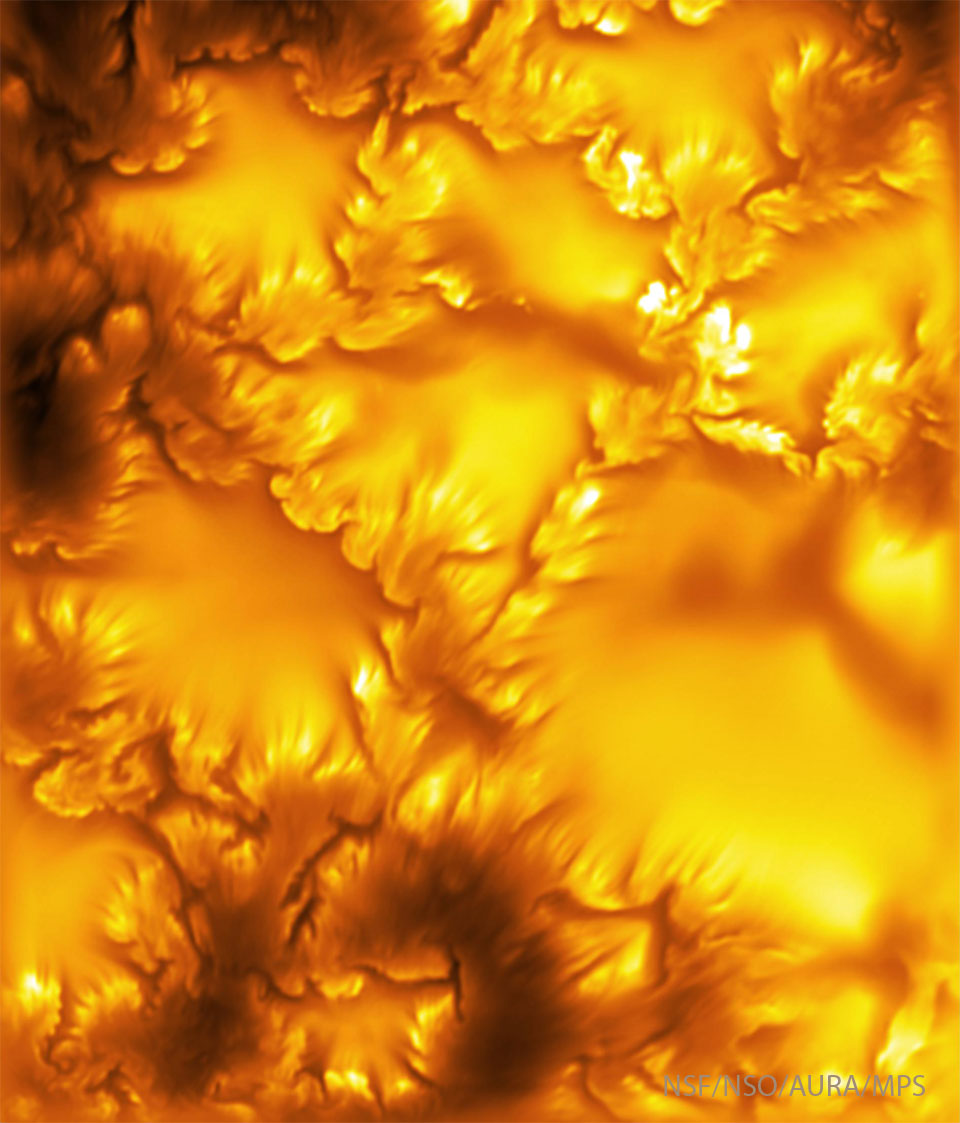
The featured image—though billed as “false-yellow”—is, in truth, a deep blue beauty. It is the highest-resolution image yet captured of the Sun in visible light, a feat that makes the Sun look both intimate and enormous at the same time. The image spans roughly the Earth’s radius, a cosmic postcard sized to remind us just how big and close the solar stage is. Yet, when you zoom in to the finest details, you see a city-sized texture of the solar surface—the kind of detail that makes you want to don a lab coat and pretend you’re a solar cartographer.
What do we actually see in this breathtaking frame? The granules—the individual cells that tinker with the Sun’s surface—appear as smooth tops, each one a tiny solar traffic roundabout. But the real show starts at the edges. Where the granules meet and mingle, the edges organize into flower-like structures whose boundaries aren’t static; they harbor multiple KHI swirls. It’s as if the Sun’s surface is hosting a fleet of mini whirlwinds, each tracing a path along the boundary of two flowing plasma streams. The result is a visual symphony: waves, swirls, and twisting ribbons that testify to complex fluid dynamics in a place you might never have imagined would host such poetry.
Why the Physics Matters
Why does this matter beyond the pretty pictures? Because the Kelvin-Helmholtz instability isn’t just a curiosity. It’s a potential mechanism for moving energy and magnetic fields around in the Sun’s atmosphere. If KHI swirls are helping to shuffle energy from the surface toward the outer solar atmosphere, they could be part of how energy is transported into the corona and potentially contribute to heating that long-standing solar mystery. In other words, these tiny, intricate motions might be a crucial piece of the puzzle for why the Sun’s outer layer behaves the way it does.
Future research will refine our understanding of how KHI interacts with the Sun’s magnetic fields—how these swirls tug on and twist magnetic lines, how energy hops from one region to another, and whether the same processes could be at work in other stars or in different solar conditions. Each new image acts as a sharper question, inviting scientists to test the boundaries of plasma physics, magnetohydrodynamics, and the energetic choreography that sustains our star’s light and heat.
A Creative Kind of Solar Chaos
If you’re watching the Sun from your desk, take a moment to appreciate the drama unfolding on its surface. The new sharpest image doesn’t just give us a prettier postcard; it offers a glimpse into a dynamic, unstable world where waves and swirls aren’t just possible—they’re being observed in real time. And as researchers continue to decode these patterns, we may uncover not only how the Sun moves energy around but how the cosmos itself channels the power of instability into the structure of stars.
In short: the Sun is teaching us to embrace instability as a creative force—one blue-tinted frame at a time.
© 2026 ways4eu.wordpress.com H.J.Sablotny — All rights reserved. The text content of this post is the intellectual property of H.J.Sablotny. Images are subject to their respective copyright holders and are used for illustration purposes only.