Ways4eu WordPress.com Blog
SPA View of ways4eu.wordpress.com
When a Quiet Comet Goes Loud: The Unexpected Brightening of Comet 220P
By Kinda Cool
on Thu Aug 27 2026
When a Quiet Comet Goes Loud: The Unexpected Brightening of Comet 220P
Quick Links:Comet 220P/McNaught | long-exposure astrophotography | diatomic carbon | periodic comets
A Sudden Sky Surprise ☄️
Comet 220P/McNaught has a reputation for doing things on its own quiet schedule—which, for a long time, meant hiding in the telescope shadow. This periodic wanderer between Mars and Jupiter typically dares us to catch a glimpse only with careful study and a bit of patience. In other words: it usually prefers to stay a dim, enigmatic fellow. But this year something decidedly unquiet happened, and the cosmos took notice.
Two surprise outbursts, to be precise, have turned 220P into something almost unrecognizable in the night sky. If you’d parked a telescope on its usual brightness for the past decade, you might have found the comet’s light curve akin to a shy cat: present, but seldom seen. Then, out of nowhere, it erupted—twice—releasing a flare of activity that has made it roughly 20,000 times brighter than its typical personality. The result? Binoculars and long-exposure camera setups now reveal a comet that once required a dark-sky sanctuary and a patient gaze to detect.
Orbit and Outburst 🔭
For the astronomy-curious, the narrative is still following a familiar arc. Comet 220P continues its elliptical waltz around the Sun, staying tucked between Mars and Jupiter, with a orbital period a little over five years. That steady rhythm reminds us that even when a celestial body suddenly steals the scene, its larger journey remains governed by gravity’s patient drumbeat. The recent brightness upsurges do not change the comet’s orbit; they simply change how we observe its current chapter.
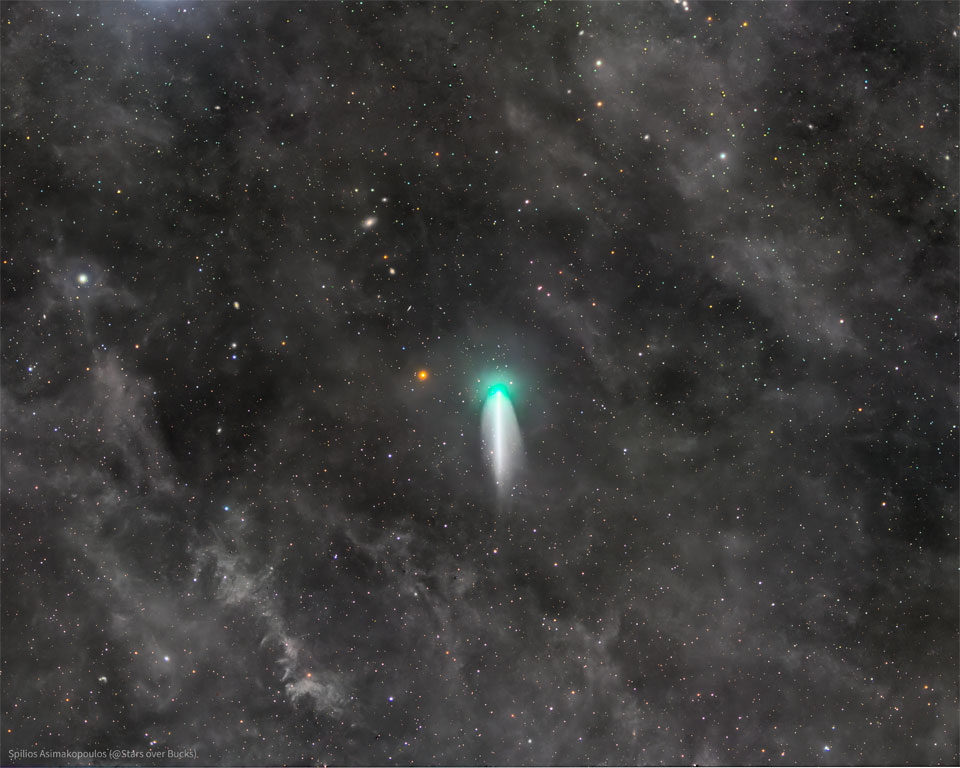
The most recent standout image—a long-duration exposure captured about ten days ago from South Africa—offers a striking portrait: a bright green head, a compact glow that hints at volatile chemistry, and a short dust tail that keeps its distance from the nucleus. The green hue is a telltale signature of diatomic carbon (C2) and other radicals that glow under sunlight and the magic of long exposures. It’s a visual reminder that comets are not merely frozen time capsules; they’re dynamic engines of gas and dust, reacting to solar warmth in ways that can surprise observers with each approach and retreat.
As for why 220P has suddenly decided to ramp up its brightness, the science remains in the realm of educated speculation. The leading suspects involve the sudden release of trapped subsurface gas, possibly triggered by internal pressure buildup, or perhaps a quake-like event on the comet’s crust that unseals vents and vents forth material in a brief, spectacular release. It’s a reminder that even icy entities traveling through the solar system carry a geology as active as any on rocky planets—just on scales that are often invisible to the naked eye, until the heavens decide to show off.
What Comes Next 🌌
Looking ahead, the trajectory suggests a near miss in October: the comet will pass roughly one Earth-Sun distance from our planet. That proximity is a friend to observers, offering a rare opportunity to witness a brighter-than-usual object in modest sky conditions. After this close approach, expectations are that 220P will begin its gentle fade as it continues along its solar orbit toward the far side of the system. It’s a transient spectacle—a reminder that the cosmos loves a good cameo, then retires to the wings as the curtain falls.
So keep your eyes to the sky, but temper your expectations with a dash of wonder. Comet 220P has reminded us that even in the predictable dance of planetary orbits, there’s room for dramatic acts and dazzling surprises. Whether you’re under dark skies with a backyard telescope or simply enjoying a long-exposure of the Milky Way’s quiet glow, 220P’s bright outbursts offer a compelling chapter in the ongoing show that is our solar neighborhood.
Image via NASA https://ift.tt/CgDnrTl
© 2026 ways4eu.wordpress.com H.J.Sablotny — All rights reserved. The text content of this post is the intellectual property of H.J.Sablotny. Images are subject to their respective copyright holders and are used for illustration purposes only.