Ways4eu WordPress.com Blog
SPA View of ways4eu.wordpress.com
Trails Across the Sky: A Night of Rotating Earth, Concentric Arcs, and a Silent Telescope
By Kinda Cool
on Mon Aug 31 2026
Trails Across the Sky: A Night of Rotating Earth, Concentric Arcs, and a Silent Telescope
An APOD meditation on Earth rotation, star trails, and one patient telescope beneath the southern sky.
Quick Links:Paranal Observatory | star trails | Earth rotation | south celestial pole
When Motion Becomes Visible
At the latitude of ESO’s Paranal Observatory in Chile, about 25 degrees south, Earth’s rotation nudges the planet’s surface eastward at more than 1,500 kilometers per hour. It’s a velocity that would make a sonic boom tremble at sea level, yet the motion remains almost entirely imperceptible to the human sense. The reason lies in perspective: our feet stay put on a rotating ball, while the stars above drift across the sky as if pulled along by a cosmic tide.
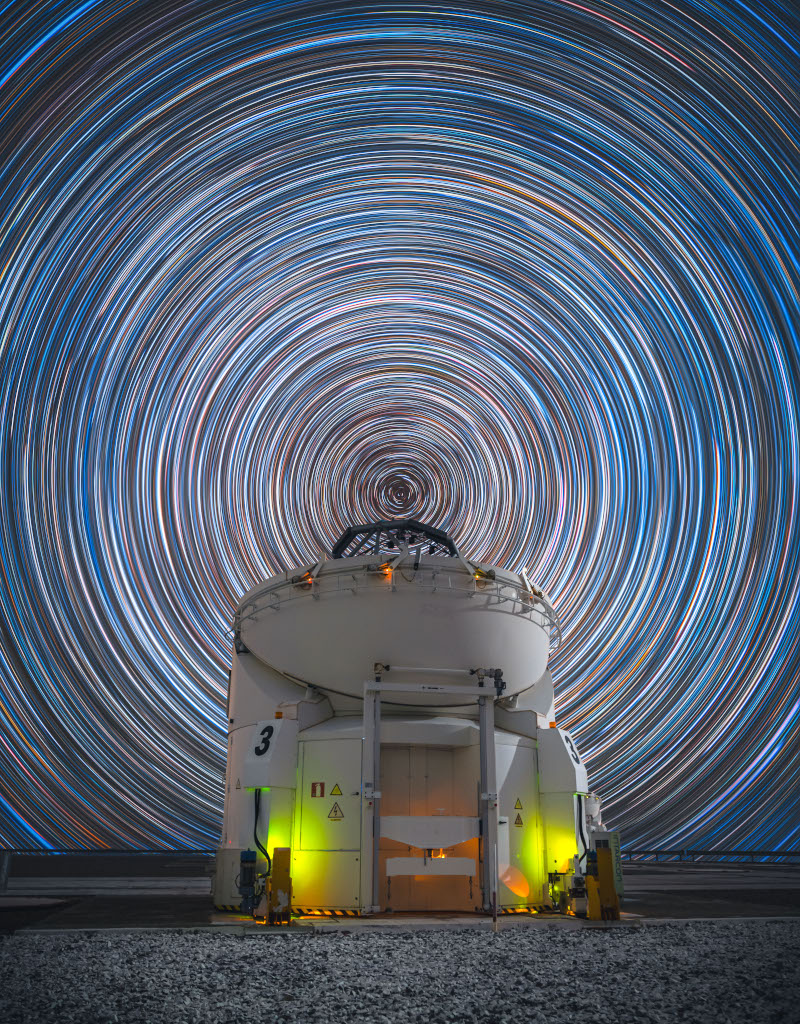
But if you know where to look, that nearly instantaneous spin of the planet becomes a patient, silvery reveal in photography. Star trails—those luminous fingerprints drawn by the spinning heavens—showcase the city-sized wink of a planet turning beneath us. The image you’re about to glimpse is a careful choreography of time stitched into light. It was composed from a digital stack of 300 consecutive 25-second exposures, all captured with a camera fixed to a tripod to trace the star trail arcs. Each frame is a quiet whisper of the night, compiled into one long, swaying line that maps the motion of the sky.
A Telescope Beneath the Arcs
The resulting arcs are graceful, concentric, and centered at the south celestial pole—the southern hemisphere’s extension of Earth’s axis of rotation into the vastness of space. It’s a reminder that the axis about which our planet pirouettes doesn’t disappear at the horizon; it simply tilts away from us and keeps its own quiet vigil, forever guiding the stars in their slow, stately circles.
In the foreground of this well-planned scene from a rotating planet sits a familiar companion to the night: one of the observatory’s operating 1.8-meter auxiliary telescopes, AT 3. It appears beneath the south celestial pole, faintly illuminated as if basking in a sliver of moonlight and a photographer’s patience. The telescope is more than a tool; it’s a vigilant spectator. While the Earth spins beneath, AT 3 rests in place, its lines and silhouette a steady counterpoint to the fluid arcs of the star trails above. It’s as if the telescope is watching the heavens do their slow dance, ready to pivot and peer when the moment calls.
This quiet visual narrative—Earth’s rapid turn rendered as a set of delicate, elongated curves, and a fixed instrument anchoring the foreground—invites a larger reflection. Our planet’s spinning motion is a daily background hum, easy to miss unless we deliberately photograph, measure, or observe. The star trails insist on the patience of seeing: a reminder that astronomy is often a practice of looking long and listening for the subtle cues that time leaves in light.
Why Star Trails Seduce
If you’re curious to recreate a touch of this vignette, what you’d do is simple in intent and challenging in discipline: fix a camera on a tripod, point it toward the south celestial pole, and let it collect a sequence of long exposures—hundreds if you can manage them. The key is consistency: identical framing, identical exposure settings, and a steady hand on the shutter. Over time, the sky writes its story in arcs, and the planet’s rotation becomes a work of art you can walk into and read.
As night after night follows Earth’s steady bow across the sky, the star trails remind us that our world is not still. It is moving with a pace faster than sound, a pace that is invisible to casual observation but incredibly visible when stacked, stacked again, and then finally seen as a chorus of arc and light. And somewhere in that chorus, AT 3 sits quietly, a faithful witness to the cosmos’ patient performance, awaiting its next cue in the grand theatre of the night.
More info:Source article
© 2026 ways4eu.wordpress.com H.J.Sablotny — All rights reserved. The text content of this post is the intellectual property of H.J.Sablotny. Images are subject to their respective copyright holders and are used for illustration purposes only.