Ways4eu WordPress.com Blog
SPA View of ways4eu.wordpress.com
A Spin Through the South: Star Trails Above Paranal
By Kinda Cool
on Tue Sep 01 2026
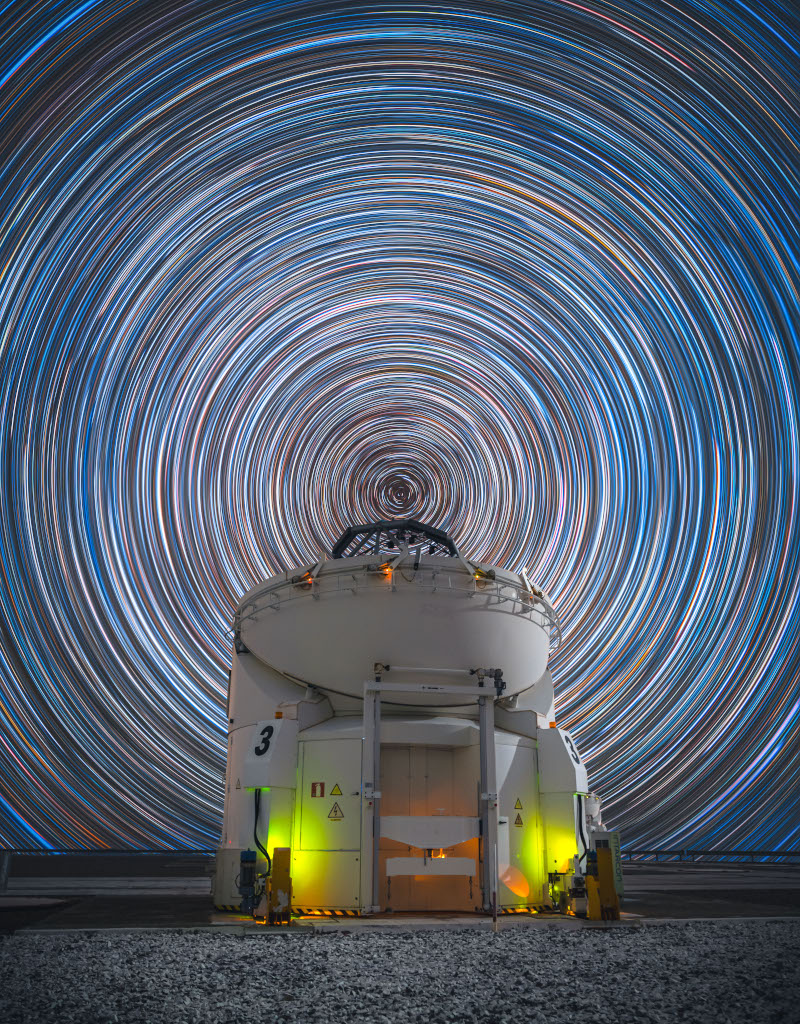
A Spin Through the South: Star Trails Above Paranal
An APOD glimpse of Earth’s spin made visible over Chile, with a patient telescope resting beneath the southern arcs.
Quick Links:Paranal Observatory | star trails | south celestial pole | Earth rotation
When the Sky Starts Drawing
At the latitude of ESO’s Paranal Observatory in Chile, about 25 degrees south, Earth’s rotation moves the planet’s surface eastward at over 1,500 kilometers per hour. And while that’s faster than the speed of sound at sea level, the motion is imperceptible to our daily senses. The human eye is a poor witness to such celestial speed, lulled by the planet’s size and the quiet steadiness of night. Yet the cosmos offers a playful reminder: line up enough moments in time, and the sky itself reveals its own choreography.
This particular star-trail moment was crafted from a digital stack of 300 consecutive 25-second exposures, all captured with a camera mounted on a simple tripod. No fancy tracking, no motors—just a fixed gaze at the southern sky, patiently folding time into a visible arc. Each exposure adds a fresh stroke to a longer story: a luminous path tracing the heavens, slowly bending into graceful streaks that radiate from a common center.
The Pole and the Telescope
The resulting image is a study in concentric motion, with arcs neatly centered on the south celestial pole—the southern hemisphere’s counterpart to the celestial north. That pole is the celestial anchor of Earth’s rotation, the point around which the sky appears to swirl as our planet pirouettes beneath it. The longer you observe, the more obvious the pattern becomes: a rolling tapestry of curved lights, each line a snapshot of how the sky shifts as Earth turns.
And there’s a quiet drama in the foreground. One of Paranal’s 1.8-meter auxiliary telescopes, AT 3, sits just beneath the south celestial pole in the frame, standing as a patient witness to the choreography. Bathed in a faint, deliberate glow, the telescope anchors the scene—a reminder that this moment of apparent motion arises from a planet in motion, while a machine built to study the cosmos remains still enough to be part of the composition. It’s a well-planned scene from a rotating world: a blend of natural astronomy and human instrumentation, both bound to the same grand cycle of rotation.
Time Painted in Arcs
Photographing star trails, in this way, is less a capture of instantaneous sight and more a map of time. Each exposure contributes a brushstroke to a larger mural, where the sky tells its story through light that traveled here long before the stars we see tonight. The camera’s fixed position makes the Earth’s daily spin the star’s performance, and the resulting arcs—centered on the south celestial pole—offer a playful, luminous reminder: motion, even when invisible to our senses, leaves its mark on the heavens above Paranal.
More info:Source article
© 2026 ways4eu.wordpress.com H.J.Sablotny — All rights reserved. The text content of this post is the intellectual property of H.J.Sablotny. Images are subject to their respective copyright holders and are used for illustration purposes only.