Ways4eu WordPress.com Blog
SPA View of ways4eu.wordpress.com
When the Sky Lines Up: Eclipses, Sequels, and the Brighter Moments in Between
By Kinda Cool
on Tue Sep 01 2026
When the Sky Lines Up: Eclipses, Sequels, and the Brighter Moments in Between
This APOD-style eclipse meditation turns one eclipse season into a tidy cosmic double bill, with solar flair first and lunar drama close behind.
Quick Links:eclipse season | total solar eclipse | partial lunar eclipse | Bailey’s beads
Why Eclipses Travel in Pairs
Eclipses tend to come in pairs. Twice a year, during an eclipse season that lasts about 34 days, Sun, Moon, and Earth can nearly align. Then the new and full phases of the Moon, separated by just over 14 days, create a solar and a lunar eclipse. But only rarely is the alignment at both new moon and full moon during a single eclipse season close enough to produce a pair with both total solar and lunar eclipses. More often, partial eclipses are part of any eclipse season.
Let’s talk about the dramatic life cycle of these celestial duos. Picture this: the Sun and Moon play a kind of cosmic tag team. In one inning, the Moon passes between us and the Sun, casting a shadow that can darken the day and briefly turn our daylight into a solar mystery. In the following innings, the Earth’s shadow drapes over the Moon, lending the night an eerie, coppery glow. The rhythm is consistent, even if the outcomes—total, partial, or penumbral—vary from season to season.
The last eclipse season of 2026 gave us a standout fortnight-separated pairing: a total solar eclipse on August 12, followed by an almost total lunar eclipse on the night of August 27/28. It was the kind of double feature that makes stargazers grin and astrophotographers stay up late enough to demand a coffee IV drip.
The 2026 Double Feature
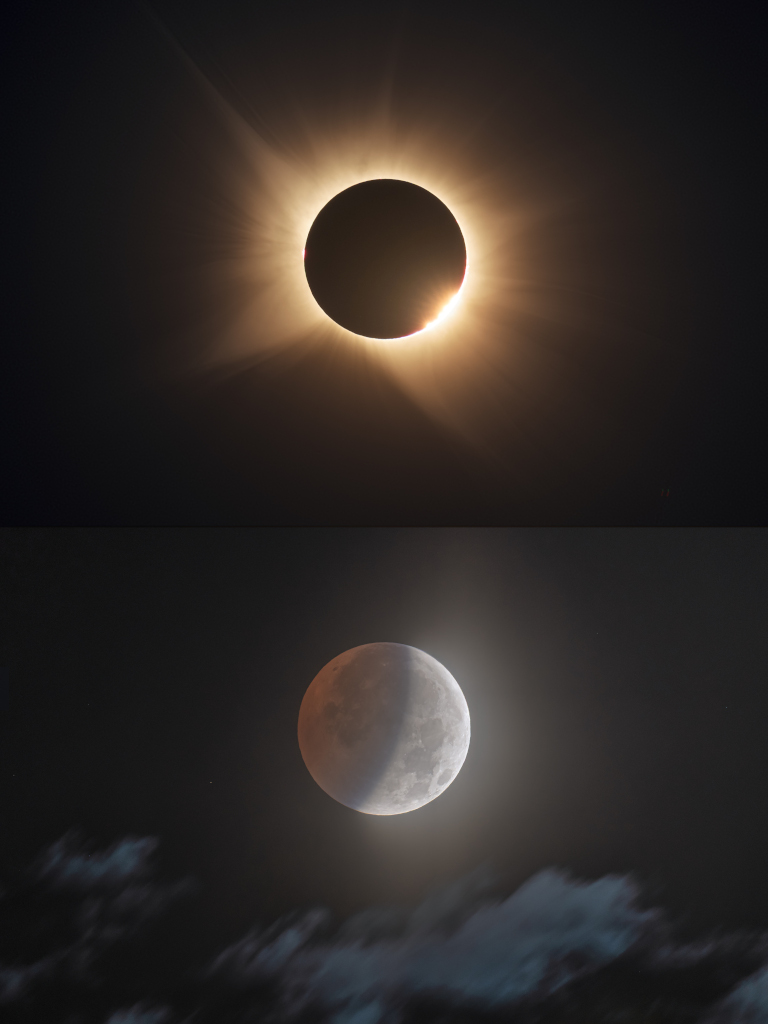
At New Moon, the solar eclipse was captured from Peñafiel, Spain, near the beginning of totality in an HDR composite image. If you’ve ever wondered what “Bailey’s beads” looks like in real life, this frame provides the answer—the edges of the Moon’s silhouette glittering with a jeweled glow, as a bright golden solar corona crowns the spectacle. It’s a moment where the Sun’s brilliance meets the Moon’s patient transit, a reminder that even the most dramatic shadows have their source in light.
Then came the following Full Moon, when the deep partial lunar eclipse was recorded from Sèvres, France. This HDR composite shows the Moon as it skulks behind Earth’s umbral shadow, not wholly eclipsed but decidedly darkened and reddened. About half the visible lunar disk appears transformed—crimson, shadowed—while the other half keeps its familiar lunar luster. It’s a powerful image that captures the nuance of a partial eclipse: not a blackout, but a dimming that makes the Moon look almost otherworldly.
Looking ahead, the coming eclipse season promises another impressive pairing, albeit in a different flavor. On February 6, 2027, an annular solar eclipse will grace the skies, when the Moon’s apparent size is a bit too small to swallow the Sun completely, leaving a bright ring—an annulus—around the Moon’s silhouette. Paired with this solar spectacle is a penumbral lunar eclipse on February 20/21, a more subtle shading of the Moon as Earth’s faint outer shadow brushes across its face. It’s not the dramatic inversion of day to night, but it’s no less celestial in its storytelling: a solar annulus followed by a lunar haze.
The Next Round
If you’re chasing the drama, here are a few tips to get the most out of these events without needing a telescope the size of a small car:
– Time it with precision: Eclipses are precise dances. A good almanac or reputable astronomy app will give you exact times for your location.
– Find a dark, open sky: Light pollution dulls the drama of the Sun’s corona and the Moon’s subtle shading.
– Capture the moment safely: Solar eclipses demand proper eye protection unless you’re using a certified solar filter for photography. Lunar eclipses offer more forgiving opportunities for naked-eye viewing.
– Watch the progression: For solar eclipses, the “diamond ring” or Bailey’s beads moments are fleeting but unforgettable. For lunar eclipses, track the gradual darkening and reddening as Earth’s shadow eclipses the Moon.
Eclipses are more than pretty pictures; they’re a reminder of the cycles that govern our sky. They show how the Sun, Moon, and Earth can align but still surprise us with different flavors of awe. Whether you’re a casual skywatcher or a full-on astrophotography enthusiast, the eclipse seasons offer a recurring invitation to pause, look up, and marvel at the universe’s patient choreography.
More info:Source article
© 2026 ways4eu.wordpress.com H.J.Sablotny — All rights reserved. The text content of this post is the intellectual property of H.J.Sablotny. Images are subject to their respective copyright holders and are used for illustration purposes only.