Ways4eu WordPress.com Blog
SPA View of ways4eu.wordpress.com
Igniting Roman’s Journey: A Sunlit Sprint to the Stars with Nancy Grace Roman on Falcon Heavy
By Kinda Cool
on Mon Sep 07 2026
Quick Links
- a Pre-Dawn Thunder from Florida
- roman Rides Toward Deep Questions
- a Telescope Built for Cosmic Accounting
- why This Launch Feels Mythic
A Pre-Dawn Thunder from Florida
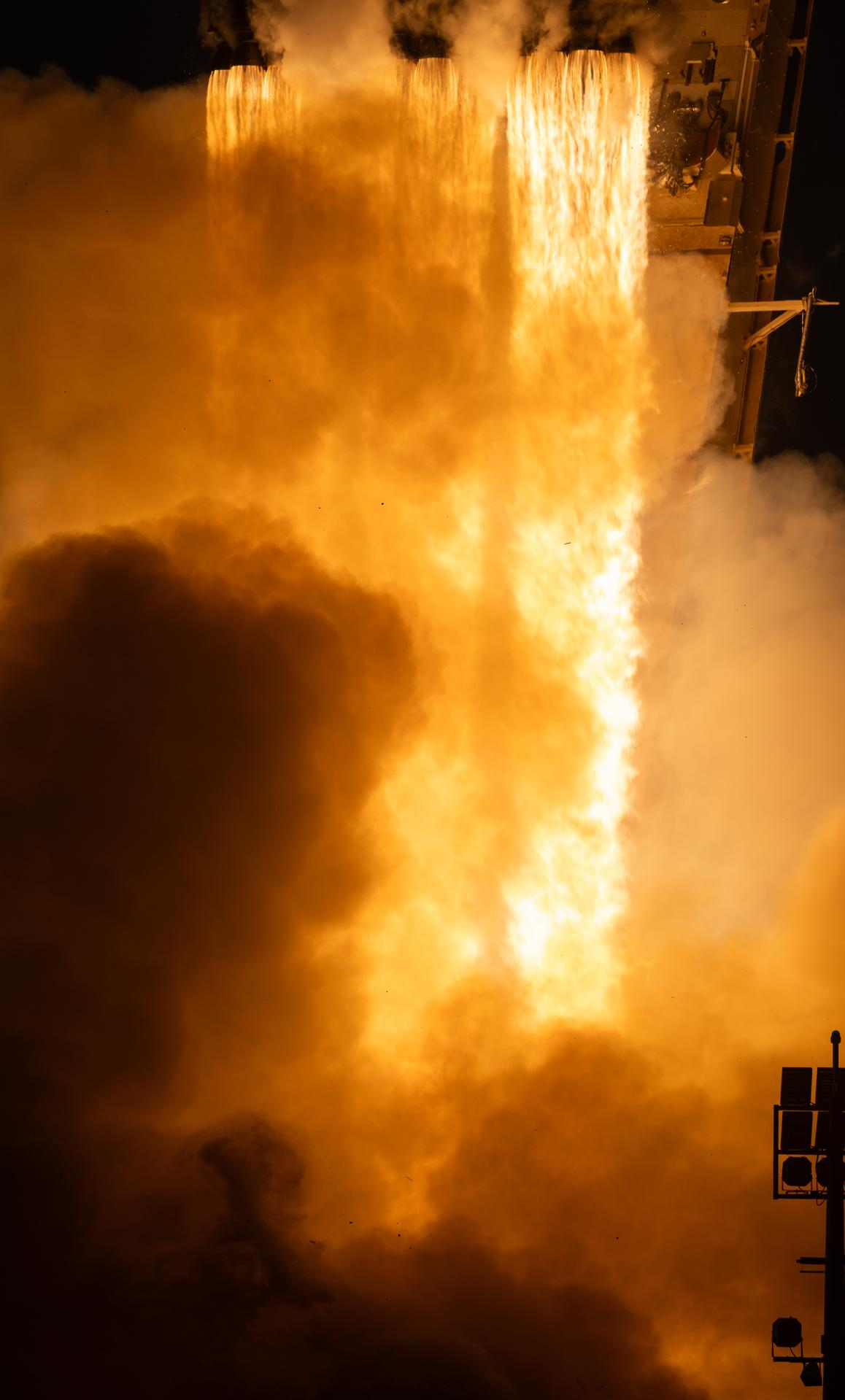
In the pre-dawn hush of Florida’s spacefaring playground, a behemoth with the heart of a hyperactive geyser rumbled to life. From Launch Complex 39A, the SpaceX Falcon Heavy roared like a chorus of caffeinated thunder, carrying a mission that sounded almost mythic in its scope: NASA’s Nancy Grace Roman Space Telescope riding into the cosmos, ready to poke the universe with a very polite, very precise stick.
The clock struck 7:26 a.m. EDT, and with the punctual bravado only a rocket can muster, the engines coughed up a plume of smoke, dust motes doing elegant trajectories in the wake. If you squinted your eyes or stared at the launch through a pair of oak-smoked sunglasses, you could swear the sky was auditioning for a space opera: dramatic, a tad futuristic, and somehow wearing a blazer that was always a size too big for Earthly worries.
Roman Rides Toward Deep Questions
What’s the Roman Space Telescope up to, you ask, besides being a solar-powered superhero in a silver-gray tux? Think big, think curious, think “let’s get to the bottom of the universe’s best-kept secrets while also counting the number of planetary systems and maybe discovering a habitable binary star on a Sunday morning.” Roman is poised to investigate dark energy and dark matter—the cosmic accelerants and invisibles that keep the universe from collapsing into a spreadsheet of chaos. It’s like inventory management for the cosmos, but with more glitter and gravitational lensing.
As the Falcon Heavy’s liftoff lit the morning like a sparkler on the Fourth of July, it wasn’t just about propulsion and engineering bravado. It was about a collaborative wink between SpaceX, NASA, and a constellation of scientists who believe the universe is not only knowable but also delightfully surprising. The Roman Space Telescope—named, in a nod to history and to the tireless spirit of pushing boundaries—promises to illuminate the dark corners of the cosmos with clarity, precision, and a touch of elegance that only space science can conjure.
So here’s to Roman—the telescope that keeps asking questions and the dawn that answers with light. May the stars stay patient, the data stay clean, and the mission stay wonderfully, brilliantly ambitious. Ignition accomplished. Journey just beginning.
A Telescope Built for Cosmic Accounting
But the mission doesn’t stop at mysteries of the dark. Roman will conduct a statistical census of planetary systems, essentially taking the universe’s pulse and tallying what kinds of worlds orbit which stars. Are there more Earth-twins than hot Jupiters, or are chilly ice giants more common than a playlist on a long car ride? Roman will help scientists answer those questions with data that would make a librarian kiss a telescope.
In the days, months, and years to come, we’ll be treated to updates that blend the awe of discovery with the warm, human thrill of watching a satellite become a planetary-scale detective. There will be data dashboards glittering with plots, timelines that resemble star maps, and the occasional press briefing where researchers politely explain that yes, the universe has more mysteries than a magician’s hat, and yes, Roman is equipped to help us sort through them.
Image via NASA https://ift.tt/HOxSghC
Why This Launch Feels Mythic
And because curiosity loves company, Roman will enable a broad range of additional astrophysics research. From peering at distant galaxies that formed when the universe was a toddler to mapping the distribution of matter across cosmic filaments like a celestial cartographer armed with a very patient pencil, the telescope is designed to be versatile enough to adapt to whatever new questions emerge from the data. It’s a research toolbox with a million drawers, each containing a carefully labeled possibility.
For now, the ignition of Roman’s journey is a reminder that exploration, in its purest form, is a team sport. It takes a rocket, a runway, a room full of brilliant minds, and a global audience ready to cheer, wonder, and occasionally nerd out about the difference between dark energy and a really stubborn coffee stain on a telescope lens. The result? A future where we’re better at understanding the cosmos, and perhaps a little savvier about our place in it.
Copyright Notice: The image and referenced source content remain the property of their respective creators and rights holders. They are used here solely for commentary, discussion, and informational purposes. Please visit the original source links for attribution and additional information.
© 2026 ways4eu.wordpress.com – H.J. Sablotny. All rights reserved. The text content of this article is the intellectual property of H.J. Sablotny and may not be reproduced, distributed, or republished without permission. Images remain the property of their respective copyright holders and are used for illustrative and commentary purposes only.