Ways4eu WordPress.com Blog
SPA View of ways4eu.wordpress.com
Nā ʻUhane Māhoe Huki Pū i ke Ola: When Twin Spirits Pull the Cosmos Toward Life
By Kinda Cool
on Tue Sep 08 2026
Quick Links
- a Galactic Duet with a Hawaiian Name
- gemini North Sees the Collision
- students Help Name the Cosmos
- why the Image Feels Alive
A Galactic Duet with a Hawaiian Name
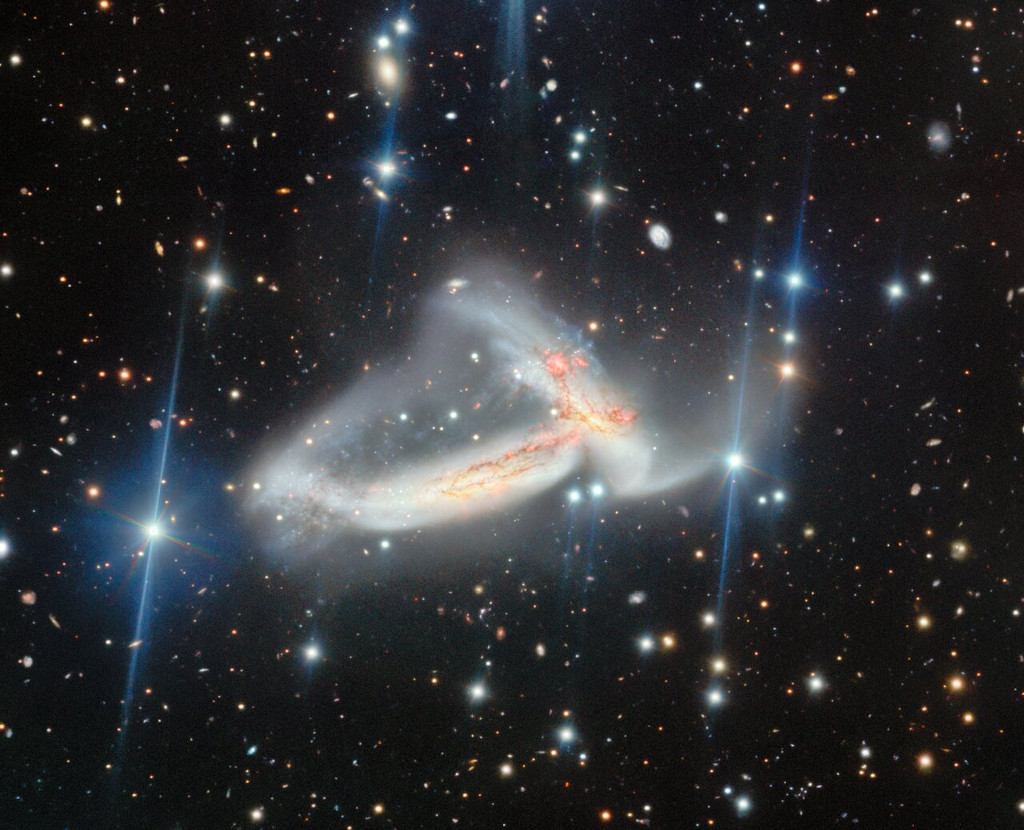
If you’ve ever wondered what happens when two celestial behemoths decide to dance, look no further than the Hawaiian name Nā ʻUhane Māhoe Huki Pū i ke Ola—the phrase that now colors an image of a pair of spiral galaxies locked in a mutual gravitational embrace. This isn’t poetry about distant lovers; it’s a precise snapshot of galaxies in the throes of a cosmic duet, about 200 million light-years away, marching toward the high-flying constellation Pegasus.
The scene is captured with stunning clarity by the 8.1-meter Gemini North telescope perched atop Maunakea, Hawai‘i. Galaxies don’t just drift by in quiet, dignified orbits; they collide, they stretch, they fling stars like confetti, and they ignite conditions ripe for star formation. In this image, the drama is not hidden in a secret corner of the universe—it’s laid bare in spiraling arms and battered disks, all caught in the act of a galactic-scale merger.
Gemini North Sees the Collision
The duo at the heart of this story is NGC 7253 and Arp 278. They earned their Hawaiian name not in a brochure, but through a thoughtful process that involved high school students in a collaborative program between the Gemini Observatory and the University of Hawaiʻi. The Project Hōkūlani internship program gave these students the chance to research, select, and name the target. The result is Nā ʻUhane Māhoe Huki Pū i ke Ola, a translation that resonates on multiple levels: “The Twin Spirits Pulling Together Creating Life.”
If you’re hunting for what makes this image particularly riveting, here are a few threads to pull:
As you gaze at the picture and read the story behind it, you’re witnessing a convergence that’s at once ancient and immediate. Ancient, because galaxies have been colliding for billions of years; immediate, because the light you see is a direct line from a moment when these two spirals were in the thick of their dance. The universe keeps turning, and with it, the opportunities for new stars, new stories, and new interpretations of who we are among the stars.
Students Help Name the Cosmos
Why that name? Because galaxy mergers are more than spectacular celestial thunder; they are cosmic life engines. When spirals collide, their gas and dust are churned into new configurations, fueling bursts of star formation. In other words, the very blocks from which stars—and ultimately planets and perhaps life as we know it—are built get stirred, shuffled, and sometimes reborn in the maelstrom. It’s a reminder that the universe is not a static stage but a vibrant workshop where creation often follows collision.
- The distances and dynamics: At roughly 200 million light-years away, the light we see left these galaxies before the dinosaurs even began to walk the Earth. Yet here they are, clearly locked in a gravitational embrace, their shapes distorted by mutual forces as they exchange angular momentum and funnel gas toward central regions.
- The star-forming spark: The gravitational interaction stirs up reservoirs of gas and dust—the elemental building blocks of life as we understand it—leading to regions of intense star formation. It’s a reminder that even the darkest, most violent events can give rise to new beginnings on cosmic timescales.
- The human connection: The story behind the name underscores a living bridge between cultures, education, and discovery. The students who named the galaxies are not just observers; they are co-authors of the narrative, shaping how we talk about these distant giants and what we choose to call them.
- The perspective of the instrument: Consider the Gemini North telescope, one of the tools that makes these detailed portraits possible. Its 8.1-meter mirror gathers the faint light from galaxies that are hundreds of millions of parsecs away, translating it into images that are as informative as they are beautiful.
So next time you hear about a galaxy merger, let Nā ʻUhane Māhoe Huki Pū i ke Ola guide your imagination. It’s not just a name; it’s a doorway into a cosmic event where collision begets creation, and where Hawaiian culture and modern astronomy meet under the same starry sky, guiding us toward life, one brilliant, spiraling moment at a time.
Image via NASA https://ift.tt/BK0dY4l
Why the Image Feels Alive
Culturally, the name grounds this distant, awe-inspiring event in a Hawaiian lens—an acknowledgment that our skies are populated, in both myth and science, with connections to place, heritage, and navigation. The region of Pegasus hosting this galaxy pair lies within the broader celestial neighborhood known to Hawaiians as Ka Lupe o Kawelo—the celestial hawk that guards the night sky and, in navigational lore, serves as a signpost for travelers across wide seas. It’s a poetic reminder that science and storytelling share a common backbone: humans looking upward, seeking meaning, and tracing pathways through the vast unknown.
This image isn’t just about pretty spirals; it’s about the ongoing dialogue between science and culture, between high-tech astronomy and young minds learning to ask better questions. Nā ʻUhane Māhoe Huki Pū i ke Ola stands as a beacon of that dialogue—a reminder that in the vast cosmos, there are twin spirits pulling together toward something essential: life, in its most expansive sense.
Copyright Notice: The image and referenced source content remain the property of their respective creators and rights holders. They are used here solely for commentary, discussion, and informational purposes. Please visit the original source links for attribution and additional information.
© 2026 ways4eu.wordpress.com – H.J. Sablotny. All rights reserved. The text content of this article is the intellectual property of H.J. Sablotny and may not be reproduced, distributed, or republished without permission. Images remain the property of their respective copyright holders and are used for illustrative and commentary purposes only.