Ways4eu WordPress.com Blog
SPA View of ways4eu.wordpress.com
The Thousand-Ruby Pinwheel: M83 in All Its Cosmic Spark
By Kinda Cool
on Wed Sep 16 2026
Quick Links
- a Cosmic Scene Comes Into Focus
- the Science Behind the View
- why the Image Feels Alive
- what the Sky Keeps Teaching
A Cosmic Scene Comes Into Focus
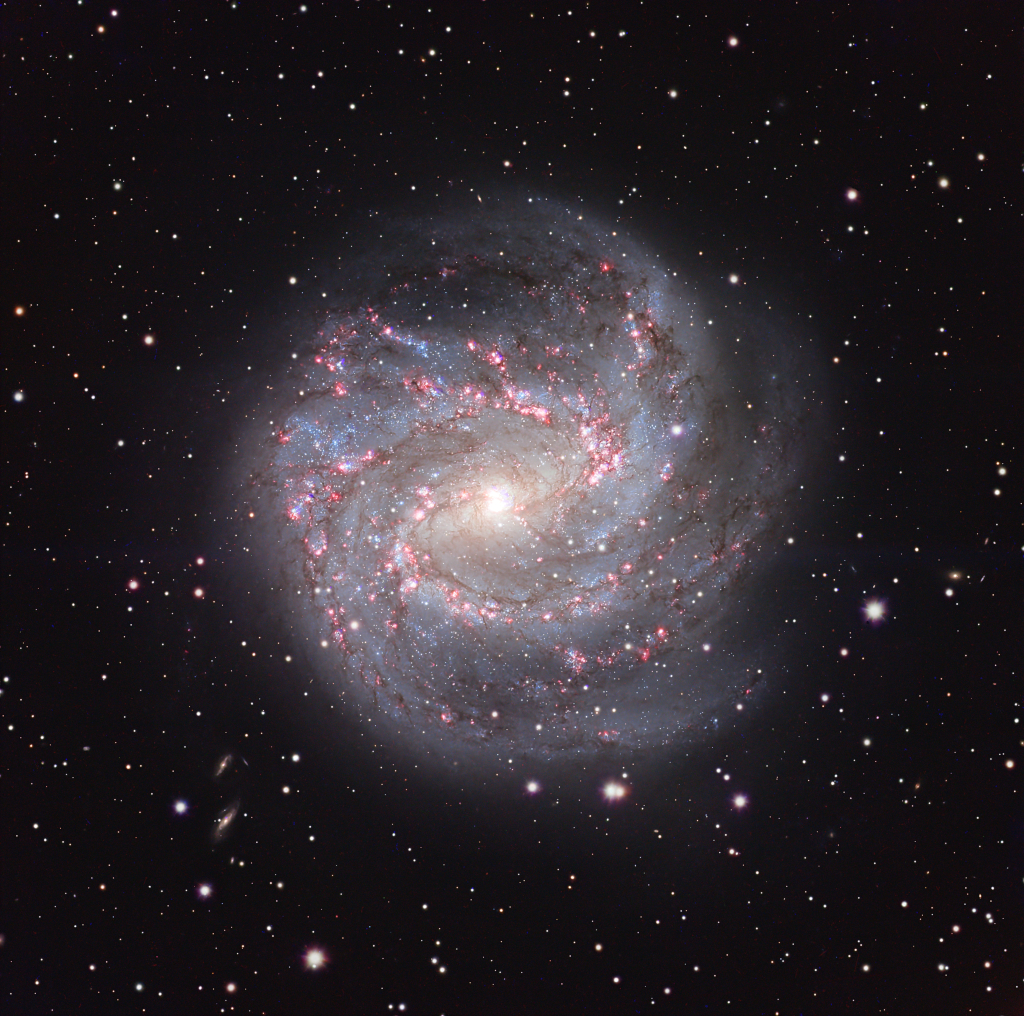
Beautiful and bright, the spiral galaxy M83 twinkles with the swagger of a celestial firework display. Sitting roughly twelve million light-years from Earth, it sits at the southeastern tip of the long, sprawling constellation Hydra—like a gem tucked into a stellar sea-serpent’s grinning mouth. If you’ve ever wondered what a cosmic pinwheel looks like when it’s lit from the inside out, M83 is the answer you didn’t know you were seeking.
Prominent spiral arms trace the galaxy’s delicate ballet of structure, their forms carved by dark dust lanes that wind through blue clusters of newborn stars. It’s as if someone took a spool of ink and let it dance across a page, the result a luminous, pinwheeling marvel we can only glimpse through telescopes and careful calculations. This is why astronomers lovingly call it the Southern Pinwheel: a celestial rotor spinning in the southern sky, a bright, elegant reminder that spiral galaxies can be both precise and exuberant.
The Science Behind the View
But M83 isn’t done with nicknames. The reddish blush of star-forming regions peppering its arms gives rise to another moniker whispered by the stargazing crowd: the Thousand-Ruby Galaxy. Picture a cosmic necklace where each ruby bead represents a stellar nursery cradling the next generation of stars. It’s a poetic way to acknowledge the galaxy’s ongoing star birth—an ongoing fireworks show held in the quiet, cold vastness of space.
Size-wise, M83 wears its modesty with pride. At about 40,000 light-years across, it’s smaller than our Milky Way, yet its personality fills the frame with character. It’s a member of a galaxy group that includes the notoriously active Centaurus A, a neighborhood full of dramatic astrophysical narratives. If galaxies had neighborhoods with coffee shops and loud concerts, M83 would be the friend who shows up with a warm smile and a sparkly tail of stars, brightening the scene without stealing the spotlight from its louder neighbor.
Why the Image Feels Alive
The core of M83 adds another layer of intrigue. It shines brightly in X-ray energies, revealing a bustling crowd of compact remnants—neutron stars and black holes—that linger since a tumultuous era of intense star formation. That bright core is not just a pretty silhouette against the dark backdrop; it’s a signpost of a galaxy that has known both exuberant creation and the denouement that often follows when stars live fast and die young. It’s easy to feel the weight and wonder of that history when you imagine the gravitational pinball game that must have occurred as these compact objects settled into their restless, powerful lives.
From a ground-based telescope’s point of view, the image is a layered story. You can see the foreground stars of our Milky Way, glittering like mislaid breadcrumbs guiding us toward the far-off spiral in Hydra. Beyond M83, distant galaxies drift in the background, quiet spectators to the drama unfolding in this nearby cosmic neighbor. It’s a reminder that our own position in the universe is a vantage point—one that lets us peek, almost playfully, at the grand architecture of galaxies a few tens of millions of light-years away.
What the Sky Keeps Teaching
If you’re sketching a mental map of the cosmos, M83 is a postcard from a bustling neighborhood: bright arms, dust lanes that carve its silhouette, nurseries of stars sparkling in a thousand tones of ruby red, and a core that thrums with the legacy of stellar fireworks. It’s a galaxy that refuses to be merely observed; it invites you to imagine the life cycles of stars, the dances of gravity, and the quiet, persistent glow of a universe that never stops writing its own luminous history.
So here’s to M83—the Thousand-Ruby Pinwheel, the Southern Pinwheel, a galaxy that wears its light with both color and clarity. A reminder that the night sky is not a single moment of awe, but a continuous, sparkling story told in spirals, dust lanes, and the steady heartbeat of star formation. If you ever find yourself under a dark sky and glimpse a faint, spinning beacon in Hydra’s direction, you’ll know you’re looking at a neighbor that has earned every title it carries—with grace, grit, and a little bit of ruby-red magic.
Image via NASAhttps://ift.tt/F92WZOx
Copyright Notice: The image and referenced content remain the property of their respective creators and rights holders. They are used here solely for commentary, discussion, and informational purposes. Please visit the original source links for attribution and additional information.
© 2026 ways4eu.wordpress.com – H.J. Sablotny. All rights reserved. The text content of this article is the intellectual property of H.J. Sablotny and may not be reproduced, distributed, or republished without permission. Images remain the property of their respective copyright holders and are used for illustrative and commentary purposes only.