Ways4eu WordPress.com Blog
SPA View of ways4eu.wordpress.com
A Figure-8 of Time: The Sun’s Daily Dance Across the Sky
By Kinda Cool
on Mon Sep 21 2026
Quick Links
A Figure-8 of Time: The Sun’s Daily Dance
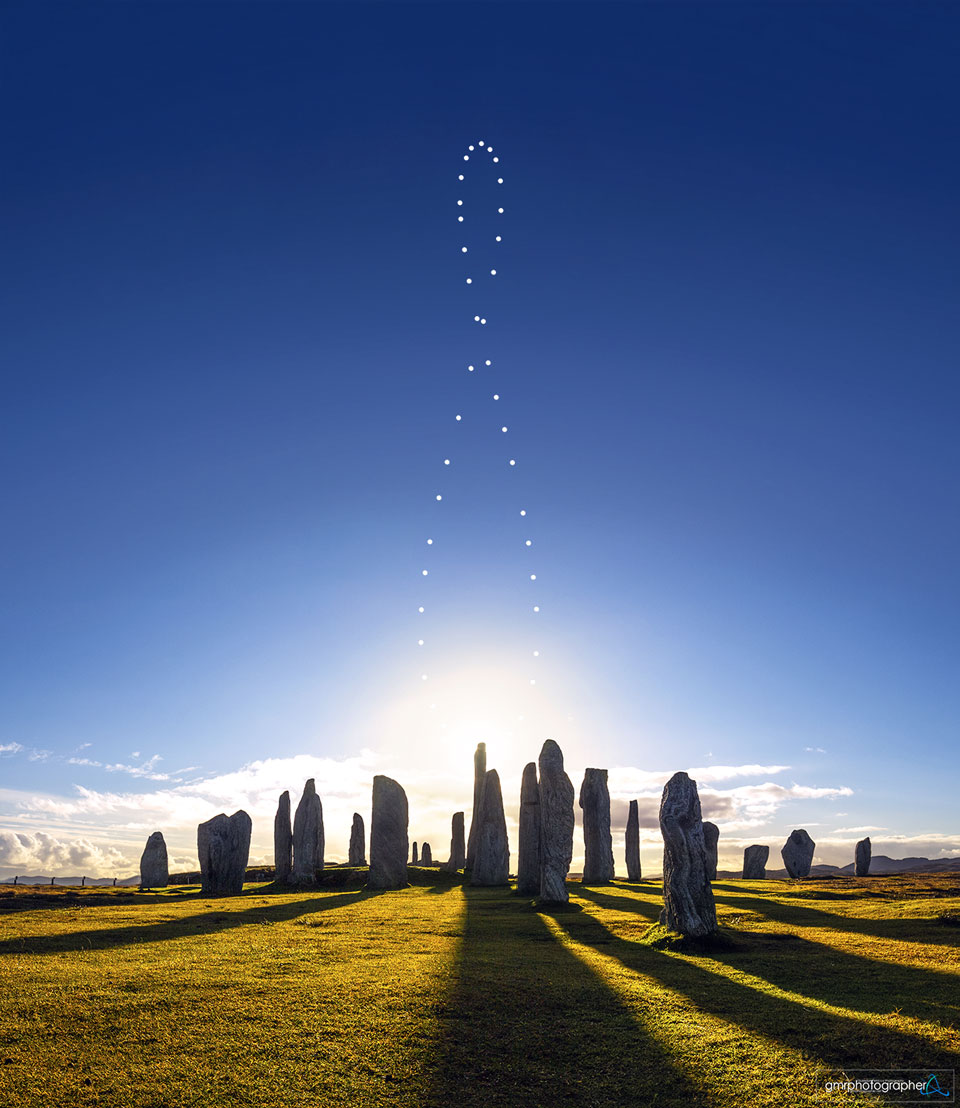
If you went outside at the same time every day and took a picture that included the Sun, how would the Sun’s position change? A visual answer to that question is an analemma, a composite image stitched from the same spot at the same time over the course of a year. The featured analemma was composed from images taken every few days at noon near the village of Callanish in the Outer Hebrides of Scotland, UK. In the foreground are the Callanish Stones, a stone circle built around 2700 BC during humanity’s Bronze Age. It is not known whether the placement of the Callanish Stones has or had astronomical significance, but you can’t deny they give the scene a certain ancient, “okay, nerds, prove it” gravitas.
So, what’s going on here? The figure-8 you see in an analemma isn’t just a quirky celestial doodle. Its ultimate form comes from two stubborn realities of our planet: the tilt of the Earth’s axis and the ellipticity of its orbit around the Sun. If the Earth were perfectly spherical, tilted not at all, and moved at a perfectly constant speed around the Sun, the Sun’s noon position would trace a neat, simple arc—no analemma, no drama, just a bland sun-jogging line across the sky. But nature loves complexity, especially when it comes to time and space.
The tilt of the Earth’s axis (about 23.5 degrees) causes the Sun’s noonday height to wax and wane over the year. In summer, the Sun climbs higher; in winter, it dives lower. All else being equal, you’d expect the Sun’s altitude at noon to follow a smooth seasonal arc. But there’s more: the Earth’s orbit around the Sun is not a perfect circle. It’s an ellipse, so our orbital speed changes: we speed up a bit when we’re closer to the Sun (perihelion) and slow down when we’re farther away (aphelion). Those variations in orbital speed shift the Sun’s apparent position in the sky from day to day.
Outer Hebrides
When you combine axial tilt with orbital eccentricity and plot the Sun’s noon position for each day of the year, the path that emerges looks like a stylized “8”—the analemma. At the solstices, you’ll see the Sun poised at the top or bottom of the figure; at the equinoxes, the Sun sits along the middle portions of the loop, not at the intersection point of the figure.
The note of timing is crucial: the benched noon in Callanish (or any fixed time) translates to a specific track in the sky. If you nudged the clock by a few minutes, the analemma would drift or distort. If you chart noon across a full year from the same place, chasing the Sun with a camera, you’re essentially drawing a solar breadcrumb trail across time.
Callanish Stones
For context, the December solstice moment—the time when days are shortest and the Sun sits low in the southern sky in the Northern Hemisphere—lands the Sun at the bottom of the analemma. Pair that with the equinoxes two days away (the moment of “equal night” when day and night are roughly equal across the globe), and you’ll catch the middle segments of the path, where the Sun’s daily journey is neither at its maximum height nor at its nadir, but somewhere in between.
Culturally, equinoxes have always had a certain gravitas. They mark shifts in seasons, a natural calendar that many civilizations celebrated with festivals, rituals, and astronomical observation. The equinox is a moment of balance—sunlight and shadow sharing the stage—and it’s fitting that so many cultures paused to acknowledge that equilibrium, even as modern life rushes on with its own timekeeping decimals and digital reminders.
In the Callanish photograph, the stones themselves become a quiet frame for a year’s worth of solar history. Whether the stones were aligned for ritual, navigation, or simply to echo the landscape’s rhythm, they now serve as anchors for a universal truth: time leaves a mark on the sky, and the sky, in turn, records our passage through it.
Bronze Age
If you’re feeling playful, you can try your own analemma experiment. Pick a fixed spot with an unobstructed view of the Sun—no trees or rooftops in the way—and photograph the Sun at the same local time every day or every few days for a year. You’ll end up with your own personal figure-8, a tiny but stubborn chronicle of the seasons, etched across the heavens and stitched together in a single, telling image.
As the year cycles toward its next equinox, consider the many ways that light, geometry, and time braid together to tell us where we’ve been and where we’re going. The Sun doesn’t lie, even when it plays hide-and-seek with the horizon. It just smiles, angles its way across the sky, and leaves behind a diagram we can study, year after year, like an ancient map drawn in light.
Image via NASAhttps://ift.tt/EnG0FTo
Sources
Copyright Notice: The image and referenced content remain the property of their respective creators and rights holders. They are used here solely for commentary, discussion, and informational purposes. Please visit the original source links for attribution and additional information.
© 2026 ways4eu.wordpress.com – H.J. Sablotny. All rights reserved. The text content of this article is the intellectual property of H.J. Sablotny and may not be reproduced, distributed, or republished without permission. Images remain the property of their respective copyright holders and are used for illustrative and commentary purposes only.