Ways4eu WordPress.com Blog
SPA View of ways4eu.wordpress.com
A Perseid, a Portal, and a Pixel Parade: Night Skies Over La Palma
By Kinda Cool
on Sun Sep 27 2026
What Happened in Space
Title: A Perseid, a Portal, and a Pixel Parade: Night Skies Over La Palma
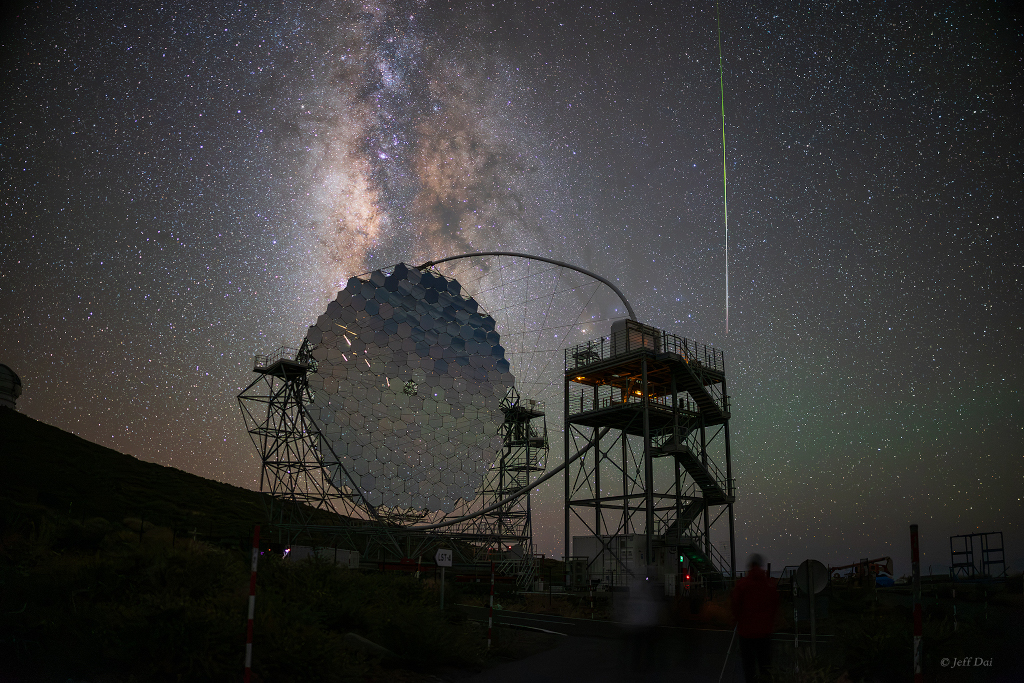
On August 15, the night over La Palma’s Observatorio del Roque de los Muchachos wore its best blue-black velvet, stitched with starlight and sprinkled with a Perseid or two. A bright, colorful meteor stitched a blazing arc through the darkness, a fleeting brushstroke against the canvas of space. Its trail curved past the central Milky Way, where dark interstellar dust clouds reconvened with luminous starlight to form that familiar, awe-inducing band that feels almost like a sidereal heartbeat rising above the horizon. It was one of those nights where the cosmos reminded us that the sky isn’t a ceiling but a stage, and we’re merely audience members with a front-row seat.
In the foreground of this tantalizing celestial tableau stood a gleaming sentinel: the 23-meter diameter mirror of the prototype Large-Sized Telescope 1 (LST-1). This isn’t just any mirror, mind you. It’s the first instrument erected at the northern-hemisphere site of the innovative Cherenkov Telescope Array Observatory, a bold experiment in chasing the faint, fleeting whispers of the universe. LST-1 is a mosaic of 198 hexagonal mirror segments, all aligned like a chorus line designed to catch a photon’s microsecond-long cameo.
The Science Behind the Scene
And what a chorus it is. LST-1 wields a large, high-efficiency, pixelized camera—an eye tuned to detect ultra-brief atmospheric flashes of visible light. These flashes last about a billionth of a second, the blink of an eye in cosmic terms. They’re produced when energetic gamma-rays from distant active galaxies and gamma-ray bursts collide with the Earth’s atmosphere, sparking cascades of secondary particles and, briefly, a flash of light that telescopes like LST-1 can catch. It’s a high-stakes, high-speed game of hide-and-seek with the universe’s most energetic emissaries.
So there we were, peering into the night with the kind of patience that only good astronomy can teach, when the Perseid meteor lit up the sky. And as if scripted by the cosmos itself, some of those meteor shards found their way onto LST-1’s stage as well. Individual mirror segments reflected the atmospheric flash of the bright meteor, a tiny, shimmering cross-pollination of natural spectacle and human curiosity. It was a reminder that even in the midst of a carefully choreographed scientific pursuit, the universe loves to improvise.
What the Images Reveal
This is the kind of scene that makes you rethink the word “instrument.” LST-1 isn’t merely a telescope; it’s a partnership—between human ingenuity and the universe’s own flamboyant performance. Each mirror segment, each pixel in the camera, is a note in a symphony designed to hear the whisper of gamma rays that travel across galaxies,-duration and drama compressed into the shortest of cosmic seconds. And on this particular night, the Milky Way wore its dust lanes and starlight like a backdrop to the most practical of curiosities: how to catch the universe in a heartbeat.
If you’ve ever stood under a clear night sky and felt the quiet hum of possibility, you know the feeling LST-1 embodies. It’s not about capturing a single photon; it’s about building a bridge—between what we can see, what we can measure, and what we still dare to dream. The Perseid’s streak reminded us of the sky’s generosity, gifting a moment of wonder while the telescope did the patient, precise work of science. The faint glimmer of a meteor becomes, in the hands of LST-1, a reminder that even the most ephemeral wonders can illuminate the path to deeper understanding.
Why the Observation Matters
As the night receded, the Scorched lace of the Milky Way remained, a cosmic highway map. And there, beneath it all, LST-1 stood ready—a set of mirror facets and a camera tuned to the extraordinary, prepared to translate the universe’s most energetic sighs into data that can be explored, interpreted, and shared. The Perseid’s meteor may have been brief, but its intersection with this cutting-edge instrument turned a moment of sky-gazing into a moment of scientific possibility.
So raise a glance toward La Palma the next clear night. Expect a meteor to flash, a galaxy to whisper, and a telescope to listen—because in that brief scintillation, we glimpse not only what’s above us, but what we’re capable of uncovering when curiosity and technology meet the heavens halfway.
Image via NASAhttps://ift.tt/SnmvXqs
Sources
Copyright Notice: The image and referenced content remain the property of their respective creators and rights holders. They are used here solely for commentary, discussion, and informational purposes. Please visit the original source links for attribution and additional information.
© 2026 ways4eu.wordpress.com – H.J. Sablotny. All rights reserved. The text content of this article is the intellectual property of H.J. Sablotny and may not be reproduced, distributed, or republished without permission. Images remain the property of their respective copyright holders and are used for illustrative and commentary purposes only.