Ways4eu WordPress.com Blog
SPA View of ways4eu.wordpress.com
Jessica Watkins Tests Bioink on the ISS
By Kinda Cool
on Thu Oct 22 2026
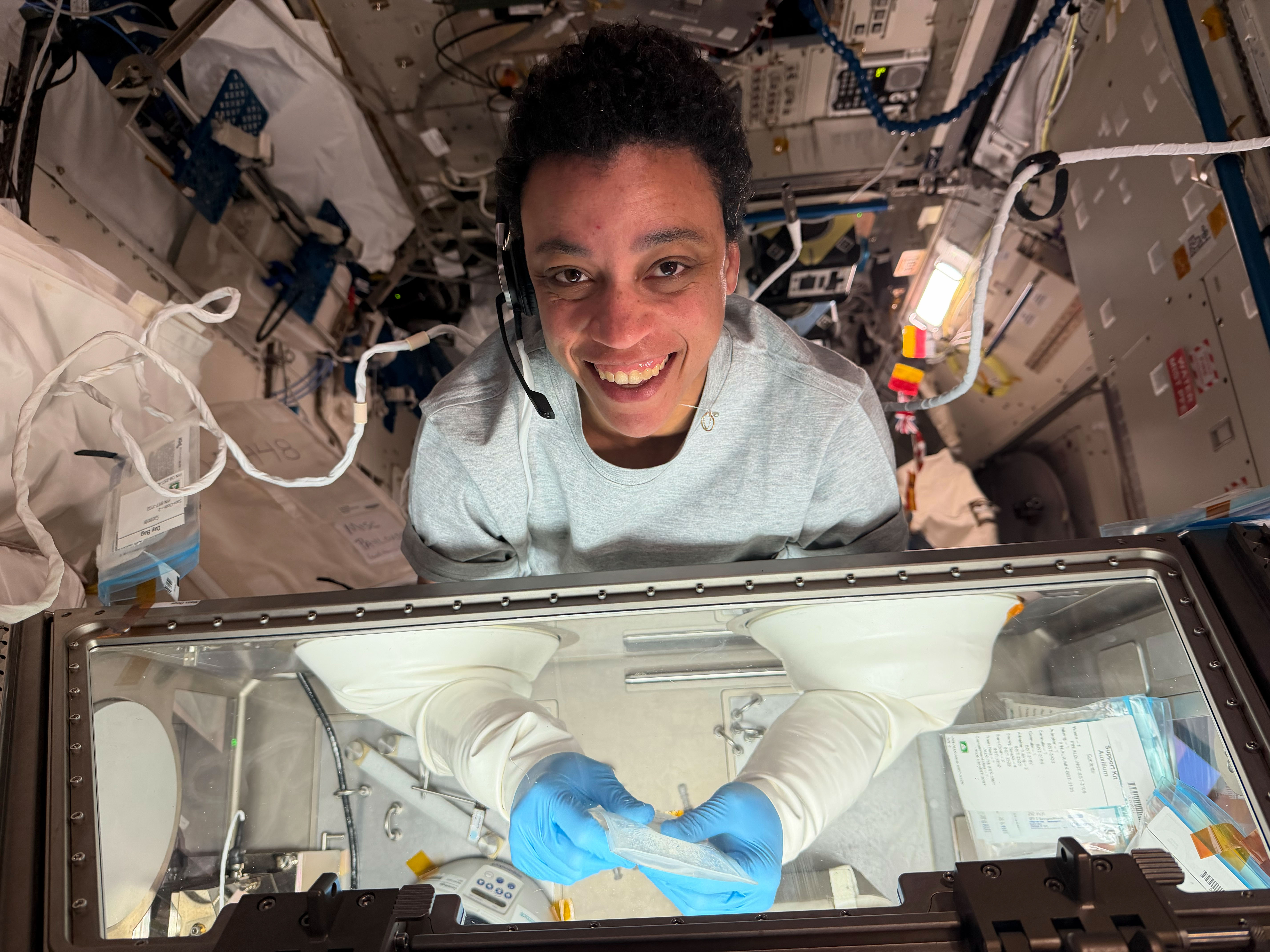
🧪 Jessica Watkins Mixes Living Cells With Bioink
If you’ve ever wondered how space-age science actually happens, you’re in for a treat. Today we’re orbiting not just around the Earth, but around the curious, caffeinated quirks of human ingenuity aboard the International Space Station, where NASA astronaut and Expedition 75 flight engineer Jessica Watkins is mixing living cell samples with a bioink inside the Kibo laboratory module’s Life Science Glovebox. It’s science, but with a glove-tock of humor you can only appreciate when gravity takes a rain check.
Let’s set the scene. The Kibo lab is a gleaming, high-tech box of possibilities, and inside it, a glovebox—yes, a literal box with flexible gloves attached to the walls—serves as the space station’s sterile stage. Inside this glovebox, Jessica works with the meticulous care of a chef preparing a finicky soufflé, except the soufflé is made of living cells and the oven is 250 miles up and spinning at 1 g of microgravity. The aim? To safely mix living cell samples with a bioink. And then, because science loves a good twist, she fills a special cartridge with the cell-ink mixture. Think of it as a space-age high-tech stamp, ready to imprint cells into a three-dimensional canvas or a precisely shaped scaffold for tissue engineering. Pretty cool, right?
If you’ve seen the NASA press photos, you’ve probably noticed two things: the glovebox looks like something out of a sci-fi kitchen and Jessica looks calm, focused, and entirely unfazed by the absence of gravity. In space, even simple tasks get a splash of drama. When you’re handling living cells in a microgravity environment, your tools become more than instruments—they’re partners in a delicate waltz with the unknown. Jessica’s not just carrying out routine experiments; she’s choreographing interactions at the cellular level with the patience of a Zen gardener and the precision of a master barista who can pull a perfect latte in zero-G.
🛰️ Microgravity Changes How Tissue Experiments Work
Bioink, for the uninitiated, isn’t just fancy ink. It’s a gel-like substance that can carry living cells and resemble the viscosity of a smoothie you’d want to sip, except you don’t sip it here—at least not with a straw. In space, liquids act differently, which means material scientists and life scientists have to adapt. Jessica’s work inside the glovebox blends science and art: selecting the right living cell samples, ensuring sterility so they don’t audition for a space horror movie, and then combining them with bioink in exacting proportions. It’s meticulous, methodical, and occasionally requires a pause to adjust a gloved hand because, let’s be honest, even perfected space tech doesn’t always anticipate the glory of a slippery moment in microgravity.
Now, why all this fuss about mixed cell samples and bioink? Researchers on the ISS are exploring how tissues could be grown or maintained in space to support long-duration missions, future spacecraft life support offerings, or even medical research that could translate back to Earth. In microgravity, cells don’t behave the same way they do on Earth. They can form unique three-dimensional structures, interact differently, and reveal insights that are harder to observe in a gravity-filled lab. Jessica’s work is part of a broader effort to understand how to cultivate living tissue in space—think of it as astronaut-grade tissue engineering with a dash of interstellar curiosity.
The Life Science Glovebox itself is a character in this story. It’s a compact, protective habitat that allows researchers to manipulate delicate samples with more control than a bare hand in the vacuum of space would permit. Inside, tools, tubes, and cartridges float in a choreographed ballet until the operator—Jessica, in this case—gives each piece its cue. The glovebox makes up for the absence of a traditional bench top by providing a contained, clean environment where samples stay safe, sterile, and, crucially, in one place for the next step of the experiment.
🧬 Glovebox Routines Turn Precision Into Progress
Humor comes naturally up here. You’d be surprised how quickly a small, silent moment can become a space punchline. Picture this: you’re in zero gravity, your gloves are on, your workstation hums with life (and maybe a faint whir from a cooling system), and a tiny cartridge with cell-ink is ready to be filled. A minute later, you realize you’ve spent more time giving your tools a careful orbit than actually performing the transfer. The crew’s laughter is the lightest kind of gravity up there—an orbiting reminder that even in the rigorous world of science, a little levity helps keep the mission on track.
Jessica Watkins isn’t just performing a routine procedure; she’s contributing to a growing body of knowledge about how living cells can be handled, preserved, and studied in space. The cartridge she fills with the cell-ink mixture is more than a container—it’s a gateway to future experiments that may push the boundaries of tissue engineering, regenerative medicine, and our understanding of biology beyond Earth. Each step, from selecting the cell samples to loading the cartridge, is a measured progression toward insights that could one day inform medical science back on the ground and support long-duration human spaceflight.
For readers who love the behind-the-scenes glimpse, there’s a satisfying rhythm to these space station routines. There’s the careful setup: securing samples, double-checking sterile conditions, verifying that the bioink formulation meets the stringent requirements of the experiment. Then the moment of action: the precise mixing, the controlled transfer of the cell-ink blend, and the cartridge filling that marks a tangible milestone in the experiment’s lifecycle. The final act? Documentation and data logging, where every microstep is recorded so that scientists on Earth can replicate, verify, and build upon the work. It’s science with a video game-friendly sense of progression—save points, checkpoints, and clear objectives all while orbiting the planet.
If you’re wondering about the human side of this high-tech endeavor, Jessica’s role embodies the spirit of exploration: curiosity coupled with discipline, and a knack for turning meticulous, sometimes fiddly tasks into meaningful science. In the quiet of the glovebox, you hear the rhythm of careful hands, the soft click of cartridge ports engaging, and the whisper of a mission that blends the practical with the theoretical. It’s a reminder that space biology isn’t a lone hero narrative; it’s teamwork across modules, crews, and continents, all connected by the shared goal of expanding humanity’s reach while deepening our understanding of life itself.
🚀 Space Biology Connects Orbit With Earthbound Medicine
As the day-to-day operations aboard the ISS continue, moments like Jessica’s glovebox work capture the essence of space science: rigorous, collaborative, and wonderfully strange in the best possible way. The glovebox may be a box, the inks and cells may be small, but the implications of this work are big, bold, and full of potential. It’s science in its most hands-on, eye-to-eye, glove-wearing form—a reminder that curiosity doesn’t take a vacation just because you’ve traded gravity for orbit.
So here’s to Jessica Watkins, Expedition 75 flight engineer, and to the quiet drama of making living cells dance in a bioink chorus inside a space station glovebox. May your cartridges be filled with precise mixtures, your data be clean, and your lab be stocked with the kind of wonder that only space—where everything is a little different and a lot exciting—can inspire. Science on the space station isn’t flashy in the way Hollywood might flash it, but it’s real, it’s rigorous, and it’s a reminder that humanity’s reach into the cosmos is fueled by careful hands, brave minds, and a sense of humor that travels with us to every new frontier.
Image via NASA https://ift.tt/blm4yF7
Copyright Notice: The image and referenced content remain the property of their respective creators and rights holders. They are used here solely for commentary, discussion, and informational purposes. Please visit the original source links for attribution and additional information.
© 2026 ways4eu.wordpress.com – H.J. Sablotny. All rights reserved. The text content of this article is the intellectual property of H.J. Sablotny and may not be reproduced, distributed, or republished without permission. Images remain the property of their respective copyright holders and are used for illustrative and commentary purposes only.