Ways4eu WordPress.com Blog
SPA View of ways4eu.wordpress.com
Andromeda Over Australia in Spring
By Kinda Cool
on Sat Oct 24 2026
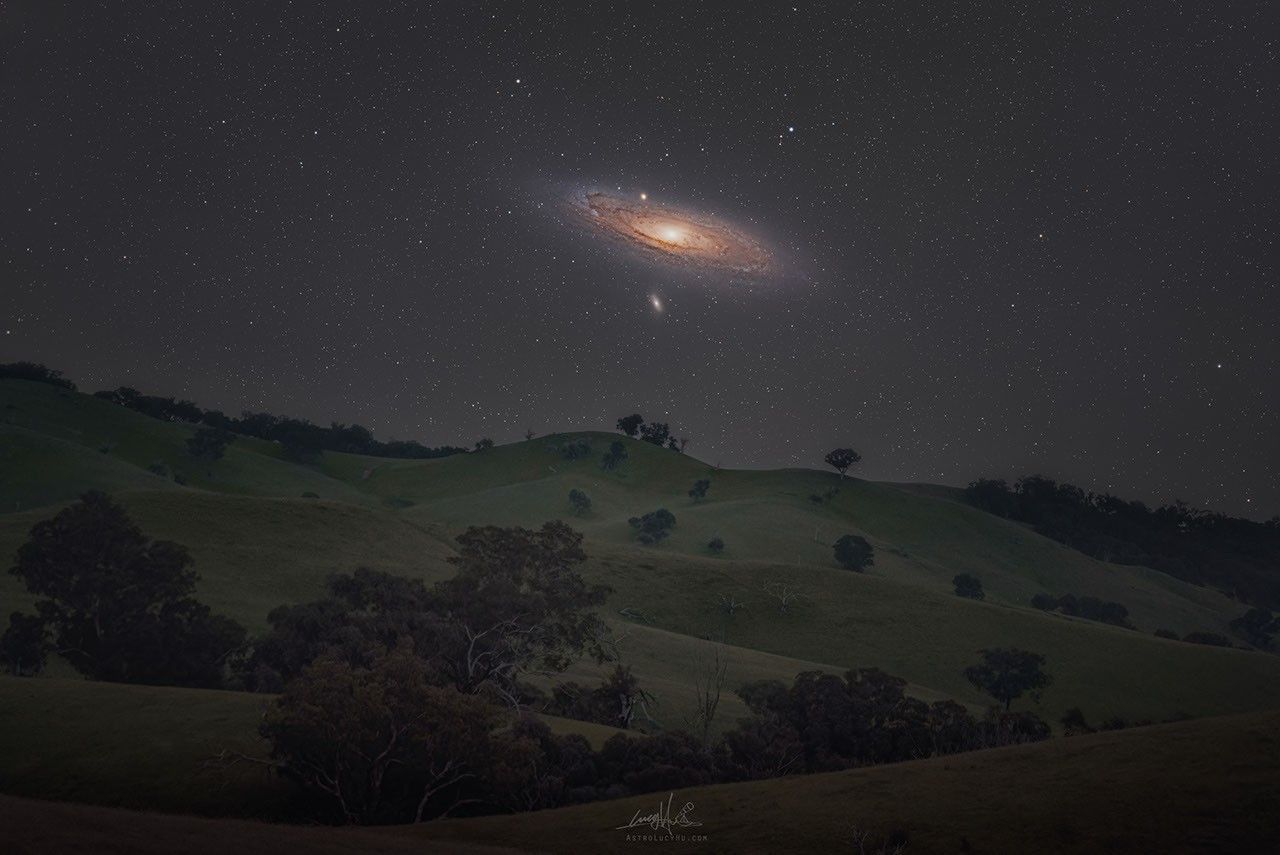
🌌 Andromeda Skims Australia’s Spring Horizon
That geometry is easy to underestimate. Northern constellations scrape the Australian horizon, so observers must find an open view with very little haze and almost no stray light. A distant ridge that looks charming by day can become a galactic bouncer after dark, politely refusing M31 admission. The reward for careful timing is a wonderfully local version of a famous object: Andromeda does not float in an abstract star chart but peeks over real hills, in real spring air, from a perspective many familiar photographs never show. Astronomy is universal, yet the practical experience is stubbornly regional. The same galaxy can be an overhead showpiece in one country and a shy horizon guest in another.
From Mullion, New South Wales, the Andromeda Galaxy makes a modest appearance in the northern sky. It never rises more than a few degrees above the horizon, but during the Southern Hemisphere’s spring, it reaches its highest point around midnight. That low angle makes every hill, haze layer, and badly timed cloud part of the observing committee. Andromeda still turns up, fashionably late and roughly 2.5 million light-years away, which is a fairly convincing excuse. At this latitude, galaxy hunting feels less like stargazing and more like negotiating with the horizon.
📷 Stacked Exposures Reveal Andromeda’s Spiral
Stacking deserves more credit than the phrase “digital processing” sometimes receives. Each exposure gathers a modest number of photons that began their journey long before humans invented cameras, tripods, or arguments about image noise. Software aligns the stars while the photographer rejects frames spoiled by wind, tracking errors, passing clouds, or an aircraft making an unscheduled cameo. The separate landscape frame solves another problem: a mount following the stars would otherwise smear the stationary hills. Combining the two creates a scene that matches how the photographer wants to communicate the night, not a single instantaneous view. It is meticulous craft disguised as celestial serenity, rather like ironing a shirt while riding a carousel.
This telephoto view was captured across the night of October 10–11 as Andromeda climbed above rolling Australian hills. Multiple exposures, digitally tracked and stacked, bring out the galaxy’s sweeping spiral structure. A separate foreground image completes the composite, keeping the landscape sharp while the camera follows the stars. It is less a single click than a small committee of photographs agreeing to cooperate—rare behavior for committees, but excellent behavior for photons. The sky supplies ancient light, the photographer supplies patience, and the software keeps the photons in formation.
🔭 M31 Spans Six Full Moon Widths
The full-Moon comparison also explains why “bright” and “easy to see” are not the same thing. Andromeda’s light is spread across an enormous apparent area, so its outer regions have low surface brightness. City glow washes them away first, leaving only the compact core. Under a genuinely dark sky, patient eyes may notice a longer oval, but photography can accumulate the faint signal far beyond what a brief glance captures. This is why a huge galaxy can hide inside what resembles a thumbprint on the sky. Size is not the problem; contrast is. Andromeda is not small or absent. It is simply performing with the house lights still on.
Also known as M31, Andromeda is one of the brightest objects in the Messier catalog. To the unaided eye, though, it appears as little more than a faint, fuzzy patch. Long exposures reveal a galaxy extending nearly six full-Moon widths across the sky. The bright core is merely the part most willing to introduce itself; the dim outer arms require patience, dark skies, and a camera that does not become bored after thirty seconds. Cosmic modesty is doing heavy lifting here: the fuzzy speck is considerably larger than its first impression.
🌠 Southern Skies Make Andromeda Play Hard to Get
That perspective also makes the photograph useful beyond its beauty. It teaches viewers to separate an object’s true scale from its apparent brightness and to think of the sky as a sphere seen from a moving planet. The hills provide orientation, the season supplies timing, and Andromeda contributes light that has crossed intergalactic space only to finish its journey just above a rural horizon. Few travel arrangements end with such an undignified scramble for a clear gap between trees. The image succeeds because it keeps both scales visible: an Australian landscape measured in kilometres and a galaxy measured in light-years, sharing one frame without either pretending the comparison is normal.
There is a pleasant lesson in that difficulty. Familiar astronomical objects are not fixed postcards but experiences shaped by season, latitude, weather, terrain, and equipment. Australian observers trade Andromeda’s height for southern treasures that northern viewers barely glimpse, while northern observers receive the opposite arrangement. Nobody gets the entire sky from one backyard; the planet insists on rotating the exhibition. That makes travel, shared images, and international observing communities more valuable. A low northern galaxy over New South Wales is therefore more than a technical achievement. It is proof that changing your place on Earth changes the story told by the same ancient light—and occasionally makes the photographer lie in colder grass.
For northern observers, Andromeda can climb high and behave like a respectable celestial landmark. From southeastern Australia, it hugs the horizon and turns observation into a careful appointment with geography. That is precisely what makes the image memorable: a familiar Local Group galaxy appears in an unfamiliar posture above an Australian landscape. The view reminds us that the night sky changes with latitude. The universe may be universal, but it still enjoys rearranging the furniture depending on where you stand. Latitude, apparently, is the universe’s seating plan—and Australia has the wonderfully awkward side view.
Copyright Notice: The image and referenced content remain the property of their respective creators and rights holders. They are used here solely for commentary, discussion, and informational purposes. Please visit the original source links for attribution and additional information.
© 2026 ways4eu.wordpress.com – H.J. Sablotny. All rights reserved. The text content of this article is the intellectual property of H.J. Sablotny and may not be reproduced, distributed, or republished without permission. Images remain the property of their respective copyright holders and are used for illustrative and commentary purposes only.