Ways4eu WordPress.com Blog
SPA View of ways4eu.wordpress.com
Dark Matter Weaves the Cosmic Web
By Kinda Cool
on Mon Oct 26 2026
🔎 Dark Matter Reveals the Universe’s Hidden Framework
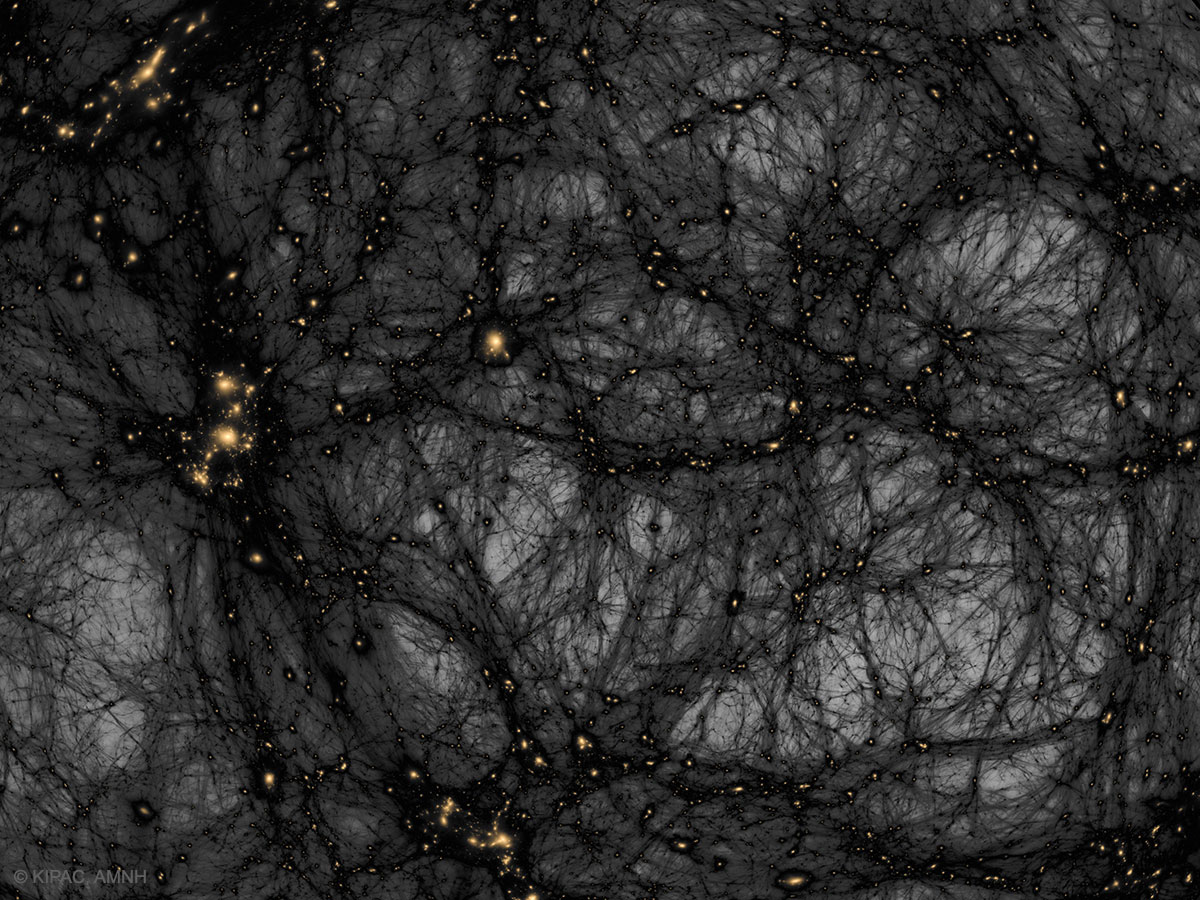
Is our universe haunted? This map certainly looks like something spooky is going on.
The haunting impression is useful because dark matter is known through effects rather than direct illumination. It does not glow, reflect or absorb light in the ordinary way, so astronomers cannot point a familiar camera at a patch of sky and ask it to smile. Instead, they infer its presence from gravity. Stars orbit within galaxies faster than the visible material alone can comfortably explain. Galaxies inside clusters move as though surrounded by far more mass than telescopes can see. Light from distant objects bends around massive foreground structures, allowing researchers to map invisible concentrations through gravitational lensing. Dark matter is therefore the quiet colleague whose name appears on none of the presentation slides yet whose work is holding the entire project together. The term can sound like a label from fantasy, but it is really an admission of observational honesty: there is matter, it affects the universe, and its nature remains unknown. Proposed particles have been hunted in underground detectors, particle accelerators and astronomical observations, so far without the grand entrance physicists would dearly appreciate. Science is comfortable with that discomfort. A mystery does not become less real because it refuses to provide a convenient headshot. It becomes a programme of measurements, competing models and very patient people explaining once again that dark matter is not simply ordinary dust hiding behind a cosmic sofa.
🕸️ Simulations Map the Cosmic Spiderweb in Detail
The dark filaments crisscrossing the image aren’t ghostly trails—they represent dark matter, an invisible substance whose gravity is thought to shape the cosmos. Dark matter helps explain why galaxies spin so quickly, why galaxies race around inside clusters, and why gravity bends light so strongly around massive objects. It also helps account for the way ordinary matter is distributed across the universe.
This image, featured in the American Museum of Natural History’s Hayden Planetarium show Dark Universe, comes from a detailed computer simulation. The dark matter appears in black, weaving through space like a cosmic spiderweb. Familiar matter—the ordinary, baryonic stuff that makes up stars, planets, and us—is shown in orange, gathered into comparatively rare clumps along the web.
Computer simulations help researchers turn those measurements into a history of structure. A model begins with ingredients based on cosmological observations and follows how gravity amplifies tiny differences in density over billions of years. Regions containing slightly more matter attract still more; emptier regions lose the contest and become great voids. The result is not a random scattering but a network of filaments, knots and sheets. Galaxies gather where the gravitational real estate is favorable, while clusters grow at especially busy intersections. Calling it a web is irresistible because the resemblance is immediate, although no cosmic spider is required and the universe has not filed a planning application. Ordinary matter follows the underlying dark-matter framework, cools into gas clouds and eventually contributes to stars, galaxies and planets. In the image, contrasting colors make this relationship legible to human eyes. The colors are explanatory choices, not a tourist’s view from a spacecraft. That distinction matters: scientific visualization translates quantities that may be invisible, enormous or mathematically abstract into a form our pattern-loving brains can examine. It is less a photograph than a carefully designed map. Like a subway diagram, it sacrifices literal appearance to reveal relationships. Nobody complains that an underground railway line is not actually bright orange; one simply appreciates knowing where it goes.
🌌 Observations Support the Simulated Large-Scale Structure
The simulation’s large-scale patterns are a good statistical match for what astronomers observe. So while the image is simulated, the cosmic architecture it depicts is grounded in evidence. The universe, it seems, has been decorating with dark threads all along.
And dark matter may not even be the universe’s strangest gravitational resident. That distinction increasingly belongs to dark energy: a still-mysterious, more uniform influence associated with the accelerating expansion of the universe. If dark matter is the web, dark energy is the reason the whole cosmic room keeps getting bigger.
The comparison with observations is where the artwork earns its scientific credentials. Astronomers survey huge numbers of galaxies, estimate their positions and study how matter clusters across different scales. They also examine the faint distortion of background galaxies caused by intervening mass, a technique called weak gravitational lensing. If simulations repeatedly produce distributions unlike the measured universe, the underlying assumptions need attention. When their statistical patterns agree, researchers gain confidence that the model captures important parts of cosmic evolution. Agreement is not a victory parade for every detail, and it does not identify the dark-matter particle. It is more like finding that a recipe produces the correct loaf while the identity of one crucial flour remains written in invisible ink. The model can still tell us how structures grow. It can test what happens when the amount of matter changes, when expansion behaves differently or when candidate dark matter has different properties. This is why simulated images are neither decorative guesses nor literal snapshots. They are visual outputs from quantitative experiments conducted on computers because the actual universe is inconveniently large, old and unwilling to restart on request. Researchers cannot rerun cosmic history with one setting adjusted. They can, however, build numerical universes, compare their outcomes and learn which versions most closely resemble the one outside the window.
🚀 Orion Preview Continues Tomorrow’s Cosmic Journey
Tomorrow’s picture: Orion the Great
Image via NASAhttps://ift.tt/6gG3TFJ
Dark energy adds another layer of cosmic audacity. While dark matter helps structures gather through gravity, dark energy is the name given to whatever drives the observed acceleration of cosmic expansion. The two are not interchangeable merely because both arrive wearing the fashionable adjective ‘dark.’ One behaves like additional gravitating matter; the other appears associated with space expanding ever faster on the largest scales. Together they dominate standard cosmological accounting, leaving familiar atoms as a surprisingly small fraction of the total. Humanity has therefore inspected the universe and discovered that most of the inventory is written in categories marked ‘nature still under investigation.’ This could feel humbling, but it is also productive. Unknowns give telescopes, detectors and theorists something meaningful to do besides admire the scenery. The Orion preview at the end of the original picture sequence offers a pleasing return to recognizable stars, yet even a familiar constellation sits inside this much larger story. Its stars formed in gas shaped by gravity, within a galaxy embedded in a dark-matter halo, in a universe whose expansion is accelerating. The night sky may look calm, but the backstage machinery is extravagantly complicated. We stand on one small planet, looking through a luminous minority of matter, trying to understand the invisible framework. For a supposedly haunted map, it is remarkably good at inviting rational questions.
Copyright Notice: The image and referenced content remain the property of their respective creators and rights holders. They are used here solely for commentary, discussion, and informational purposes. Please visit the original source links for attribution and additional information.
© 2026 ways4eu.wordpress.com – H.J. Sablotny. All rights reserved. The text content of this article is the intellectual property of H.J. Sablotny and may not be reproduced, distributed, or republished without permission. Images remain the property of their respective copyright holders and are used for illustrative and commentary purposes only.