Ways4eu WordPress.com Blog
SPA View of ways4eu.wordpress.com
NASA’s X-59 Pilot Prepares for Quiet Flight
By Kinda Cool
on Tue Oct 27 2026
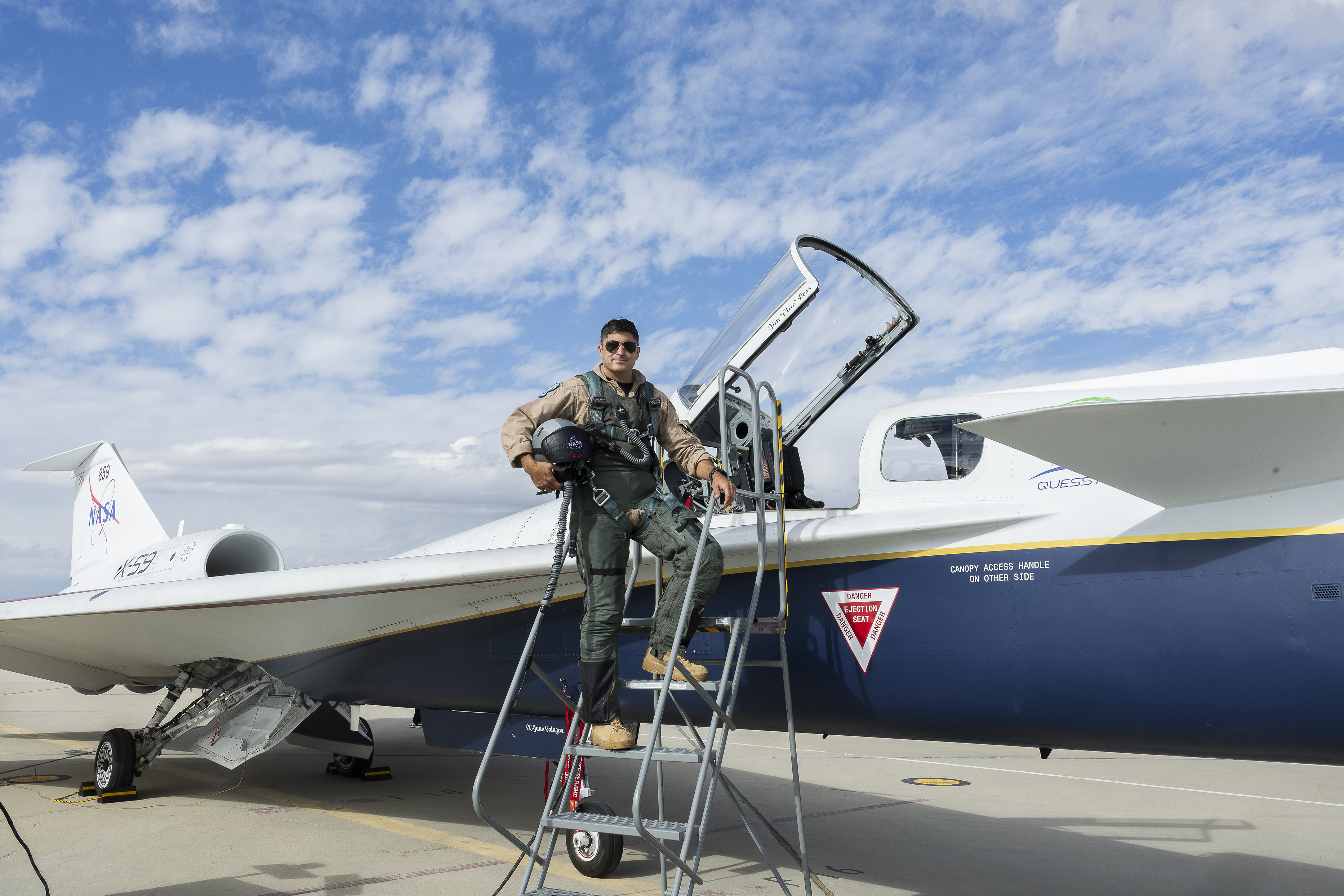
✈️ Mike Lippert Prepares to Fly the X-59
On Oct. 21, 2026, NASA test pilot Mike Lippert posed for a photo on the day of his first flight in the agency’s X-59quiet supersonic research aircraft. It’s the sort of preflight picture that says, “Ready for takeoff,” while the airplane behind you says, “I was designed by someone who really likes long noses.”
Lippert’s October 21 flight was the payoff for months of simulator sessions, cockpit familiarization, engine runs and work with the mission-control team. He flew for about an hour, reached Mach 1.4 and climbed to 55,000 feet while evaluating handling and aircraft systems. That makes the photograph more than a generic “someday soon” pose: it records the day preparation became first-hand experience in a unique X-plane. Test pilots do not merely demonstrate bravery by sitting nearest the pointy end. They execute precise cards, notice subtle behavior and describe it in language engineers can use. “It felt weird” may be emotionally honest, but the debriefing usually demands considerably more nouns.
🔇 NASA Targets a Quieter Sonic Boom
The X-59 has an unusual job: fly faster than sound while making the sonic boom much quieter. NASA hopes the aircraft’s flights will help researchers learn whether a gentler sonic “thump” could make supersonic travel over land more acceptable. In other words, the X-59 is trying to go very fast without making everyone below it look up from their lunch.
The X-59’s long nose is central to shaping shock waves so they do not merge into the abrupt pressure change heard as a conventional sonic boom. Other features along the aircraft control how those waves form and travel toward the ground. The geometry creates an unusual cockpit problem: the pilot cannot look straight ahead through a normal windscreen because the nose blocks the view. NASA therefore uses an external-vision system combining cameras and displays. It is not a decorative dashboard upgrade; it supports forward awareness during operations. The aircraft looks futuristic because several difficult aerodynamic compromises have been made visible rather than politely hidden under a conventional fuselage.
🧪 Test Pilots Connect Aircraft and Engineers
For Lippert, climbing into the experimental aircraft is more than a photo opportunity. Test pilots help evaluate how new aircraft perform, sharing what they learn with engineers and researchers. The X-59’s sleek shape and specialized design make it a particularly distinctive ride—less “ordinary airplane” and more “arrow that discovered aviation.”
As Lippert completed his first flight in the X-59, the aircraft stood ready to put its quiet-flight idea to the test. The goal isn’t to eliminate the thrill of breaking the sound barrier; it’s to make the soundtrack a little less dramatic. Somewhere, a windowpane is cautiously optimistic.
Quesst is ultimately a research program about people on the ground as well as aerodynamics in the air. After the aircraft and its acoustic signature are sufficiently validated, NASA plans community overflights and surveys to learn how residents respond to the quieter thumps. Those data can be shared with regulators considering standards for civil supersonic flight over land. The X-59 is not a prototype airliner and will not carry passengers from Los Angeles to lunch in New York. It is a measurement tool built to answer whether noise can be reduced to a level communities and regulators might accept. Commercial designers would still face fuel use, cost, emissions, airport operations and the minor matter of finding customers who enjoy paying for speed.
🚀 Quiet Supersonic Research Could Reshape Travel
Experimental flying advances in carefully reviewed steps. Maintenance, weather, chase aircraft, instrumentation and test points must align before a sortie. A successful flight may look uneventful because the exciting work is hidden in stable temperatures, expected control response and data arriving exactly where it should. Lippert’s milestone expanded the pool of pilots with direct X-59 experience and gave the team another perspective on the aircraft. That redundancy matters in a long research campaign. The dream is quieter supersonic travel, but the route is built from simulator hours, checklists and flights whose greatest achievement may be behaving precisely as predicted. Aviation history celebrates the dramatic sound barrier; Quesst is trying to make progress by lowering the volume.
The regulatory ambition explains why community response matters so much. Long-standing restrictions on routine civil supersonic flight over land were written around disturbance from conventional booms. If shaped shock waves produce a much quieter signature, regulators could eventually consider noise-based standards rather than a simple speed threshold. That would not automatically authorize routes or guarantee an airline market; it would provide evidence for a policy conversation. Surveys must therefore be designed carefully, with known flight conditions, acoustic measurements and questions that distinguish surprise from sustained annoyance. One person’s gentle thump may be another person’s dog-related emergency meeting. Data from many communities can reveal how loudness, frequency, time of day and expectation influence acceptance. The X-59 exists to connect aerodynamic theory with those human reactions. Its success will not be measured only by Mach number, but by whether engineers can predict the sound on the ground and whether people describe that sound as tolerable. Lippert’s flight is one step in that chain: pilot observations validate the machine, instruments validate the shock pattern and communities eventually validate—or reject—the experience. Quiet supersonic travel is therefore not a solo sprint by a sleek aircraft. It is a relay involving pilots, engineers, acousticians, regulators and residents who did not volunteer to become supporting characters in an aviation experiment. NASA’s job is to make every handoff measurable. The X-59 may look like an arrow, but its real destination is a rulebook. Even favorable noise results would leave airlines to solve economics, emissions, range and airport integration. Quesst is opening one locked door, not claiming the entire building. That narrower mission is scientifically stronger: measure the sound, measure the response and let later designers argue about ticket prices. Until then, every X-59 sortie is a research flight rather than a preview service. Nobody is serving drinks at Mach 1.4, and the baggage allowance remains an impressively compact collection of sensors. The glamour is real; so is the telemetry review waiting afterward. Experimental aviation advances one verified test point at a time.
Copyright Notice: The image and referenced content remain the property of their respective creators and rights holders. They are used here solely for commentary, discussion, and informational purposes. Please visit the original source links for attribution and additional information.
© 2026 ways4eu.wordpress.com – H.J. Sablotny. All rights reserved. The text content of this article is the intellectual property of H.J. Sablotny and may not be reproduced, distributed, or republished without permission. Images remain the property of their respective copyright holders and are used for illustrative and commentary purposes only.