Ways4eu WordPress.com Blog
SPA View of ways4eu.wordpress.com
NASA’s NEO Surveyor Sunshade
By Kinda Cool
on Wed Oct 28 2026
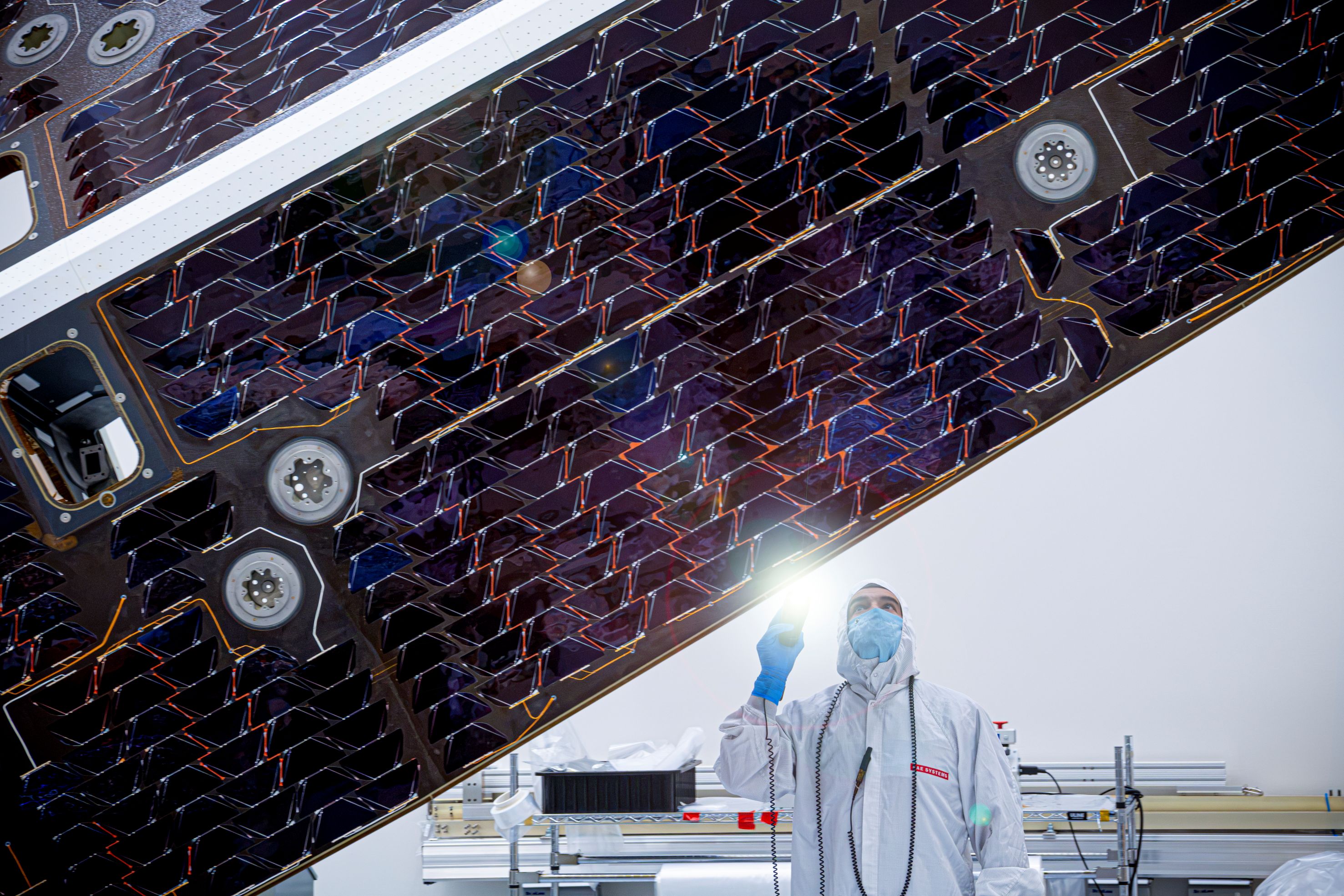
🛰️ NEO Surveyor’s Sunshade Protects Infrared Vision
A technician inspects the large sunshade for NASA’s Near-Earth Object Surveyor mission at BAE Systems Space & Mission Systems in Boulder, Colorado, in late July. It’s an important piece of equipment—and, frankly, the kind of shade we’d all appreciate on a hot summer day.
Infrared astronomy depends on controlling heat because the telescope is trying to measure exactly that kind of radiation. A warm spacecraft can glow in the same wavelengths as the objects it is searching for, creating background noise that hides faint targets. The Sun is therefore both the power source and the neighbour who refuses to lower the volume. NEO Surveyor’s large shade blocks direct sunlight and helps the instrument maintain a stable, cold environment without relying on an unlimited supply of active refrigeration. Stability matters as much as a low temperature: changing thermal conditions can alter focus, alignment and detector response. Engineers must treat the shade as part of the optical system even though it never forms an image. Its job is to create darkness, reject heat and keep the telescope’s own signature from impersonating an asteroid. That may be the least glamorous role in planetary defence, but glamorous hardware is notoriously poor at discovering objects when it has accidentally become the brightest infrared source in its own field of view.
☀️ Cooler Instruments Reveal Faint Near-Earth Objects
NEO Surveyor is designed to search for asteroids and comets that come close to Earth. Its sunshade will help protect the spacecraft’s sensitive infrared instruments from the Sun’s heat, allowing them to spot the faint warmth of nearby objects in space. Think of it as a giant cosmic umbrella, except it’s less about staying dry and more about keeping the telescope cool enough to do its job.
That job is a bit like finding a dim object in a dark room—while the room is the solar system and the object may be moving very fast. With the Sun’s glare and heat kept at bay, NEO Surveyor can focus on the search instead of squinting into the cosmic equivalent of a bright flashlight.
Heat-sensing observations provide information that visible-light surveys cannot always deliver on their own. A dark asteroid may reflect little sunlight and appear faint even when it is physically large, while a smaller bright object can look deceptively prominent. Infrared measurements respond more directly to temperature and help scientists estimate size when combined with an orbit and assumptions about thermal behaviour. NEO Surveyor uses two infrared bands so that repeated observations can distinguish moving objects from the fixed stellar background and improve characterization. Discovery is not a single snapshot. The spacecraft must revisit regions of sky, link detections into tracks and provide positions that other observatories can follow. Computers perform much of that pattern recognition, but survey design determines whether the right evidence exists. The shade makes the measurements possible; cadence turns them into motion; follow-up turns motion into an orbit. Planetary defence begins with a surprisingly bureaucratic sequence for something often advertised with a dramatic picture of a rock.
🔧 Boulder Inspection Advances NASA’s Planetary Mission
The Boulder inspection is one step in getting the spacecraft ready for its mission. And while the sunshade may not look like a traditional superhero gadget, it has an important role: helping NASA keep an eye on objects that pass near our planetary neighborhood.
Space may be famously cold, but for an infrared telescope, staying cool is serious business. Somewhere, a beach umbrella is feeling remarkably underqualified.
Ground inspection in Boulder is valuable because a deployable or structurally large component must survive several incompatible demands. It has to fit the launch configuration, tolerate vibration and acceleration, deploy as intended and then hold its geometry in the thermal environment of space. Materials expand and contract, hinges carry loads, cables need routing and every reflective or dark surface has a thermal purpose. Technicians therefore examine workmanship, alignment, clearances and interfaces long before the observatory can look outward. Testing may include deployment rehearsals, vibration, thermal-vacuum conditions and electrical checks with the spacecraft bus. Each test reduces a different uncertainty. A sunshade that looks simple in a photograph is actually a boundary between hot and cold sides of a tightly integrated machine. The technician’s careful glance is not ceremonial; it belongs to a chain of evidence showing that a six-metre structure can travel folded, open reliably and spend years doing almost nothing visible—which is exactly what good shade is supposed to do.
🌌 Sunshade Engineering Strengthens Planetary Defense
Finding a near-Earth object is only the first stage of risk assessment. Astronomers need repeated positions to refine its orbit and determine whether an apparent close approach remains concerning as uncertainty shrinks. Additional observations can estimate size, rotation and physical properties, all of which matter when evaluating possible consequences or future mitigation. Most objects will never threaten Earth, so the survey’s value lies partly in replacing vague unknowns with well-constrained non-threats. That is not as cinematic as deflection, but it is far more common and immediately useful. A comprehensive catalogue gives planners time, and time is the resource every response strategy needs. NEO Surveyor’s shade contributes by allowing systematic infrared searches close to directions in the sky that are challenging from the ground. It does not swat asteroids away like a cosmic umbrella. It helps make sure the umbrellas stay in the closet unless calculations show rain is actually coming.
The mission also illustrates why planetary defence is an international and long-term activity. A survey spacecraft can discover and characterize objects, but ground observatories, data centres and researchers around the world help confirm detections and refine trajectories. Orbit predictions improve as the observation arc grows, and estimates must be updated when new measurements arrive. Public communication matters because a preliminary probability can change dramatically without the asteroid itself changing course; the calculation is becoming less uncertain. Explaining that process prevents routine refinement from looking like either a hidden emergency or an embarrassing reversal. NEO Surveyor’s hardware is designed for patient repetition rather than one heroic encounter. Its sunshade supports that patience by keeping thermal conditions suitable observation after observation. The result should be a clearer inventory of the neighbourhood through which Earth travels. Knowing the neighbours is not alarmism. It is the astronomical version of checking who owns the very large, fast-moving dog near the garden gate.
🔗 Sources
Copyright Notice: The image and referenced content remain the property of their respective creators and rights holders. They are used here solely for commentary, discussion, and informational purposes. Please visit the original source links for attribution and additional information.
© 2026 ways4eu.wordpress.com – H.J. Sablotny. All rights reserved. The text content of this article is the intellectual property of H.J. Sablotny and may not be reproduced, distributed, or republished without permission. Images remain the property of their respective copyright holders and are used for illustrative and commentary purposes only.