Ways4eu WordPress.com Blog
SPA View of ways4eu.wordpress.com
Noctilucent Clouds over Sweden
By Kinda Cool
on Wed Oct 28 2026
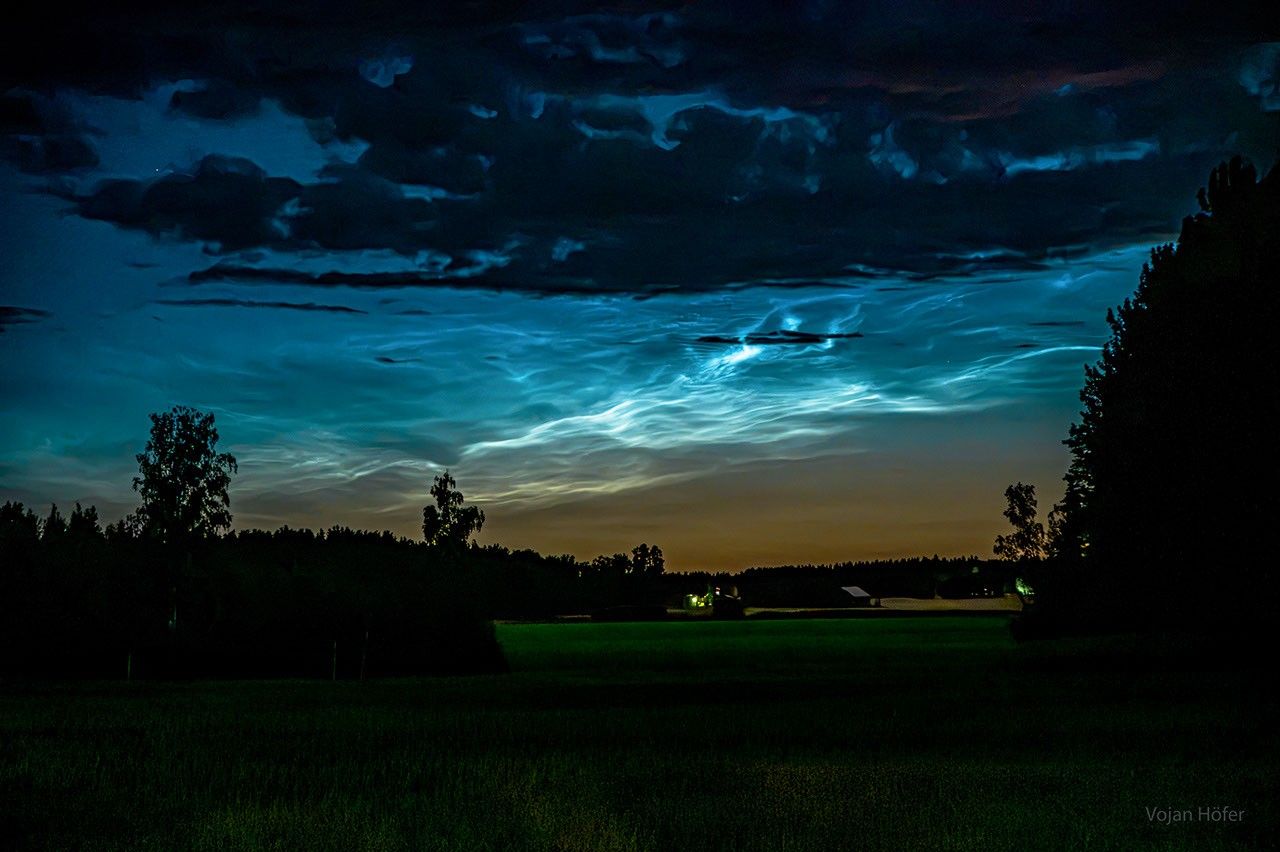
🌌 Sweden’s Night-Shining Clouds Open the View
Night has arrived in Sweden—but the sky hasn’t quite clocked out.
Noctilucent clouds occupy a part of the atmosphere very different from the familiar weather layer. Ordinary clouds form in the troposphere, where aircraft fly and storms develop, but these ice clouds appear near the mesopause roughly 80 to 85 kilometres above the ground. Air there is extraordinarily thin, so even a small amount of ice can create a delicate structure rather than a thick blanket. Tiny crystals form when the upper atmosphere becomes cold enough and water vapour finds particles on which to freeze. Dust left by meteors can provide some of those microscopic starting points. The result is a cloud so high that local night does not immediately reach it. An observer stands in Earth’s shadow while the upper layer remains sunlit, producing the strange impression that the sky has saved one last lamp for closing time. The physics is precise, but the visual effect feels like an atmospheric loophole written in blue thread.
☀️ High-Altitude Ice Crystals Catch Hidden Sunlight
High above the ground near Linköping, a delicate web of electric-blue clouds glows against the darkening sky. Below, green fields and trees sit in silhouette. Above, the clouds seem to catch the last light of a Sun that has already dipped below the horizon.
The trick is their altitude. Noctilucent clouds—also known as polar mesospheric clouds—form exceptionally high in Earth’s atmosphere. While the ground is in shadow, these lofty clouds can still be lit by sunlight from below the horizon. They’re usually too faint to notice, but summer twilight gives them just the right lighting for a rare appearance.
Viewing geometry explains why the display belongs to twilight rather than the middle of a bright day. When the Sun is just below the horizon, its light travels over the darkened landscape and strikes the high cloud layer from underneath. Lower clouds have already entered shadow, which gives the noctilucent structures contrast against the darker sky. They often appear as ripples, bands, knots or fine wave patterns because winds and atmospheric waves reshape the thin ice layer. High northern latitudes are especially favourable during summer, when the mesosphere becomes cold enough for crystals even though the ground below is enjoying its warm season. Sweden therefore offers both the latitude and the long twilight that make patient observation worthwhile. The best display can change quickly as illumination geometry shifts, so a quiet horizon may become intricate and then fade before anyone has finished arguing with the camera settings.
🔬 Noctilucent Clouds Keep Scientists Asking Questions
The name means “night-shining,” which is a rather elegant way of saying these clouds are excellent at staying up past bedtime. The early-August display over Sweden is a striking example: a blue, luminous network suspended above the landscape like lacework in the sky.
Scientists have learned much about noctilucent clouds in recent decades, but how they form and change is still an active area of research. So while the view may look otherworldly, it’s also a reminder that Earth’s atmosphere still has a few mysteries tucked away.
Scientists study these clouds because the upper atmosphere responds to forces that are difficult to sample directly. Satellites, ground cameras and instruments that measure temperature, water vapour and particle properties provide complementary views. Long-term changes in brightness or frequency may reflect shifts in mesospheric temperature and moisture, but interpretation requires care. Solar activity, atmospheric circulation, volcanic material, rocket exhaust and the availability of condensation particles can all influence what observers see. Greenhouse gases also behave differently high above Earth than they do near the surface; carbon dioxide can contribute to cooling in the thin mesosphere, while methane chemistry can add water vapour. That makes noctilucent clouds interesting indicators, not simple thermometers with a blue display. A spectacular photograph may prompt a climate question, but answering it demands consistent records, physical models and the scientific discipline to resist turning one beautiful evening into a global trend line.
🛰️ Atmospheric Research Tracks Their Changing Patterns
Amateur observers can contribute useful information by recording location, time, direction, elevation and changing structure rather than collecting only a dramatic image. A wide northern horizon and the period after sunset or before sunrise are more important than expensive equipment. Binoculars can reveal fine waves, while a camera on a stable support can preserve faint details that the eye notices only briefly. Comparing observations from several places helps show how broad the cloud field is and how quickly patterns travel. It also turns a private sighting into a small piece of atmospheric documentation. The reward is immediate even when no research project receives the file: the observer learns to distinguish night-shining clouds from ordinary cirrus illuminated by city lights or lingering sunset. Noctilucent displays encourage exactly the habit science needs—look carefully, note the conditions and remain delighted without letting delight replace description. Sweden’s luminous sky is both spectacle and measurement opportunity, which is an efficient use of twilight.
There is also a reason the clouds often look electrically blue. Small ice particles scatter shorter wavelengths efficiently, and the long path of twilight filters the illumination before it reaches the observer. Colour can vary with viewing conditions, atmospheric dust, camera settings and the darkness of the background sky, so photographs should not be treated as laboratory colour charts. The fine structures can move or transform over minutes as waves pass through the mesosphere. Time-lapse sequences make those dynamics obvious and show that the apparent veil is a changing layer rather than a painted stripe. Researchers use such motion to investigate winds and wave activity high above ordinary weather. For a casual observer, the same movement is a reminder to keep watching after the first photograph. The most elaborate pattern may appear when the camera has already been lowered. Twilight is inconsiderate that way.
A reported sighting becomes more useful when it includes negative observations as well as successful ones. Recording that the northern horizon remained clear on a suitable night helps researchers distinguish absence from lack of attention. Networks of observers can compare latitude, local time and cloud extent, creating a broader picture than any single camera provides. The practice also improves identification: illuminated cirrus usually changes character as lower twilight fades, whereas true noctilucent clouds retain their sharp, silvery-blue structure because they remain much higher. Maps, star positions and compass directions make descriptions reproducible. None of this bureaucracy reduces the wonder. It gives the wonder coordinates. A Swedish summer night can therefore offer two experiences at once—a beautiful display for anyone who looks up and a small atmospheric data set for anyone who writes down what happened.
🔗 Sources
Copyright Notice: The image and referenced content remain the property of their respective creators and rights holders. They are used here solely for commentary, discussion, and informational purposes. Please visit the original source links for attribution and additional information.
© 2026 ways4eu.wordpress.com – H.J. Sablotny. All rights reserved. The text content of this article is the intellectual property of H.J. Sablotny and may not be reproduced, distributed, or republished without permission. Images remain the property of their respective copyright holders and are used for illustrative and commentary purposes only.