Ways4eu WordPress.com Blog
SPA View of ways4eu.wordpress.com
Hubble Prepares the Way for Roman
By Kinda Cool
on Fri Oct 30 2026
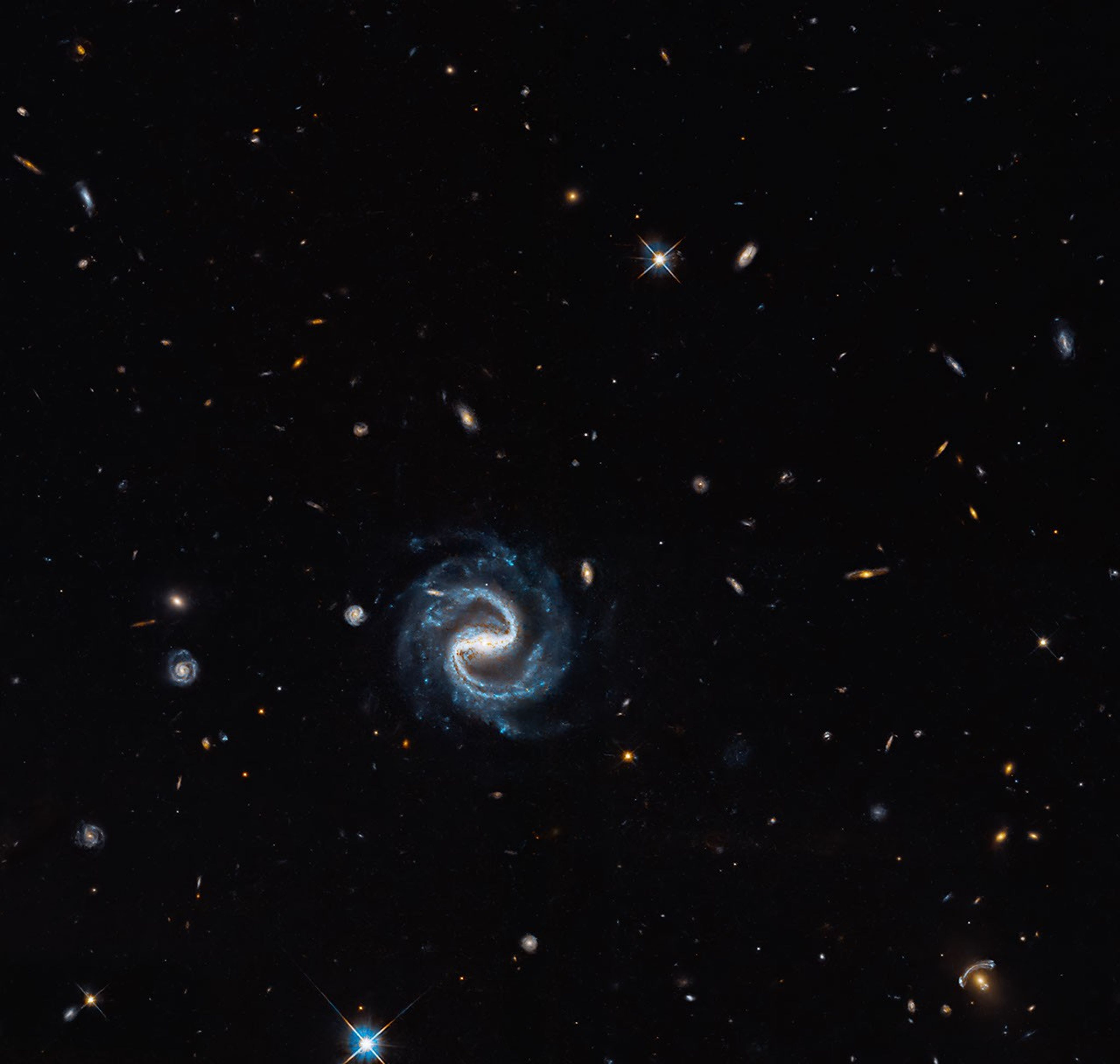
🔭 Hubble Finds a Lens Beside a Spiral
A barred spiral galaxy dominates the center of this Hubble field, but NASA’s scientific target sits near the lower-right corner. There, a reddish elliptical galaxy about 4.5 billion light-years away acts as a gravitational lens. A more distant blue galaxy, roughly eight billion light-years away, appears stretched into two images: a prominent arc on one side and a smaller, flipped counterarc on the other.
The central spiral is about the size of the Milky Way and may have a small satellite galaxy nearby. Those objects make the field visually rich, yet the lens matters because it joins geometry, gravity and hidden mass in one observable pattern. The background galaxy is not physically bent into a crescent. Its light follows curved paths through spacetime around the foreground galaxy, and Hubble records the distorted images that reach us.
The distances add an extraordinary time dimension. Light from the foreground lens began its journey when the Solar System was forming; light from the background source started billions of years earlier. Both arrive together in the detector, layered into one exposure. Astronomical images routinely place different epochs side by side, which is why “what time was this photograph taken?” becomes a question with several correct answers and an unreasonable amount of travel.
🌀 Gravitational Lensing Measures Invisible Mass
General relativity predicts that mass curves spacetime and changes the paths followed by light. When a foreground galaxy, a background galaxy and Earth align closely enough, the foreground object behaves like a cosmic lens. Perfect alignment can produce an Einstein ring; less symmetrical geometry creates arcs, multiple images or distorted shapes. The arc-counterarc pair here is two views of the same background galaxy, not neighboring blue companions.
The amount and shape of distortion depend on the lens’s total mass distribution. Stars and gas contribute, but visible matter alone often cannot reproduce the observed bending. Astronomers build lens models to infer the additional gravitational contribution associated with dark matter. Each well-measured system becomes a probe of mass that does not emit light. The galaxy is effectively announcing, “There is more of me than you can see,” using another galaxy’s photons as stationery.
Lensing also magnifies distant sources that might otherwise be too faint or small to study. The magnification is uneven, so researchers must model and reverse the distortion before reconstructing the source. That work requires accurate positions, redshifts, instrument calibration and assumptions about the foreground mass. A striking arc is the introduction, not the conclusion. The science begins when the picture is converted into constraints and competing models are tested against the details.
🌌 Roman Will Search a Much Wider Sky
NASA’s Nancy Grace Roman Space Telescope and Hubble have primary mirrors of the same 2.4-metre diameter, but their optical designs serve different observing strategies. Hubble provides exceptionally sharp, targeted views across ultraviolet, visible and near-infrared wavelengths. Roman’s Wide Field Instrument is optimized for broad near-infrared surveys with a field of view at least 100 times larger than Hubble’s widest visible-light camera and about 200 times Hubble’s infrared field.
Roman’s focal plane contains 18 detectors and produces roughly 300-megapixel images. A single exposure covers a patch of sky larger than the apparent full Moon while retaining fine angular resolution. That changes gravitational-lens research from hunting individual systems to assembling large, more uniform samples. Rare alignments become easier to find when the camera is not looking through a cosmic drinking straw.
Wide surveys support questions that need statistics: how dark matter is distributed, how cosmic structure grows, how galaxies evolve and how the expansion of the universe changes over time. Roman will also search for exoplanets through microlensing and repeatedly observe selected fields to detect objects that vary or move. The telescope is not a replacement for Hubble. It is a different instrument whose broad census makes Hubble’s detailed follow-up more valuable.
📚 Hubble Data Trains Roman Analysis
The featured Hubble observation belongs to a preparatory program collecting known lenses and high-resolution distortions. Researchers use those images to develop and test computer models that estimate foreground mass and reconstruct background sources. The methods can then be adapted to Roman’s much larger data stream. Preparation matters because a wide survey can discover more candidates than astronomers could sensibly analyze one by one with handcrafted methods.
Hubble can also revisit especially interesting objects found by Roman, while Roman can place a Hubble target into a much broader population. This is a productive division of labor: Roman identifies patterns and outliers across huge areas; Hubble or other observatories can examine selected cases in depth or at complementary wavelengths. Scientific instruments become more powerful when their differences are planned as connections rather than advertised as a telescope beauty contest.
The image is therefore both result and rehearsal. The arc already tells astronomers about a remote foreground galaxy and an even more distant source. At the same time, its measured shape helps build the tools needed for a future lens catalog. The spiral at center may attract the first glance, but the small blue curve at the edge carries the strategic importance. The universe has hidden the assignment in the corner; Hubble found it, and Roman is being equipped to collect the whole class.
Large samples also expose biases that a collection of famous lenses can hide. The easiest arcs to notice are bright, wide and visually clean, but nature produces messier systems near foreground stars, crowded galaxies or detector artifacts. Roman’s consistent survey strategy will let researchers measure how often different lens configurations occur and quantify which candidates their algorithms miss. That calibration is essential before lens counts can be used to test models of galaxy mass and cosmic structure.
The preparatory work must also distinguish real lenses from spiral arms, ring galaxies, diffraction features and chance alignments. Human reviewers are good at recognizing unusual shapes but inconsistent across millions of sources; automated classifiers are fast but inherit the biases in their training sets. Hubble’s confirmed examples give both groups a demanding reference library. Roman’s abundance will then test whether those methods remain reliable when the rare object is buried inside a data stream designed to make “large sample” sound modest. Spectroscopic follow-up remains important because redshifts for lens and source anchor the physical model and convert a beautiful arc into a calibrated measurement.
🔗 Sources and Further Reading
- NASA: Hubble Charts a Path for Roman with Gravitational Lenses
- NASA: Hubble vs. Roman
- NASA: Roman Wide Field Instrument
- Original NASA image
Copyright Notice: The image and referenced content remain the property of their respective creators and rights holders. They are used here solely for commentary, discussion, and informational purposes. Please visit the original source links for attribution and additional information.
© 2026 ways4eu.wordpress.com – H.J. Sablotny. All rights reserved. The text content of this article is the intellectual property of H.J. Sablotny and may not be reproduced, distributed, or republished without permission. Images remain the property of their respective copyright holders and are used for illustrative and commentary purposes only.