Ways4eu WordPress.com Blog
SPA View of ways4eu.wordpress.com
Ghosts in the Cepheus Flare
By Kinda Cool
on Sun Nov 01 2026
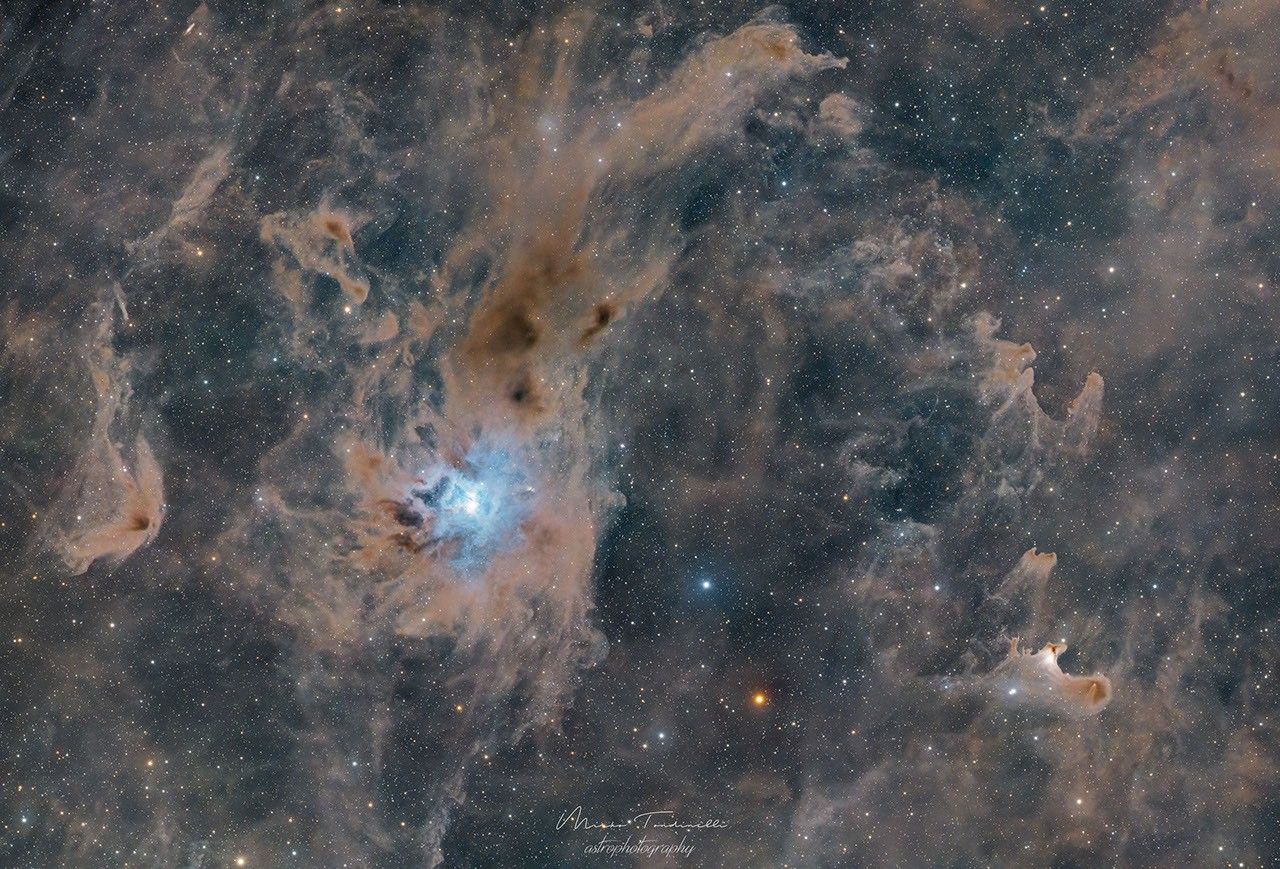
👻 Dust Clouds Haunt the Cepheus Flare
Something does appear to be lurking in this wide field in the royal constellation Cepheus, but the apparitions are not supernatural. They are interstellar dust clouds along the edge of the Cepheus Flaremolecular-cloud complex, roughly 1,200 light-years from Earth and above the bright plane of the Milky Way. Mirko Tondinelli’s telescopic view turns extremely faint reflected light into shapes that the human eye is eager to interpret as faces, cloaks and figures.
The “flare” is not a flash. It is the name given to a large region of molecular clouds that seems to widen away from the Galactic plane. These clouds contain cold gas and solid dust grains, the raw material from which stars can form. Most of the material emits little visible light, so it is mapped through radio observations, infrared emission, extinction of background stars and the scattered light that happens to reach a camera.
That combination explains the Halloween mood. Dust blocks some background starlight, creating black cavities, while nearby stars illuminate selected edges in gray, brown or blue. The field is not empty darkness with a few decorative wisps; it is structured material at different depths. Space has supplied the fog, the lighting and an unsettling cast. The photographer’s job was to persuade all three to remain still for a very long exposure.
🌫️ The Ghost Nebula Contains New Stars
At lower right lies vdB 141, also catalogued as Sh2-136 and commonly called the Ghost Nebula. NASA describes it as more than two light-years across. The nickname comes from its folded reflective shapes, not from any physical boundary around a single object. The nebula is part of a larger cloud, and its visible outline depends on where dust is dense enough to block light and where nearby stars provide enough illumination to reveal a surface.
Reddish patches inside the Ghost Nebula mark dense cores associated with the earliest stages of star formation. Gravity can make a sufficiently cold, massive concentration collapse, but the process is not a simple fall toward one central point. Turbulence, magnetic fields, rotation and feedback from young stars all influence whether a core fragments and how quickly it evolves. The red details are therefore not “baby stars” neatly lined up for a portrait; they are evidence of a difficult transformation underway inside obscuring material.
Infrared and radio observations are crucial because visible light cannot penetrate the densest regions. Longer wavelengths can trace warm dust, molecular gas and embedded sources hidden from an optical camera. Comparing those data with a visible image separates a dramatic silhouette from the physics beneath it. The Ghost Nebula may look like it has arrived to collect the living, but its actual business is almost the opposite: it contains places where new stars are beginning to assemble.
🔵 The Iris Nebula Reflects Blue Starlight
Left of center, NGC 7023—the Iris Nebula—provides the field’s clearest color contrast. It is a reflection nebula: dust does not generate the blue visible glow through nuclear reactions or hot ionized gas. Instead, grains scatter light from young stars. Shorter blue wavelengths scatter efficiently, which is also why Earth’s clear daytime sky appears blue, although the grain sizes and geometry in a nebula are not identical to molecules in our atmosphere.
Dark lanes around the Iris are not holes in space. They are thicker dust lying along the line of sight, removing background light and hiding parts of the illuminated cloud. The eye reads the blue center and black surroundings as a flower opening in darkness, hence the name. Catalogues are often less poetic—NGC 7023 is simply an entry—but a useful nickname can guide the first look as long as it does not replace the explanation.
Hot young stars supply both illumination and energy. Their radiation changes nearby grains and gas, while winds and outflows reshape the cloud. The resulting boundaries are temporary on astronomical timescales. A photograph freezes one phase of an environment that is dispersing in some places and condensing in others. The Iris looks serene because the exposure averages photons, not because star formation has discovered a quiet working arrangement.
📷 A Six-Moon View Requires Patient Imaging
The full frame spans almost six apparent full-Moon widths. That sounds enormous until one remembers how dim the dust is. A large angular field does not guarantee an easy naked-eye target. The photographer must gather many exposures, calibrate detector noise, correct uneven illumination, align the stars and combine the data without erasing faint structures or manufacturing false ones. The finished scene represents both sky and careful signal processing.
Color requires restraint. Astronomical cameras may record separate filtered exposures that are later assigned and balanced into a final image. Stretching contrast reveals dust the raw frame barely shows, but aggressive processing can clip black regions, oversaturate stars or turn noise into imaginary filaments. A reliable image credit matters because it lets viewers find capture details and distinguish observation from another repost that has been sharpened until the nebula appears to have developed upholstery.
The photograph works because the visual joke and the astrophysics point in different directions. Human perception sees ghosts; astronomy sees dust, scattered light and gravitational collapse. Both readings begin with the same shapes, but only one predicts young stars hidden inside them. The Cepheus Flare is haunting in the useful sense: it keeps the eye in the frame long enough to notice that a dark cloud can be a nursery rather than an absence.
The six-Moon field also prevents a common misunderstanding about scale. The Ghost and Iris nebulae appear close in the image because the camera sees them in nearly the same direction, but a two-dimensional frame cannot establish the exact distance between every cloud layer. Dust complexes contain foreground sheets, denser knots and illuminated surfaces distributed through space. Apparent neighbors may occupy different depths, so names drawn around bright patches are guides to a continuous environment rather than fences in the sky.
Cepheus is circumpolar from many northern locations, remaining above the horizon through the year, but the faint nebulae demand dark, transparent conditions and imaging equipment. Visual observers should not expect the published colors through an eyepiece. The achievement is not that a camera has made the cloud “more real” than human sight; it has integrated weak signals long enough to reveal structures our eyes cannot accumulate.
🔗 Sources and Further Reading
- NASA APOD: Haunting the Cepheus Flare
- NASA: Reflection Nebulae and Cosmic Dust
- ESA/Hubble: The Iris Nebula
- Original NASA image and credit
Copyright Notice: The image and referenced content remain the property of their respective creators and rights holders. They are used here solely for commentary, discussion, and informational purposes. Please visit the original source links for attribution and additional information.
© 2026 ways4eu.wordpress.com – H.J. Sablotny. All rights reserved. The text content of this article is the intellectual property of H.J. Sablotny and may not be reproduced, distributed, or republished without permission. Images remain the property of their respective copyright holders and are used for illustrative and commentary purposes only.