Ways4eu WordPress.com Blog
SPA View of ways4eu.wordpress.com
Webb Finds a Cat in the Carina Nebula
By Kinda Cool
on Sun Nov 01 2026
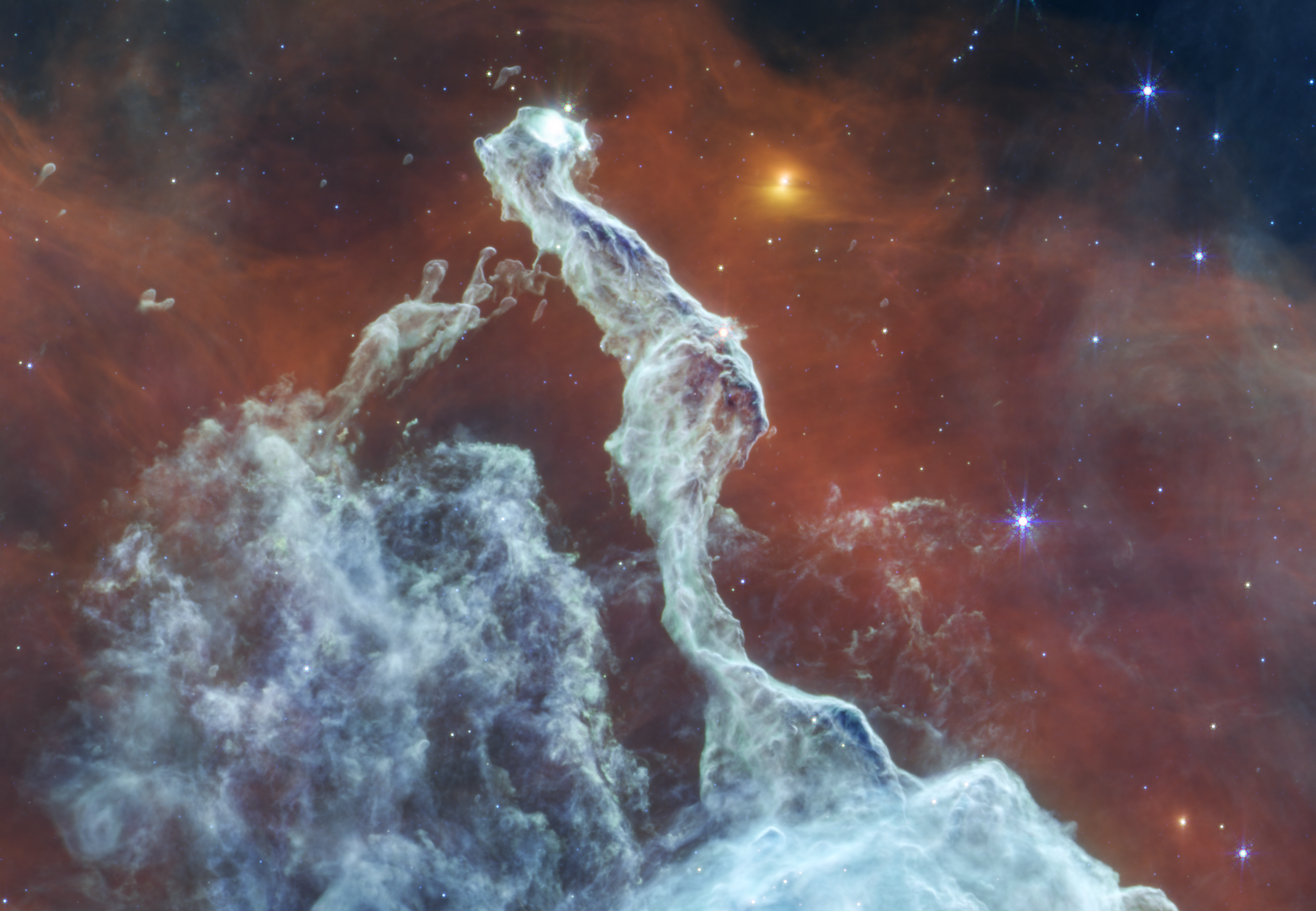
🐈 A Dust Pillar Resembles a Cosmic Cat
NASA’s “Cat’s Head Nebula” is not a separate feline-shaped cloud with an official catalogue number of its own. It is a pillar inside NGC 3372, the enormous Carina Nebula about 7,500 light-years away. In the released view, a narrow central structure suggests a seated cat seen partly from behind, with a turned head, a bright eye and a tail extending downward. The resemblance is visual; the material is gas and dust shaped by stars.
Pareidolia gives the image its memorable nickname. The same instinct makes people see faces in sockets, animals in clouds and a cat judging them from a refrigerator. Here the nickname helps viewers navigate a complicated field, but it should not be mistaken for anatomy. The “eye” is probably a young star embedded in dust, and the “fur” is a network of filaments and globules rather than anything that will improve after brushing.
The pillar survives because it is denser than some of its surroundings. Massive stars elsewhere in Carina flood the region with ultraviolet radiation and drive strong stellar winds. Those forces ionize, heat and erode exposed material. Dense knots resist longer, leaving sculpted columns as the more vulnerable gas around them is removed. The cat shape is therefore not being assembled; it is being revealed and worn away at the same time.
🌬️ Massive Stars Sculpt the Feline Profile
Astronomers call the interaction “stellar feedback.” Young massive stars return energy and matter to the cloud that formed them through radiation, winds and eventually supernova explosions. Feedback can halt star formation by dispersing gas, compress neighboring material into new dense pockets or do both in different places. The Cat’s Head offers a small, visually coherent example of a process operating throughout Carina.
A bright rim can mark the interface where energetic radiation meets a dense surface. Behind that boundary, material may remain cooler and shielded; in front, gas is ionized or swept away. Fine strands visible around the pillar record uneven density and local conditions. They are not static outlines. On timescales far longer than a human life but short for a nebula, the profile will change and the current “cat” will lose the pose that earned it publicity.
The probable infant star near the right side complicates the picture. NASA notes a narrow filament crossing the light source but does not claim that the two are physically connected. Apparent overlap in a two-dimensional image can join structures at different depths. That caution is important: even Webb cannot turn one photograph into a complete three-dimensional map. Sometimes a cosmic whisker is merely passing in front of the eye.
🔭 Hubble and Webb See Different Structures
Hubble’s visible-light image shows the pillar as an opaque dark form bordered by glowing gas. Visible wavelengths are strongly blocked by dust, so the structure appears as a silhouette and only selected young sources emerge. Webb’s near-infrared camera, NIRCam, penetrates more of the dust, revealing many stars and background galaxies. The comparison demonstrates why “what does the nebula really look like?” has no single-wavelength answer.
The mid-infrared view comes from Webb’s MIRI instrument. At these wavelengths, warm dust and carbon-based molecules energized by starlight emit strongly. NASA reports that changes in local composition and conditions produce variations in brightness and color. MIRI makes fine strands and globules especially conspicuous to the left of the pillar. It is not seeing through all dust; it is detecting emission from dust that visible eyes cannot register.
Webb’s familiar eight-point star pattern is instrumental rather than a structure around each star. Six large diffraction spikes arise from the hexagonal mirror segments, and two fainter horizontal spikes come from supports for the secondary mirror. Recognizing that signature prevents a processing artifact from becoming a new astrophysical theory. The telescope is extraordinarily sensitive, but it still leaves its optical handwriting on bright points.
🌌 Infrared Colors Translate Invisible Light
The released image uses color to represent infrared wavelengths outside human vision. Those colors are not a deception and not the view an astronaut would see through a window. They are a translation: filtered measurements are assigned visible colors so differences in wavelength, temperature or composition can be compared. A useful caption explains that translation rather than calling the picture either “natural” or “fake.”
Image processors balance scientific information with legibility. If every weak signal were displayed linearly, bright regions would dominate and faint structures would vanish. Stretching intensity reveals filaments across a wide dynamic range, while calibration removes detector effects. The credit line names NASA, ESA, CSA, STScI and processor Joseph DePasquale because producing a public image is part observation, part instrument science and part disciplined visual communication.
The Cat’s Head succeeds as Halloween astronomy because the joke does not exhaust the object. First comes the cat, then the questions: why is the pillar still there, what is the bright “eye,” and why do three instruments disagree about the scenery? Webb answers by adding wavelengths rather than replacing Hubble. The universe has not placed a pet inside Carina; it has given stellar feedback unusually effective branding.
Carina is one of the Milky Way’s most vigorous nearby star-forming complexes and contains several clusters of massive stars. Its radiation field makes the Cat’s Head a harsh environment rather than a quiet cloud portrait. The same stars that illuminate the structure are helping destroy it. That tension—birth sites eroded by the generation they produced—is a recurring feature of star formation.
MIRI operates at wavelengths longer than NIRCam and must be kept extremely cold so the telescope does not overwhelm faint cosmic infrared signals with its own heat. Webb’s sunshield and orbit near the Sun–Earth L2 region create the stable thermal environment. The feline image therefore depends on engineering that keeps a giant observatory colder and steadier than any cat has voluntarily agreed to be.
Carina contains several clusters of massive stars, making it one of the Milky Way’s most vigorous nearby star-forming complexes. The same stars that illuminate the pillar are helping destroy it through radiation and winds. That tension—new stars eroding the cloud that produced them—is a recurring feature of stellar nurseries.
Comparing the three views is scientifically richer than selecting the prettiest. Hubble outlines the opaque pillar, NIRCam reveals stars through some dust, and MIRI traces warm grains and molecular emission. Each instrument samples a different interaction between light and matter. Together they turn one Halloween silhouette into a layered account of erosion, embedded sources and changing chemistry.
🔗 Sources and Further Reading
- NASA: James Webb Captures the Cat’s Head
- NASA: Cat’s Head Nebula — Webb MIRI Image
- NASA: Multiwavelength Flight into the Cat’s Head
- NASA SVS: Giant Cosmic Cat Spotted
Copyright Notice: The image and referenced content remain the property of their respective creators and rights holders. They are used here solely for commentary, discussion, and informational purposes. Please visit the original source links for attribution and additional information.
© 2026 ways4eu.wordpress.com – H.J. Sablotny. All rights reserved. The text content of this article is the intellectual property of H.J. Sablotny and may not be reproduced, distributed, or republished without permission. Images remain the property of their respective copyright holders and are used for illustrative and commentary purposes only.