Ways4eu WordPress.com Blog
SPA View of ways4eu.wordpress.com
Aurora and Steam Transform Hverir at Night
By Kinda Cool
on Sun Nov 01 2026
🌌 Hverir Blends Geothermal Steam With Aurora
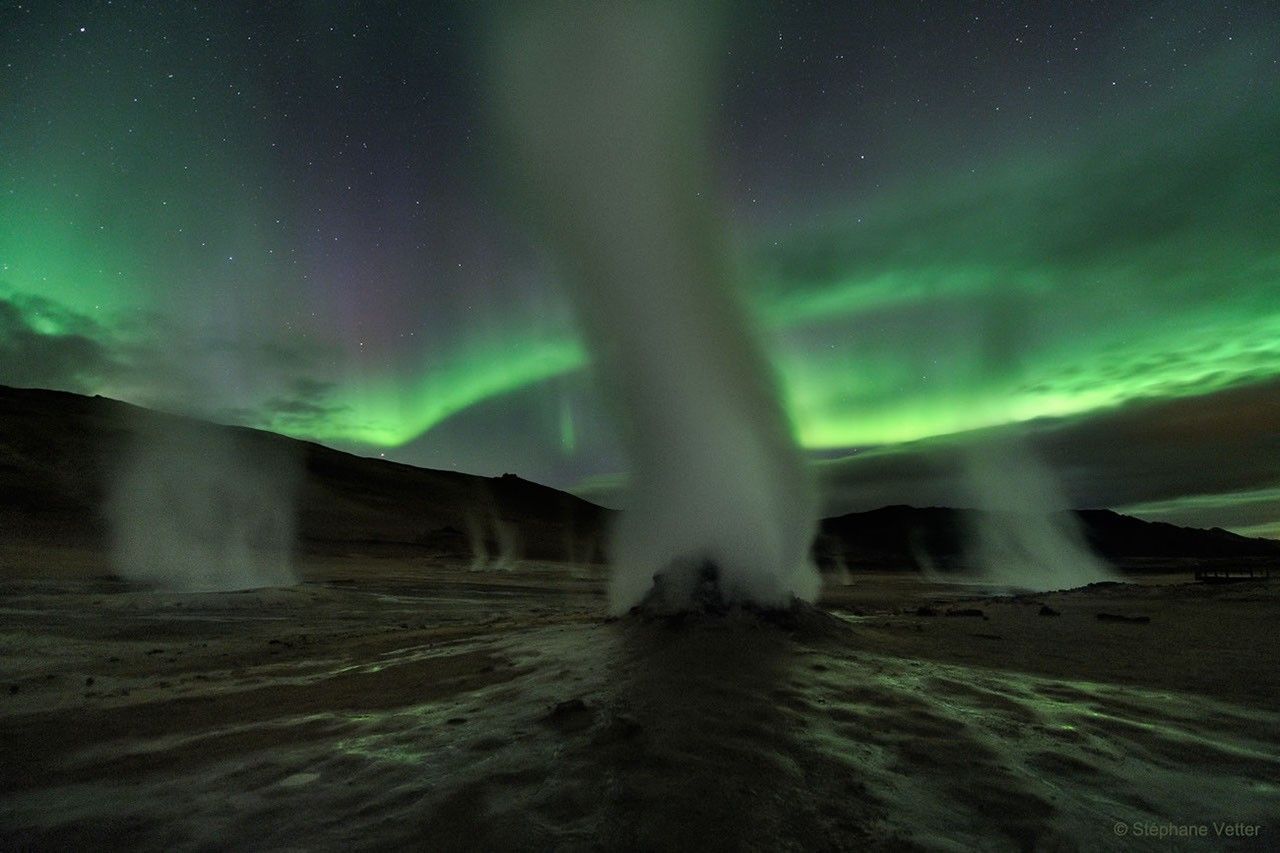
At first glance, the scene looks like a landscape borrowed from a hostile exoplanet: green light hangs above a dark plain while white columns twist upward from the ground. Yet the photograph was made on Earth, at Hverir, a high-temperature geothermal field in northeastern Iceland. Photographer Stéphane Vetter captured the moment in 2013, and NASA later presented it as an Astronomy Picture of the Day. The image works because two real terrestrial processes occupy the same frame: geothermal heat rises from below, and an aurora responds to energy arriving from the Sun.
The pale towers are not clouds descending from the sky. They are steam and gas escaping through fumaroles in a volcanic landscape. Against a daylight background, those vents would be recognizable geological features; after dark, their edges dissolve into the air and their scale becomes difficult to judge. The auroral glow behind them gives the vapor an eerie outline. Nothing has been digitally invented to make the place strange. The apparent alien world is produced by careful timing, unusual light, and a site where Earth openly displays its internal heat.
That combination gives the photograph more substance than a seasonal visual joke. It places the atmosphere, the magnetosphere, and Icelandic geology in one composition. A viewer can enjoy the Halloween mood before learning any science, but the science makes the mood more impressive: the lights and the steam come from systems operating on radically different scales. One begins with activity on the Sun and interactions high above the planet; the other begins with heat, water, and fractured rock beneath the photographer’s feet.
🧭 Icelandic Geology Explains the Alien Mood
Hverir lies near Lake Mývatn at the foot of the Námafjall ridge, within the volcanically active landscape of northern Iceland. The area is known for boiling mud pots, mineral-stained ground, hissing vents, and persistent steam. Visit North Iceland describes Námafjall as a place of fumaroles, mud pools, and vivid mineral deposits. Those details matter when reading the photograph. The barren foreground and vapor plumes are not theatrical props; they are visible signs of groundwater being heated in a region shaped by volcanism.
A fumarole forms where heated water becomes steam and finds a route through cracks to the surface. Gases can travel with that steam, and minerals altered or deposited by geothermal activity color the surrounding soil. Hverir is therefore visually dramatic even without an aurora. Yellow, orange, gray, and red deposits mark chemical changes in the ground, while the lack of lush vegetation leaves the machinery of the landscape unusually exposed. In daylight, the site can resemble a geological workshop. At night, much of that color vanishes and motion becomes the dominant clue.
The photograph compresses distance in a useful way. Steam in the near and middle ground appears to mingle with light that is actually produced far above it. The eye reads both as luminous material moving through darkness, although their causes are unrelated. That visual rhyme is why the image feels coherent rather than merely busy. The ground seems to answer the sky: one sends up vapor, the other sends down light. The resemblance is aesthetic, but it encourages a correct scientific question—what processes can make an apparently quiet planet look so active?
⚡ Solar Particles Create the Green Curtain
An aurora begins with the connection between the solar wind and Earth’s magnetic environment. Energy and particles from the Sun disturb the magnetosphere, and accelerated electrons can travel along magnetic field lines toward polar regions. In the upper atmosphere they collide with atoms and molecules, transferring energy. When those atmospheric constituents return to lower-energy states, they release light. NOAA’s aurora explanation describes this process and the familiar auroral oval centered around a magnetic pole.
Green is the color most strongly associated with the northern lights because atomic oxygen commonly emits yellow-green light under typical auroral conditions. Other colors are possible. Oxygen can contribute red emissions at higher altitudes, while nitrogen can produce blue, pink, or purplish tones depending on particle energy and atmospheric conditions. NASA’s aurora guide illustrates how different interactions and altitudes shape the palette. Vetter’s image does not need every color to be effective; the dominant green creates a powerful contrast with the dark ground and white steam.
Geomagnetic activity can also change where an aurora is visible. During stronger disturbances, the auroral oval expands away from the pole, allowing observers at lower latitudes to see displays that would usually remain farther north. Iceland already occupies an excellent position for aurora watching, but visibility still depends on more than latitude. Clouds, moonlight, artificial light, local weather, and the timing of geomagnetic activity all influence what a person actually sees. A photograph is therefore the record of several conditions agreeing at once, not an automatic reward for standing in a northern landscape.
📷 Stéphane Vetter Turns Science Into Atmosphere
The original APOD credit identifies Stéphane Vetter as the photographer and dates the scene to a dark, stormy night in 2013. His framing makes the geothermal vents large enough to behave like characters while preserving a broad view of the aurora. That choice avoids a common weakness in night-sky photography: a spectacular sky floating above an anonymous strip of land. Here the foreground is scientifically and visually specific. Remove Hverir’s steam and the result would still be an aurora photograph, but it would lose the dialogue between the planet’s interior and its upper atmosphere.
Long-exposure night photography can reveal structure and color differently from a quick glance by the human eye. A camera gathers light over time, so faint auroral forms, stars, and illuminated vapor may become more legible. That does not make the scene false; it means the photograph is an instrument as well as an image. The viewer should read it as a carefully recorded interval. Steam shifts during the exposure, auroral curtains change shape, and the sensor accumulates their light into a single frame that represents duration rather than an instantaneous snapshot.
The result is especially effective because it preserves ambiguity for a moment. The question posed by the APOD caption—what spooky planet is this?—works only if the image delays recognition. Once Iceland and the aurora are identified, the mystery becomes explanation. That transition is one of science communication’s most useful structures: surprise attracts attention, but precise location, physical mechanisms, and attribution reward it. The photograph is memorable not because Earth imitates science fiction, but because ordinary planetary processes can exceed a designer’s imagination.
🌍 Vetter’s Photograph Connects Two Restless Systems
The geothermal field and the aurora differ in their energy sources, locations, and timescales. Hverir’s activity belongs to Iceland’s geological setting, where heat below the surface drives hot water, steam, and chemical alteration. The aurora belongs to space weather, where solar activity can disturb Earth’s magnetic environment. Placing them together does not imply that one causes the other. Instead, the image becomes a compact lesson in how several independent Earth systems can be visible from one viewpoint.
The distinction is important because beautiful images often invite accidental causal stories. The fumaroles do not generate the aurora, and auroral particles do not create Iceland’s geothermal vents. Their apparent interaction occurs inside the photograph. Recognizing that separation does not reduce the wonder; it sharpens it. A single observer can stand on crust shaped by geological heat, breathe in the lower atmosphere, and watch light produced in the upper atmosphere by a chain of events that began far beyond the local horizon. Few images demonstrate Earth’s layered character so efficiently.
Space weather also has consequences beyond photography. Strong geomagnetic storms can affect satellite operations, radio communication, navigation, and electrical infrastructure. NOAA’s geomagnetic-storm overview explains how energy added to the upper atmosphere can increase drag on low-Earth-orbit satellites and how geomagnetically induced currents can affect technological systems. The same disturbance that produces a graceful green curtain may therefore be monitored as an operational hazard. Beauty and risk are not contradictions; they are different human readings of the same physical event.
🎃 Halloween Framing Makes Earth Feel Unfamiliar
The Halloween framing succeeds because it grows directly from the photograph. Steam becomes a procession of pale figures, the green aurora resembles theatrical lighting, and the dark volcanic plain supplies the required stage. The humor never needs a fake monster. Earth handles the production itself, with a budget measured in geothermal heat and solar energy. Even the title’s suggestion of another planet is gently overturned: the punchline is that our familiar world contains landscapes capable of looking completely foreign.
NASA has returned to this image in more than one seasonal APOD presentation, including versions published in 2017 and 2022. That repetition shows why the photograph lasts. It is tied to Halloween, yet it remains useful as an explanation of auroras and geothermal terrain. A purely decorative image might age after the joke is understood. Vetter’s scene continues to offer layers: first atmosphere, then geography, then heliophysics, then the practical craft of making a night photograph in a difficult landscape.
The most satisfying reading is therefore also the simplest. This is not a spooky planet discovered around another star. It is Earth viewed at an unusually expressive moment. Hverir releases steam from a restless geological setting; the upper atmosphere answers solar-driven particles with green light; a photographer recognizes that the two displays belong in the same frame. The scene feels supernatural only until its causes are named. After that, it becomes something better: a reminder that accurate explanations can make a mysterious image more astonishing, not less.
Sources:NASA APOD original; Visit North Iceland; NASA aurora science; NOAA Space Weather Prediction Center.
Copyright Notice: The image and referenced content remain the property of their respective creators and rights holders. They are used here solely for commentary, discussion, and informational purposes. Please visit the original source links for attribution and additional information.
© 2026 ways4eu.wordpress.com – H.J. Sablotny. All rights reserved. The text content of this article is the intellectual property of H.J. Sablotny and may not be reproduced, distributed, or republished without permission. Images remain the property of their respective copyright holders and are used for illustrative and commentary purposes only.