Ways4eu WordPress.com Blog
SPA View of ways4eu.wordpress.com
A Rainbow Meteor Crosses Pan-STARRS’s Tail
By JohnTheWordWhirlwind
on Tue Nov 03 2026
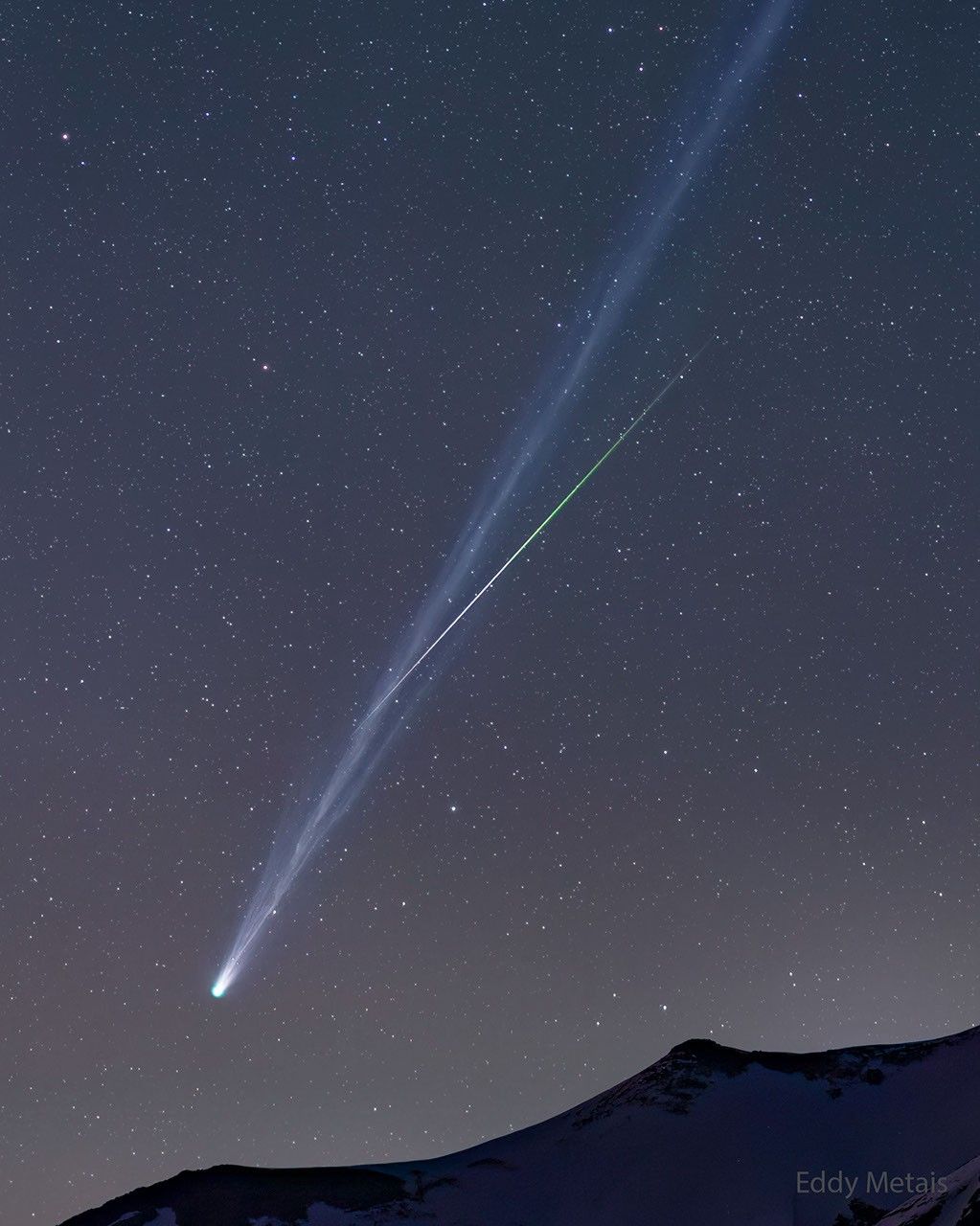
☄️ Comet and Meteor Share Only the Camera’s View
Eddy Metais photographed Comet C/2025 R3 (Pan-STARRS) above Hautacam, France, in April 2026 while a bright meteor crossed the foreground. The resulting frame makes the streak appear connected with the comet’s tails, but perspective has compressed two very different distances. The meteor glowed inside Earth’s atmosphere; the comet was far beyond it, travelling through the Solar System.
That alignment is a chance event. Thousands of cometary bodies and countless fragments occupy different orbits, and a two-dimensional photograph cannot establish parentage. NASA’s Astronomy Picture of the Day therefore asks whether the meteor came from the pictured comet and answers, “Probably not.” The composition is real; the family relationship is unsupported. Celestial photobombing remains easier than celestial genealogy.
The timing adds another layer. The comet’s image was captured in April but selected as APOD on 3 November, when several annual meteor showers were active or approaching. The photograph is not a live view of the November sky. Astrophotography often separates capture date from publication date, and both belong in a careful caption.
🔵 Pan-STARRS Shows Two Different Tails
Comet C/2025 R3 displays a pale dust tail and a blue ion tail. Dust released from the nucleus follows curved paths influenced by the comet’s motion and pressure from sunlight. The ion tail consists of charged gas shaped more directly by the solar wind and magnetic field, so it tends to point away from the Sun. The two tails can diverge even though they leave the same small nucleus.
The blue colour commonly comes from ionised carbon monoxide molecules emitting at characteristic wavelengths. A camera’s sensitivity and processing affect how strongly the colour appears, but the physics is not an artistic filter invented after capture. The dust tail reflects sunlight and therefore looks broader and more neutral. One comet can operate two visual departments with different supervisors.
Pan-STARRS refers to the survey system that discovered the comet, not to its composition. The Panoramic Survey Telescope and Rapid Response System in Hawaii repeatedly images the sky to find moving or changing objects. The designation C/2025 R3 records a non-periodic comet discovered in the second half of September 2025. Catalogue names are less lyrical than “rainbow meteor,” but they prevent every new fuzzy dot from being called Kevin.
🌈 Meteor Colors Reveal Heat and Chemistry
A meteor appears when a small meteoroid enters the atmosphere at high speed, compressing and heating the air while material ablates from its surface. The luminous path may last only a fraction of a second. Sand-sized particles can create bright streaks because velocity converts a tiny mass into intense energy. The object is not burning like charcoal in ordinary oxygen; the glow combines excited atmospheric gases and vaporised material.
Different colours can arise from composition, speed, altitude and camera response. Sodium may contribute yellow-orange light, magnesium green-blue and ionised calcium violet, while atmospheric nitrogen and oxygen add their own emissions. The rainbow segmentation in a photograph can also be influenced by changing brightness, sensor colour filters and the meteor’s movement across pixels. A single image suggests complexity but does not provide a laboratory-grade chemical analysis.
Photographing both objects required planning and luck. The comet’s faint tails demand tracked exposures and dark skies; the meteor arrives without appointment and moves at an entirely different angular speed. Image processing must preserve the transient streak without making the comet or stars look artificial. The photographer prepared for the predictable guest and happened to catch the one that entered through the ceiling.
🌠 November Brings Three Established Meteor Showers
The Southern Taurids peak in early November, followed by the Northern Taurids roughly a week later. Both are associated with material from Comet 2P/Encke and related debris. Taurids often produce relatively slow, bright meteors and occasional fireballs. The shower name comes from the radiant in Taurus, the point from which paths appear to diverge because of perspective.
The Leonids peak later in November and originate from Comet 55P/Tempel-Tuttle. Most years produce a modest display, but the stream has occasionally generated meteor storms when Earth crosses dense trails. Observers need dark skies, patience and a wide view rather than a telescope. Meteors can appear anywhere, while staring only at the radiant is an excellent way to let the best one happen behind you.
None of those known associations makes the April meteor a fragment of C/2025 R3. Matching a meteor to a parent requires orbit information and repeated shower patterns, not visual proximity in one frame. The photograph’s power lies in the honest coincidence: a distant comet releasing material under sunlight and a nearby grain ending its journey in air happened to align for one exposure. Space supplied the depth; the camera made them neighbours.
Observers hoping to see the November showers should allow their eyes about twenty minutes to adapt to darkness, move away from direct lights and dress for a longer wait than the forecast’s most optimistic sentence. Moonlight, cloud and local light pollution can reduce the number visible. A reclining chair and wide sky are more useful than magnification. Telescopes narrow the field so dramatically that they are excellent devices for missing meteors with scientific precision.
Comet photography requires a different plan. An ephemeris predicts position, while tracking keeps stars and the comet sharp during longer exposures. Because a comet moves relative to the star field, stacking many frames can create either trailed stars or a blurred nucleus unless the processing aligns the intended target. Photographers often make separate alignments and combine them carefully. The finished image may look like one effortless moment while representing hours of collection and decisions about motion.
The APOD selection also demonstrates the value of metadata. Credit identifies Eddy Metais, location places the horizon at Hautacam and the April capture date prevents confusion with November showers. Without those details, the frame becomes an orphaned spectacle repeatedly assigned to the wrong event. Astronomy images are evidence as well as art. A beautiful coincidence becomes more beautiful when viewers know which part was planned, which part was luck and which two objects never met.
Meteor cameras often record precise time and sky position so networks can reconstruct a path and possible orbit from multiple stations. A single artistic photograph rarely supplies that triangulation. If another camera captured the same streak, researchers could estimate altitude and trajectory; otherwise its origin remains broad. The image can be scientifically informed without pretending it is a complete meteor survey.
🔗 Sources and Further Reading
- NASA APOD: Comet Pan-STARRS and Rainbow Meteor
- NASA: November 2026 Skywatching Tips
- NASA: Meteors and Meteorites
- Original APOD image
Copyright Notice: The image and referenced content remain the property of their respective creators and rights holders. They are used here solely for commentary, discussion, and informational purposes. Please visit the original source links for attribution and additional information.
© 2026 ways4eu.wordpress.com – H.J. Sablotny. All rights reserved. The text content of this article is the intellectual property of H.J. Sablotny and may not be reproduced, distributed, or republished without permission. Images remain the property of their respective copyright holders and are used for illustrative and commentary purposes only.