Ways4eu WordPress.com Blog
SPA View of ways4eu.wordpress.com
Mars’s 1,800-Kilometer Morning Cloud
By JohnTheWordWhirlwind
on Tue Nov 03 2026
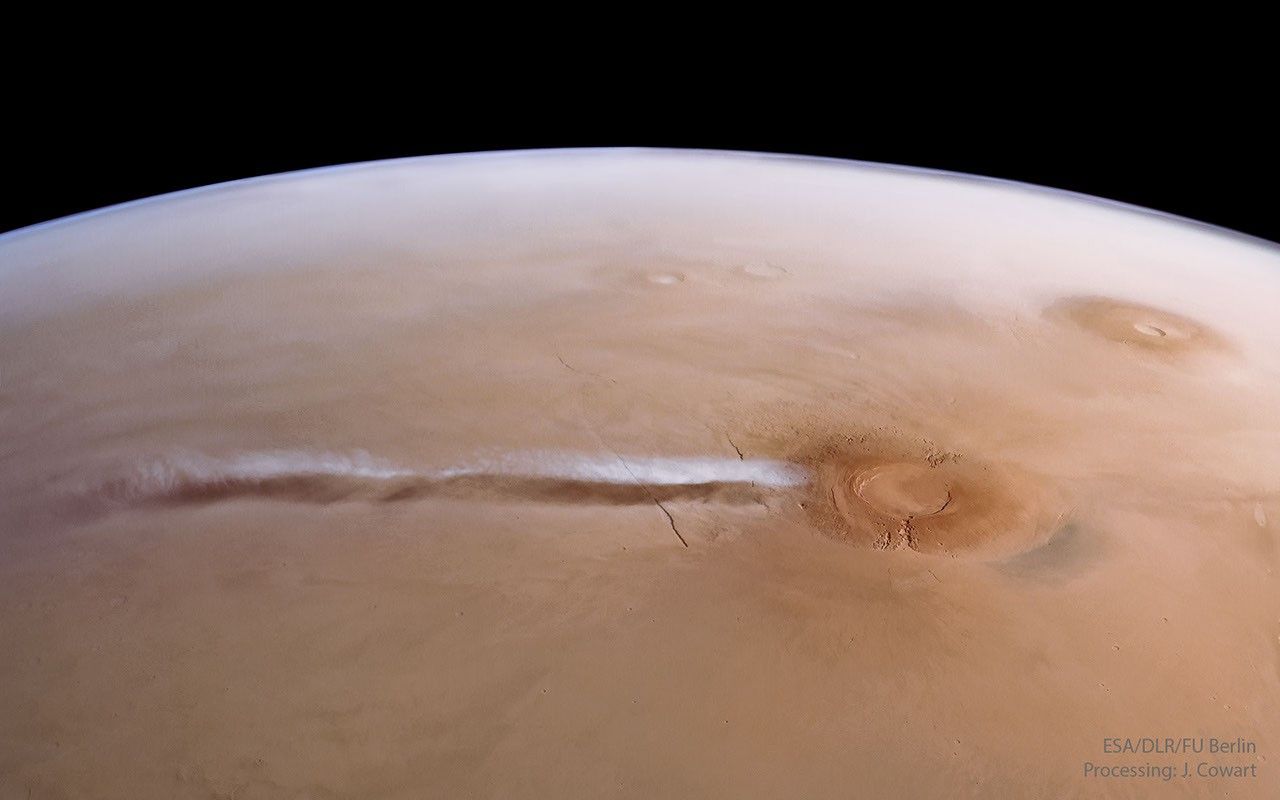
☁️ Arsia Mons Builds a Cloud Before Breakfast
Every spring and summer in Mars’s southern hemisphere, a bright white cloud appears west of Arsia Mons and begins an extraordinary daily commute. The Arsia Mons Elongated Cloud, usually shortened to AMEC, forms near the summit of the enormous shield volcano in the early morning. Winds then draw it westward into a narrow plume that can reach roughly 1,800 kilometres. By late morning it has vanished, only to repeat the performance on later mornings when the season and weather cooperate.
The cloud is made of water ice, not volcanic smoke. Arsia Mons has been inactive for millions of years, and spacecraft have not detected an eruption hiding beneath the plume. The volcano matters because it rises about twenty kilometres above the surrounding plains and forces moving air to respond to a mountain of exceptional scale. Calling AMEC a volcanic cloud is therefore accurate only in the geographical sense: the volcano supplies the obstacle, while atmospheric physics supplies the cloud.
Long clouds are not automatically thick clouds. AMEC may stretch farther than many countries while remaining comparatively narrow and delicate. Its spectacular length comes from rapid growth and strong winds rather than from a continent-sized reservoir of ice. From orbit it resembles a banner tied to the volcano; in reality, fresh ice crystals continually form near Arsia Mons while older portions travel downstream and begin to dissipate. Mars has invented a conveyor belt whose product is morning fog and whose warranty expires before lunch.
🌊 Mountain Waves Lift Thin Martian Air
On Earth, moist air rising over mountains can cool until water condenses, producing an orographic cloud. AMEC follows the same broad principle in an atmosphere that is far thinner, colder and dominated by carbon dioxide. Air flowing across Arsia Mons generates atmospheric gravity waves. In the rising part of a wave, pressure and temperature fall enough for scarce water vapour to freeze onto microscopic particles, creating the visible water-ice cloud high above the western flank.
The new modelling reported by ESA in 2026 suggests that the process may involve unusually strong vertical motions and extremely cold pockets. Researchers combined Mars Express observations with a sophisticated Mars weather model to reproduce the cloud’s daily cycle. That comparison matters because a beautiful image can show where a cloud is, but a model tests which temperatures, winds and wave patterns could have put it there. AMEC is not merely long; it is a demanding examination question for Martian meteorology.
Dust remains part of the puzzle. Cloud droplets and ice crystals often need tiny aerosol particles on which to form, yet the relevant altitude may contain too little ordinary dust for simple explanations. The model points toward exotic conditions in which water ice can form despite the shortage of obvious condensation nuclei. Scientists are still testing the details, which is more interesting than declaring the mystery solved because a computer produced a convincing white streak. On Mars, even cloud seeding apparently requires peer review.
🛰️ Mars Express Catches a Fast Daily Cycle
NASA’s Viking Orbiter 2 photographed the feature in 1977, but its repeating behaviour became much clearer through ESA’s Mars Express mission. The spacecraft’s Visual Monitoring Camera is especially useful because it can observe broad areas at different local times. High-resolution instruments are excellent for detail, yet a modest wide-angle camera can be better for following a cloud that grows over hundreds of kilometres and disappears within a few hours. Scientific value does not always arrive with the longest equipment name.
Timing is crucial. Many Mars orbiters pass over a location at nearly the same local time on every orbit, which can make a morning-only event easy to miss. Mars Express has viewing opportunities that reveal the plume during its rapid development. Images show the cloud emerging before sunrise, lengthening after dawn and fading as the atmosphere warms. A single frame looks like an object; a sequence reveals a process with a timetable.
The seasonal window also matters. AMEC appears during southern spring and summer, around the period when Mars is relatively dusty and atmospheric circulation favours the necessary waves. It does not hang over Arsia Mons throughout the year. Any caption that presents it as a permanent tail turns weather into scenery. The plume is better understood as a recurring event: predictable enough to plan observations, variable enough to keep researchers checking what the next morning produces.
🔬 One Cloud Tests Weather Models on Two Worlds
AMEC helps scientists examine how clouds form in a thin atmosphere, how mountains launch waves and how water moves through the Martian climate. Those questions extend beyond one photogenic plume. Water-ice clouds affect temperature by scattering sunlight and infrared radiation, while atmospheric waves move energy and momentum between altitudes. Improving those processes in models makes forecasts and climate reconstructions more realistic, including the conditions future robotic or human missions may encounter.
The comparison with Earth is valuable precisely because the planets are different. Both worlds produce orographic clouds, but Mars offers lower gravity, vastly lower surface pressure, colder temperatures and a different aerosol environment. A theory that works in both settings is stronger than one tuned to a single planet. AMEC therefore acts as a natural laboratory: the experiment runs each morning, the mountain never calls in sick, and Mars Express keeps the attendance sheet.
The image remains visually simple—a volcano, a white line and a rust-coloured planet—but the explanation joins topography, radiation, dust, water and atmospheric dynamics. That is why scientists continue watching a cloud first recorded almost half a century ago. Its existence is no longer surprising; its exact microphysics still is. The longest cloud on Mars is also a reminder that scale does not guarantee simplicity. Sometimes the largest clue in the picture is the one still asking the most precise questions.
AMEC also provides a test of the Martian water cycle. Mars holds most accessible water as polar or subsurface ice, while only a small amount circulates as atmospheric vapour and cloud. Measuring when the plume appears, how quickly it grows and where it evaporates constrains how water is transported between regions and altitudes. The cloud does not deliver rain to Arsia Mons; pressure is too low and ice particles generally sublimate. Its importance lies in movement: a trace constituent becomes visible long enough to reveal winds that would otherwise leave no white line behind.
🔗 Sources and Further Reading
- ESA: Mars’s Oddest Cloud May Be Even Odder
- ESA: Return of Mars’s Extremely Elongated Cloud
- NASA APOD: A Long Cloud on Mars
- Original NASA/ESA image feed
Copyright Notice: The image and referenced content remain the property of their respective creators and rights holders. They are used here solely for commentary, discussion, and informational purposes. Please visit the original source links for attribution and additional information.
© 2026 ways4eu.wordpress.com – H.J. Sablotny. All rights reserved. The text content of this article is the intellectual property of H.J. Sablotny and may not be reproduced, distributed, or republished without permission. Images remain the property of their respective copyright holders and are used for illustrative and commentary purposes only.