Ways4eu WordPress.com Blog
SPA View of ways4eu.wordpress.com
Enceladus in Silhouette Reveals an Ocean Moon
By JohnTheWordWhirlwind
on Thu Nov 05 2026
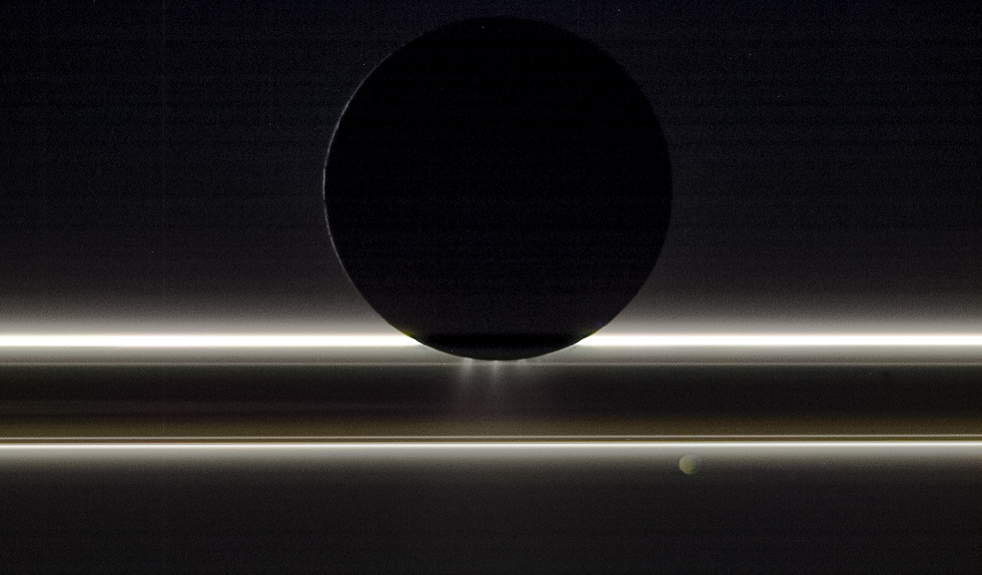
🌑 Backlighting Makes Enceladus’s Icy Plumes Visible
Some moons keep their secrets under wraps. Enceladus, apparently, prefers to let them erupt into space.
Cassini captured the backlit view on November 1, 2009. Placing the Sun behind Enceladus suppresses much of the moon’s bright surface while illuminating fine particles around its limb. That geometry makes the south-polar jets stand out as luminous threads. Enceladus is only about 500 kilometers across and reflects an exceptional fraction of incoming sunlight because fresh ice covers much of its surface. In ordinary lighting it can look like a brilliant snowball. In silhouette, the active material leaving that snowball becomes the subject.
💦 South-Polar Tiger Stripes Vent an Underground Ocean
Backlit by the Sun in this Cassini image captured on November 1, 2009, Saturn’s 500-kilometer-wide moon glows at the edges while a delicate spray of icy plumes streams from its south pole. The dramatic lighting makes the jets easy to spot—and hard to mistake for anything ordinary.
The plumes emerge from long fractures near the south pole nicknamed tiger stripes. Cassini found that these fractures are warmer than surrounding terrain and vent water vapor, ice grains, salts and organic compounds. Gravity measurements, libration studies and other evidence support a global subsurface ocean beneath the ice rather than a small isolated reservoir. Tidal flexing caused by Saturn’s gravity supplies heat as Enceladus follows its slightly eccentric orbit. The moon is therefore not geologically quiet. Its exterior may be frozen, but orbital energy continually works the interior and keeps pathways open between ocean and space.
🪐 Ejected Ice Continuously Feeds Saturn’s Broad E Ring
Cassini discovered the plumes in 2005. Scientists think they may be connected to an ocean beneath Enceladus’s icy crust, making these sparkling eruptions more than a cosmic snow globe: they could offer clues to what lies below. The material also feeds Saturn’s faint outer E ring, so Enceladus is effectively supplying Saturn with a little atmospheric accessorizing.
Material from the jets helps maintain Saturn’s diffuse E ring. Ice grains escape Enceladus, spread along the moon’s orbit and create a broad structure very different from the dense main rings. In the 2009 image, Saturn’s rings also scatter light back toward the camera, while the small moon Pandora appears faintly illuminated by Saturnlight. Pandora is roughly eighty kilometers across and normally associated with the F ring, yet here it plays a subtle supporting role near the lower edge. The scene contains several kinds of reflected and scattered light: sunlight around Enceladus, ring light, Saturnlight and jets made visible because the camera is looking almost into the Sun.
🔬 Cassini Turned a Silhouette into an Astrobiology Target
The moon’s surface is extraordinarily reflective, shining like fresh snow. Nearby, Saturn’s rings scatter sunlight toward Cassini’s cameras, adding a soft glow to the scene. And in the lower right, look closely: Pandora, an 80-kilometer moon, is faintly illuminated by “Saturnlight”—proof that even the night side gets its moment in the spotlight.
Enceladus became a major astrobiology target because the plumes provide samples from an ocean without requiring a spacecraft to drill through kilometers of ice. Cassini flew through them and detected compounds relevant to habitability, including salts, organics and molecular hydrogen associated with hydrothermal processes. Habitability is not evidence of life; it means liquid water, chemistry and energy may coexist in a potentially supportive environment. A future mission could analyze plume material with instruments designed specifically for biosignatures. The silhouette is therefore more than a beautiful finale from a completed mission. It shows a moon placing samples of its hidden ocean directly into space—as if Enceladus noticed the drilling budget and offered curbside pickup.
Cassini’s plume encounters also revealed silica-rich particles whose properties point to warm water-rock interactions on the ocean floor. Molecular hydrogen detected in the plume is consistent with hydrothermal chemistry that can provide energy for microbes on Earth. Phosphates have since been identified in material originating from Enceladus’s ocean, adding another biologically important element to the inventory. These findings do not justify announcing alien organisms. They justify a sharper question: can a small icy moon maintain the chemical gradients, nutrients and stable environments that life could use? Enceladus moved from overlooked ice ball to priority ocean world because each instrument constrained a different part of that question.
The 2009 image came during a mission that repeatedly adjusted its trajectory to revisit Enceladus. Cassini used targeted flybys at different altitudes and instrument orientations, trading one perfect global portrait for measurements of particles, fields, temperature and composition. Imaging located the jets; the Composite Infrared Spectrometer mapped warmth; the Ion and Neutral Mass Spectrometer sampled gases; the Cosmic Dust Analyzer examined grains. No single detector discovered “an ocean” alone. The conclusion emerged because independent measurements pointed toward a coherent interior model.
Enceladus’s extreme brightness also helps maintain low surface temperatures because clean ice reflects most sunlight. Fresh plume fallout continually resurfaces parts of the moon, covering older terrain and preserving the bright appearance. Crater counts vary across the surface, showing that some regions are geologically young while others retain older impacts. The south polar terrain is fractured and comparatively youthful, consistent with active renewal. That pattern links the beautiful white exterior to a dynamic process: Enceladus looks freshly snowed upon because, in a sense, it is snowing material from its own interior.
A dedicated return mission would face difficult choices. Flying through plumes provides repeated samples with relatively modest landing risk, but instruments must distinguish native compounds from spacecraft contamination and changes caused by high-speed impact. Landing near the south pole could add geophysical context while confronting fractured terrain and extreme cold. Orbital radar and gravity science could refine the ice-shell thickness; mass spectrometers could search for complex chemical patterns. Mission design is therefore inseparable from the biological question. Scientists must decide which measurement would genuinely separate geology from possible biology rather than merely producing a longer list of intriguing molecules. Cassini proved that the samples are accessible. The next step is to ask questions precise enough that Enceladus cannot answer every result with “maybe.”
The image’s beauty comes from geometry, but its importance comes from access. Backlighting exposes particles, flybys collect them, and chemistry turns them into evidence about an unseen sea. Enceladus is compelling because a hidden environment continually advertises itself outside the ice. That invitation makes the small moon one of the Solar System’s most practical places to search for evidence of habitable chemistry.
🔗 Sources and Further Reading
Copyright Notice: The image and referenced content remain the property of their respective creators and rights holders. They are used here solely for commentary, discussion, and informational purposes. Please visit the original source links for attribution and additional information.
© 2026 ways4eu.wordpress.com – H.J. Sablotny. All rights reserved. The text content of this article is the intellectual property of H.J. Sablotny and may not be reproduced, distributed, or republished without permission. Images remain the property of their respective copyright holders and are used for illustrative and commentary purposes only.