Ways4eu WordPress.com Blog
SPA View of ways4eu.wordpress.com
IC 342: The Galaxy Behind Our Milky Way
By JohnTheWordWhirlwind
on Thu Nov 05 2026
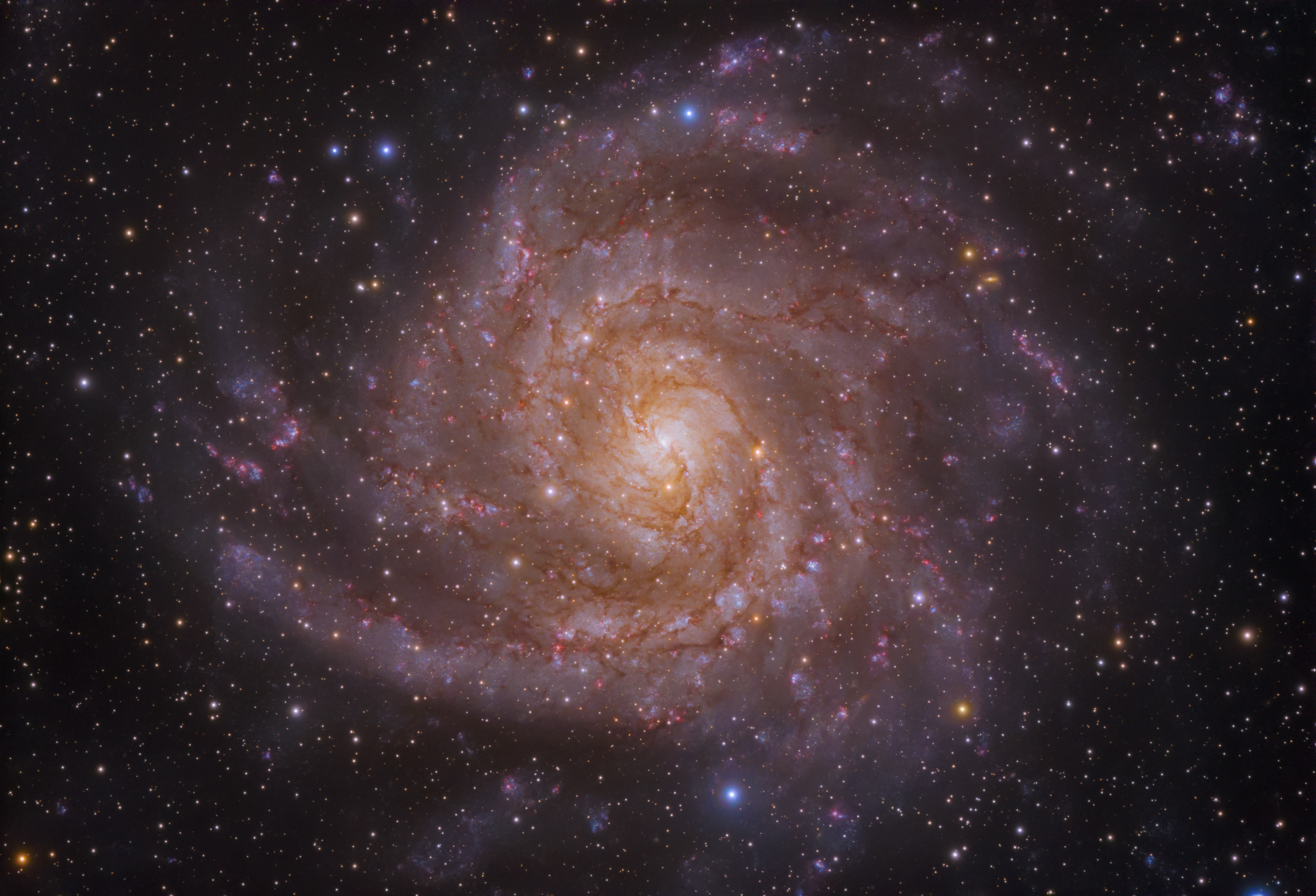
🌌 IC 342 Hides Behind Our Galactic Foreground
Some galaxies are hard to spot—not because they’re shy, but because the Milky Way keeps getting in the way.
Today’s image peers through the crowded plane of our own galaxy, past its stars, gas, and dust, to reveal IC 342, also known as Caldwell 5. Nicknamed the Hidden Galaxy, it’s a bright spiral and one of the most prominent members of the IC 342/Maffei Group.
The nickname does not mean that IC 342 is intrinsically faint. It is a large, nearly face-on spiral in Camelopardalis and would be a conspicuous northern-sky galaxy if our line of sight did not run close to the Milky Way’s crowded plane. Foreground stars are only the most obvious obstruction. Interstellar dust absorbs and reddens visible light, while glowing gas and complicated background structure make it difficult to separate the distant galaxy from material in our own. That is also why published distances have varied. Modern estimates cluster around roughly ten million light-years, close enough to make IC 342 one of the important galaxies in the nearby cosmic neighborhood, yet far enough for every foreground correction to matter. Caldwell 5 is therefore hidden in the same way that a bright building can be hidden by fog: the building has not dimmed; the path between observer and target has become difficult.
🔭 Infrared Eyes Penetrate the Milky Way’s Dust
“Hidden” is relative, of course. IC 342 is about 10 million light-years away, making its group a fairly close neighbor to the Local Group, home to the Milky Way. But the foreground clutter between us and IC 342 makes it difficult to measure the galaxy accurately. That cosmic traffic jam has muddied its history—including inspiring the idea that IC 342 was once ejected from the Local Group. Turns out, when your view is obscured, even galactic family stories can get complicated.
Different wavelengths turn that obstruction into a scientific opportunity. Visible-light photographs emphasize the foreground veil, but infrared light passes through much of the dust and reveals the galaxy’s stellar structure more clearly. Radio observations trace cold molecular gas, the raw material from which stars form, while hydrogen-alpha emission highlights gas ionized by hot, young stars. Comparing those views lets astronomers distinguish dust inside IC 342 from dust in the Milky Way. The process is not simply cosmetic image enhancement. Each wavelength responds to different matter and physical conditions, so a multiwavelength portrait becomes a layered measurement. Researchers can map the central region, estimate how rapidly gas is converted into stars, and examine how material moves through the disk. The Hidden Galaxy is consequently a useful demonstration of a basic astronomical rule: when one kind of light is blocked, change the light rather than abandoning the target.
✨ Star Formation Lights the Galaxy’s Spiral Arms
IC 342 has plenty going on of its own. Dust within the galaxy sometimes blocks the glow of hydrogen gas, which can point to regions where bright, young stars are forming. And maps of its magnetic fields offer clues to one of astronomy’s big questions: how do spiral arms form and hold their shape? Magnetic fields may be an important part of the answer.
So the Hidden Galaxy isn’t entirely hidden—and it may help reveal how galaxies get their stunning spirals.
IC 342 is especially active near its center. Dust lanes channel gas toward a compact nuclear region where clusters of young stars and luminous gas clouds crowd together. Across the disk, pink-red hydrogen-alpha knots mark stellar nurseries, while blue regions indicate populations of hot, short-lived stars. Massive stars reshape those nurseries through ultraviolet radiation, winds and eventual supernova explosions. The cycle compresses some clouds, disperses others and enriches the surrounding gas with heavier elements. Because IC 342 is viewed almost face-on, astronomers can follow that activity across the spiral pattern without looking through the full thickness of an edge-on disk. The irony is useful: our own Galaxy makes the object hard to see, but IC 342’s orientation makes its internal layout unusually instructive once the foreground has been accounted for.
🧲 Magnetic Fields Trace an Ordered Cosmic Structure
Tomorrow’s picture: open space Image via NASA https://ift.tt/cxRz24G
Radio polarization maps add another layer by revealing ordered magnetic fields that curve through the disk. Those fields do not paint the visible arms perfectly; in places, magnetic arms occupy the spaces between the optical ones. That offset gives researchers a way to test ideas about spiral density waves, gas compression and the dynamo processes that maintain galactic magnetism. Magnetic fields are not decorative lines pasted onto a galaxy. They influence charged particles and cosmic rays, interact with turbulent gas and may affect how clouds collapse. IC 342 therefore links a beautiful spiral image to several hard questions: how spiral patterns persist, how gas flows inward, and how star formation reorganizes a disk over time. The galaxy remains partly concealed, but the obstruction has forced astronomers to develop a richer portrait than a single visible-light photograph could provide.
IC 342 also belongs to the IC 342/Maffei Group, a nearby association whose members are unusually difficult to inventory because the Milky Way blocks the same region. Establishing accurate distances changes estimates of the group’s mass, motion and possible gravitational influence on neighboring systems. Astronomers use standard candles such as the tip of the red-giant branch, applying infrared observations to reduce the effect of extinction. The exercise shows why distance is not a minor caption detail. Luminosity, physical size, star-formation rate and group membership all depend on it. A ten-percent distance revision propagates through much of the interpretation. The galaxy’s playful nickname therefore points to a serious measurement problem: foreground dust can make an entire nearby group look less certain than far more distant objects seen through cleaner windows.
Observing IC 342 is also a practical lesson for amateur astrophotographers. Long exposures collect the galaxy but also collect a dense foreground of Milky Way stars, gradients from sky glow and color shifts caused by extinction. Processing that data requires restraint: removing every foreground star would falsify the reason the target is called hidden, while aggressive contrast can make dust corrections look like invented structure. A successful portrait preserves the veil and still reveals the spiral beneath it. The difficulty is not merely obtaining enough photons. It is deciding which photons belong to which galaxy.
🔗 Sources and Further Reading
- NASA: Hubble’s Hidden Galaxy
- NASA APOD: Hidden Galaxy IC 342
- Astronomy & Astrophysics: Magnetic Fields in IC 342
Copyright Notice: The image and referenced content remain the property of their respective creators and rights holders. They are used here solely for commentary, discussion, and informational purposes. Please visit the original source links for attribution and additional information.
© 2026 ways4eu.wordpress.com – H.J. Sablotny. All rights reserved. The text content of this article is the intellectual property of H.J. Sablotny and may not be reproduced, distributed, or republished without permission. Images remain the property of their respective copyright holders and are used for illustrative and commentary purposes only.