Ways4eu WordPress.com Blog
SPA View of ways4eu.wordpress.com
Swift Observatory’s Final Descent
By JohnTheWordWhirlwind
on Fri Nov 06 2026
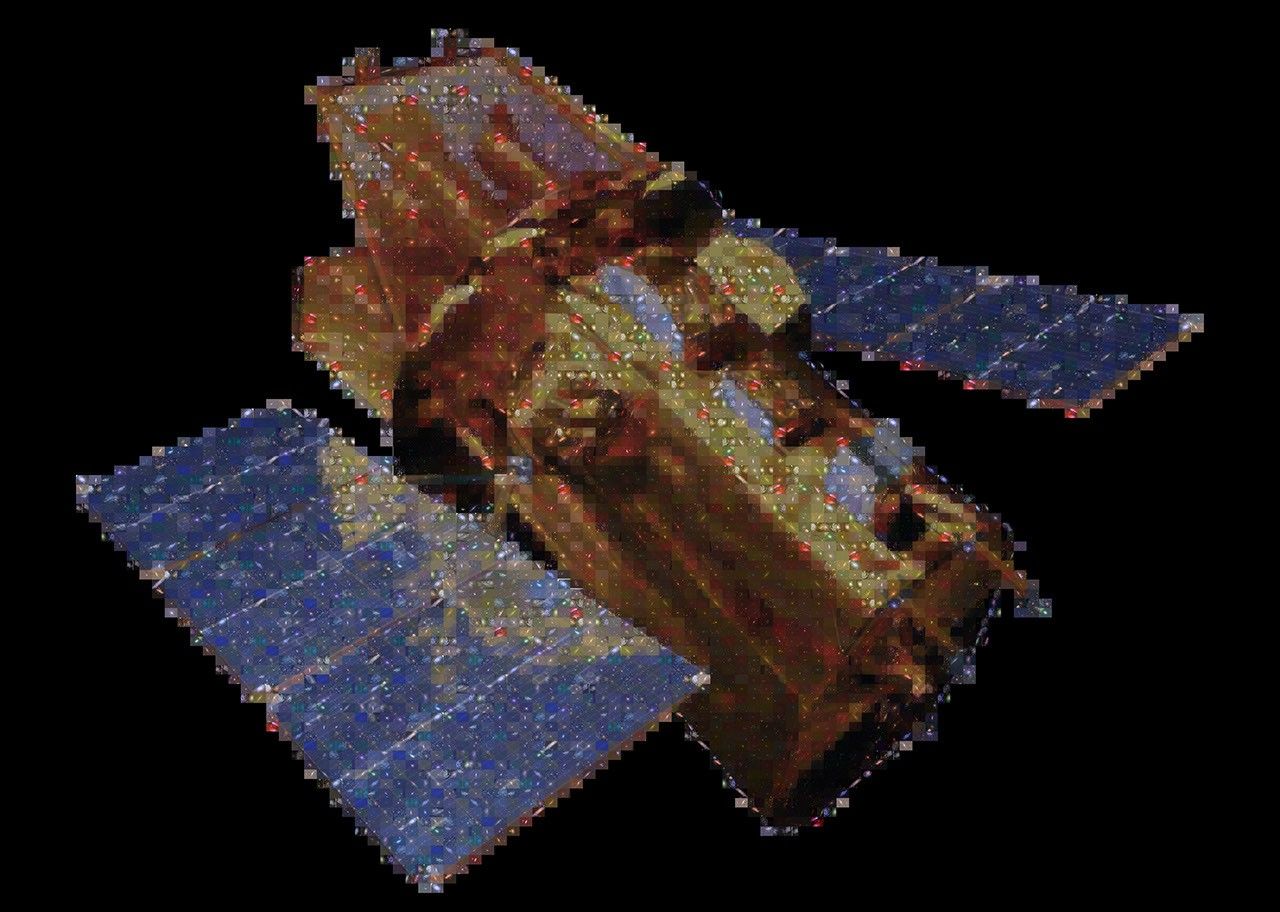
🌠 Swift Built a Career Around Sudden Cosmic Explosions
After nearly 22 years spent chasing the universe’s brightest outbursts, NASA’s Neil GehrelsSwift Observatory has made its final exit. On November 4 at 7:39 a.m. EST, the satellite re-entered Earth’s atmosphere over North Sumatra, Indonesia—ending its mission in a blaze of glory, and quite literally a little bit of fire.
Swift’s farewell image is a mosaic assembled in 2018 from the first one million pictures taken by its Ultraviolet/Optical Telescope. A million images: an impressive portfolio by any measure, even for a telescope that made a career of catching cosmic fireworks.
Swift launched on November 20, 2004, for a mission initially expected to last about two years. Its specialty was speed. Gamma-ray bursts appear without warning and may fade rapidly, so an observatory that detects one must alert other astronomers and turn toward the source before the afterglow disappears. Swift’s Burst Alert Telescope watched a wide field of sky for high-energy flashes. Once it found a burst, the spacecraft could autonomously slew so its X-Ray Telescope and Ultraviolet/Optical Telescope examined the same location. That sequence connected the initial explosion to longer-lived emission across several wavelengths. A mission named Swift was therefore not engaging in decorative branding; rapid response was the scientific design.
🔄 Three Instruments Followed Bursts within Minutes
Swift was more than one instrument in orbit. Its ultraviolet and optical telescope worked alongside X-ray and gamma-ray telescopes, letting astronomers quickly spot and study some of the fastest, most energetic explosions in the universe. When the cosmos went off-script, Swift was ready to swivel, observe and send the news home.
But even a nimble spacecraft can’t dodge every challenge. The latest solar maximum sped up the decay of Swift’s orbit, and an innovative effort to boost the satellite and extend its mission did not succeed. In the end, Swift streaked through the atmosphere like a shooting star—one final flash from a mission that spent decades watching much bigger ones.
Gamma-ray bursts can mark the collapse of massive stars or the merger of compact objects such as neutron stars. Their brief high-energy signal carries enormous power but limited context. Swift’s follow-up observations helped locate host galaxies, measure fading light and distribute positions to ground-based telescopes. The observatory also studied supernovae, tidal disruption events, active galaxies, novae, comets and other changing sources. Its million-image ultraviolet/optical mosaic celebrates volume, but the deeper achievement was coordination. Swift turned transient astronomy into a networked practice in which automated alerts allowed observatories around the world to respond. The spacecraft did not simply collect pictures; it changed who could arrive in time for an event.
☀️ Solar Activity Accelerated the Observatory’s Orbital Decay
The spacecraft is gone, but its remarkable archive of observations remains. Researchers will continue mining Swift’s data for years, bringing new light to the mysteries of the cosmos. Not a bad legacy for a satellite that made a habit of looking up.
May Swift inspire the next generation of missions to boldly go into space, explore new data and seek out new science. The universe, after all, is still putting on a show.
Low Earth orbit is not empty. Wisps of upper atmosphere create drag, and stronger solar activity heats and expands that atmosphere, increasing density at satellite altitude. Swift’s orbit decayed faster during the recent solar maximum. NASA explored an ambitious private reboost mission, but the servicing spacecraft encountered control problems and did not attempt capture. Swift briefly returned to science before descending too low to maintain operations. On October 20 it entered safe mode around 275 kilometers altitude, and controllers ended the mission. Reentry occurred on November 4, 2026, at 12:39 UTC over North Sumatra, Indonesia. Most hardware would have burned during descent, though dense components can sometimes survive. The observatory that chased cosmic explosions finally met a very terrestrial one: atmospheric drag winning by persistence.
📚 Swift’s Archive Survives the Spacecraft’s Reentry
The spacecraft’s destruction does not destroy its measurements. Calibrated data, software, catalogs and observing records remain available for new analyses, including questions not imagined when the observations were taken. Researchers can compare Swift events with later gravitational-wave detections, improved galaxy surveys or revised models. The reentry is also being used to test thermospheric density models because the final trajectory provides a real outcome against which forecasts can be compared. That is an appropriate final contribution from a mission built around rapid, uncertain events. Swift leaves no telescope in orbit, but it leaves a mature system for reacting to the changing sky and an archive covering nearly twenty-two years. The mission ended; the citations have not.
Swift’s statistics show the scale of that legacy. Over its lifetime it detected more than two thousand gamma-ray bursts and observed well over a thousand supernovae, alongside black-hole feeding events and objects inside our own Solar System. Numbers alone can become mission brochure wallpaper, so the operational chain is more revealing: detect a burst, calculate a position, notify the world, turn the spacecraft and begin multiwavelength follow-up while the source is still changing. That sequence was repeated often enough to become infrastructure for an entire research community. Swift was renamed in 2018 for Neil Gehrels, its first principal investigator, recognizing the leadership behind the mission’s scientific culture. The final mosaic may look like a memorial, but every tile is also an entry point into a dataset with calibration, timing and coordinates. Researchers do not have to admire the farewell image to keep using what it represents.
Uncontrolled reentry also creates a public-safety and communication challenge. Forecast uncertainty remains large until the final orbits because small errors in atmospheric density and spacecraft attitude accumulate along a path moving kilometers each second. Agencies publish time windows and ground tracks rather than pretending to know an exact landing point days in advance. Earth’s oceans and sparsely populated areas make harm unlikely, and most spacecraft mass burns up, but dense parts can survive. Swift’s final time and region now give modelers a valuable benchmark. The same solar-driven atmosphere that ended the mission supplied data for improving future orbit and debris forecasts. Even descent became an observation campaign.
The observatory’s end also leaves a capability gap. Other missions can detect high-energy transients, but Swift’s particular combination of wide-field trigger, rapid slew and coordinated follow-up was unusually productive. Future missions will inherit its methods even when their instruments, alert systems and orbits differ. Legacy is therefore operational as well as archival.
🔗 Sources and Further Reading
- NASA: Swift mission ends ahead of re-entry
- NASA CCMC: Swift reentry record
- NASA HEASARC: Swift mission and instruments
- The Aerospace Corporation: Swift reentry
Copyright Notice: The image and referenced content remain the property of their respective creators and rights holders. They are used here solely for commentary, discussion, and informational purposes. Please visit the original source links for attribution and additional information.
© 2026 ways4eu.wordpress.com – H.J. Sablotny. All rights reserved. The text content of this article is the intellectual property of H.J. Sablotny and may not be reproduced, distributed, or republished without permission. Images remain the property of their respective copyright holders and are used for illustrative and commentary purposes only.