Ways4eu WordPress.com Blog
SPA View of ways4eu.wordpress.com
M30’s Ancient Stars Stage a Blue Comeback
By JohnTheWordWhirlwind
on Sat Nov 07 2026
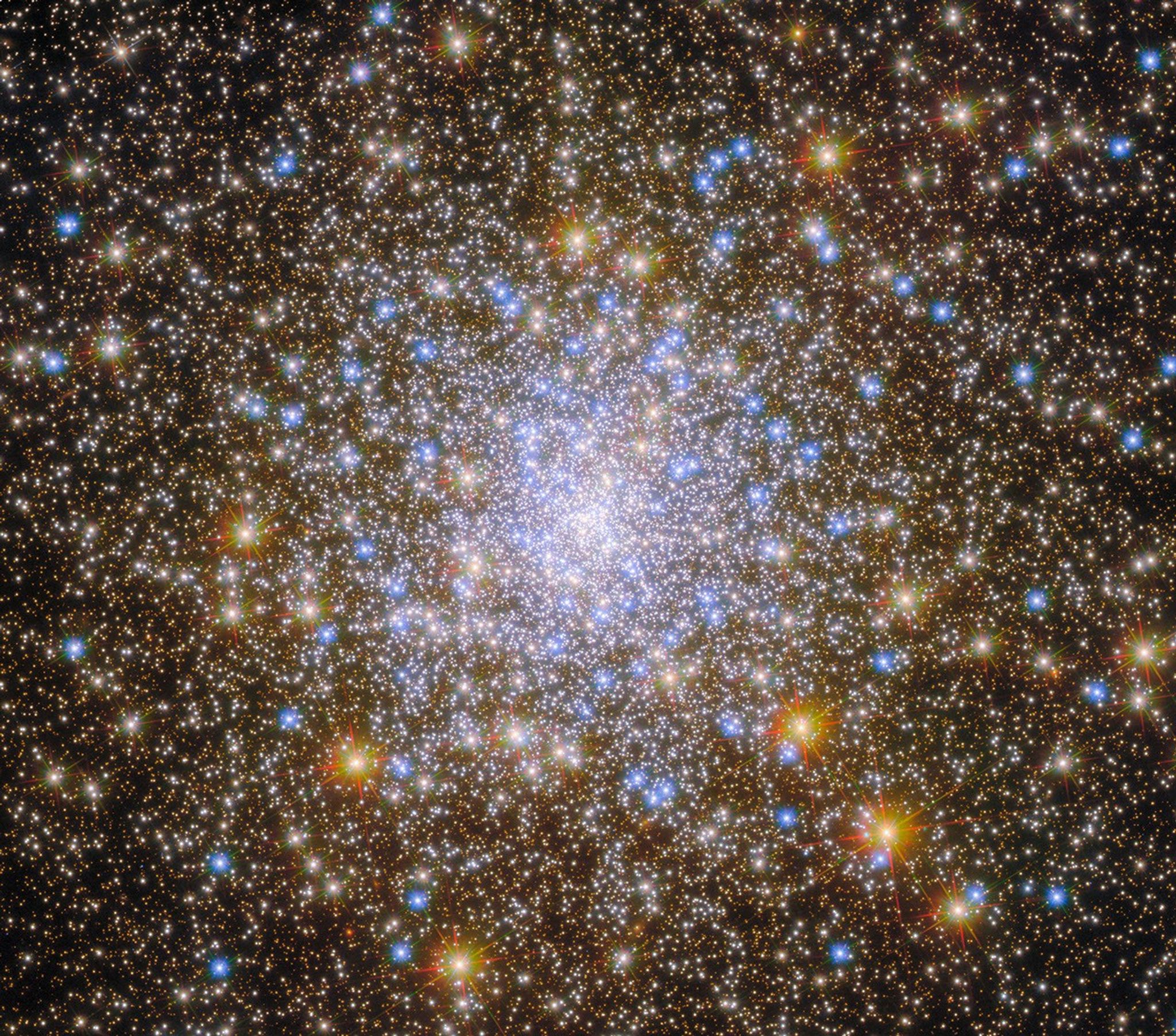
✨ Messier 30 Packs Ancient Stars into One Portrait
The glitter in this new NASA image of Messier 30 is not a loose sprinkling of nearby stars. M30, also catalogued as NGC 7099, is a globular cluster: a roughly spherical, gravitationally bound system that contains hundreds of thousands of stars. NASA places it about 27,500 light-years away in the constellation Capricornus, while its broader Hubble catalogue page rounds the distance to 28,000 light-years. At roughly 90 light-years across, the cluster is both enormous and extraordinarily concentrated. The luminous center is not a photographic flare added for drama. It is the visible consequence of many stars occupying a comparatively compact volume, so their light overlaps into a brilliant central crowd.
Globular clusters are valuable because they preserve populations formed early in the Milky Way’s history. NASA describes M30 as about 13 billion years old, close enough to the universe’s own age to make the phrase ‘ancient neighborhood’ feel almost inadequate. Most of its stars formed from the same early reservoir of gas and have aged together. That shared history gives astronomers a useful laboratory: differences among the stars are less likely to be caused by wildly different birth dates than they would be in a mixed field population. The cluster is not a retirement home in the quiet sense, however. Its residents still exchange energy, orbit through a dense gravitational environment and occasionally interact in ways that alter individual stellar lives.
Charles Messier discovered the object in 1764 while compiling a catalogue of diffuse sights that comet hunters might otherwise mistake for comets. The practical nuisance became one of astronomy’s most durable observing lists. M30 has an apparent magnitude of about 7.7, making it fainter than the unaided-eye limit under ordinary conditions but accessible through binoculars or a small telescope in a dark sky. Its location in Capricornus places it well south of the more familiar northern showpieces. A backyard observer sees a compact hazy patch; Hubble resolves the haze into an immense population whose color and position can be measured star by star.
🌀 Gravity Reshaped M30 Through Core Collapse
M30 is classified as a core-collapsed globular cluster. Over very long periods, repeated gravitational encounters redistribute energy among stars. More massive stars tend to sink inward while lighter members can migrate outward, and the central region contracts until its density rises sharply. The phrase ‘core collapse’ sounds like the cluster has imploded into a single object, but the process is a change in the distribution and motion of its stellar population. The cluster remains a cluster. What changes is the concentration at its heart, and that denser environment increases the chance of close interactions. M30’s steeply bright center is therefore not merely picturesque; it is a record of the cluster’s internal dynamics.
A 2009 ESA/Hubble study of M30 connected two populations of unusual stars to a major core-collapse event that occurred about two billion years ago. As the core contracted, the probability of stars passing close enough to collide rose. At the same time, tight binary systems in the dense center could exchange mass or be rearranged by encounters. The event did not create every feature at once like a celestial firework. It altered the rates and conditions under which stellar interactions occurred, leaving patterns that astronomers could later identify in a color-magnitude diagram. The cluster’s present arrangement is thus evidence about motion across billions of years, not simply a snapshot of where points of light happened to land.
Density also complicates observation. In the core, stars appear so close together on the sky that a ground-based telescope may blend several sources into one patch of light. Hubble’s resolution above Earth’s atmosphere helps separate those sources, but careful photometry is still required. Astronomers measure brightness through selected filters, correct instrumental effects and compare where stars fall relative to the cluster’s expected evolutionary sequences. A colorful image invites the eye to admire the crowded center; the research depends on turning those colors and positions into data. Even the most photogenic stellar traffic jam needs lane markings before scientists can say which travelers are behaving unusually.
💙 Blue Stragglers Follow Two Rejuvenation Routes
The best-known exceptions in M30 are blue straggler stars. In an old cluster, the hot, massive blue stars born at the beginning should have exhausted their fuel and evolved away from the main sequence long ago. Blue stragglers appear hotter, brighter and younger than the surrounding population, but they are not late arrivals from a recent wave of star formation. They are older stars whose later interactions supplied fresh mass or merged stellar material, allowing them to occupy a place on the diagram normally associated with younger, more massive stars. ‘Rejuvenation’ describes their observable condition; it does not mean that time reversed inside them.
Hubble observations identified two distinct blue-straggler sequences in M30. One is consistent with direct stellar collisions, which can combine material into a more massive star. The other is associated with binary systems in which one star transfers hydrogen-rich matter to its companion. The second route is sometimes nicknamed stellar vampirism, although the donor and recipient are obeying orbital physics rather than auditioning for a cape. The distinction matters because a single label, blue straggler, can hide different formation histories. By separating the sequences, researchers obtained evidence that M30’s dense environment supported both collision-driven and binary-driven routes during and after its dynamical upheaval.
Blue stragglers are useful precisely because they connect stellar evolution with cluster dynamics. A textbook model can describe how an isolated star changes according to its mass and composition. A globular cluster adds neighbors, binaries and close encounters. Those interactions can change a star’s mass, and mass strongly influences temperature, luminosity and lifetime. M30 therefore shows why a cluster cannot be understood as hundreds of thousands of isolated clocks that all started together. The clocks can collide, exchange parts and reset what an observer infers from their faces. Astronomers still respect the cluster’s ancient age while explaining why a small number of members look suspiciously energetic for their cohort.
🔭 Hubble Turns a Star Cluster into History
The new portrait was released by the NASA Hubble mission team on November 5, 2026, and highlighted by NASA the following day. Image credits name ESA/Hubble and NASA together with M. Libralato, G. Piotto and A. Sarajedini, signaling that the picture rests on an observing and research program rather than on a camera pointed casually at a pretty target. Hubble images commonly combine exposures taken through different filters, then assign colors that help distinguish physical information while creating a coherent view. The result is visually immediate, but its scientific value depends on calibrated measurements, documented processing and comparison with models.
Hubble’s Messier catalogue also makes a useful bridge between historic observing and modern astrophysics. Messier recorded objects to avoid confusing them with comets; today the same entries organize public tours through star formation, stellar death, galaxies and clusters. M30 is especially effective because its story works at several scales. The whole cluster traces early galactic history, the central density records long-term gravitational evolution, and individual blue stragglers reveal collisions or mass transfer. One image can therefore be read as a portrait, a map of stellar demographics and the visible front page of a much larger dataset.
The responsible way to enjoy the image is to keep its beauty and its limits together. The frame does not show stars physically touching, and color alone does not label a blue straggler’s origin. Those conclusions come from repeated observations, photometry and dynamical interpretation. Nor should the dense center be described as a black hole without specific evidence; core collapse in a globular cluster has a defined dynamical meaning. What the portrait safely demonstrates is already remarkable: gravity has held an ancient system together for billions of years while continually rearranging its members. M30 still sparkles, but the real headline is that its sparkle carries a history of formation, migration, collision and exchange.
🔗 Sources and Further Reading
- NASA: M30’s Sparkling Stars
- NASA Science: Hubble Learns Galactic History From Stars
- NASA Science: Messier 30 catalogue entry
- ESA/Hubble: Vampires and Collisions Rejuvenate Stars
- Original NASA image-feed URL
Copyright © 2026 Ways4Eu. All rights reserved.
Curated and edited for Ways4Eu.