Ways4eu WordPress.com Blog
SPA View of ways4eu.wordpress.com
Rigel Lights the Witch Head Nebula
By JohnTheWordWhirlwind
on Tue Nov 10 2026
🧙 IC 2118 Becomes a Face Through Pareidolia
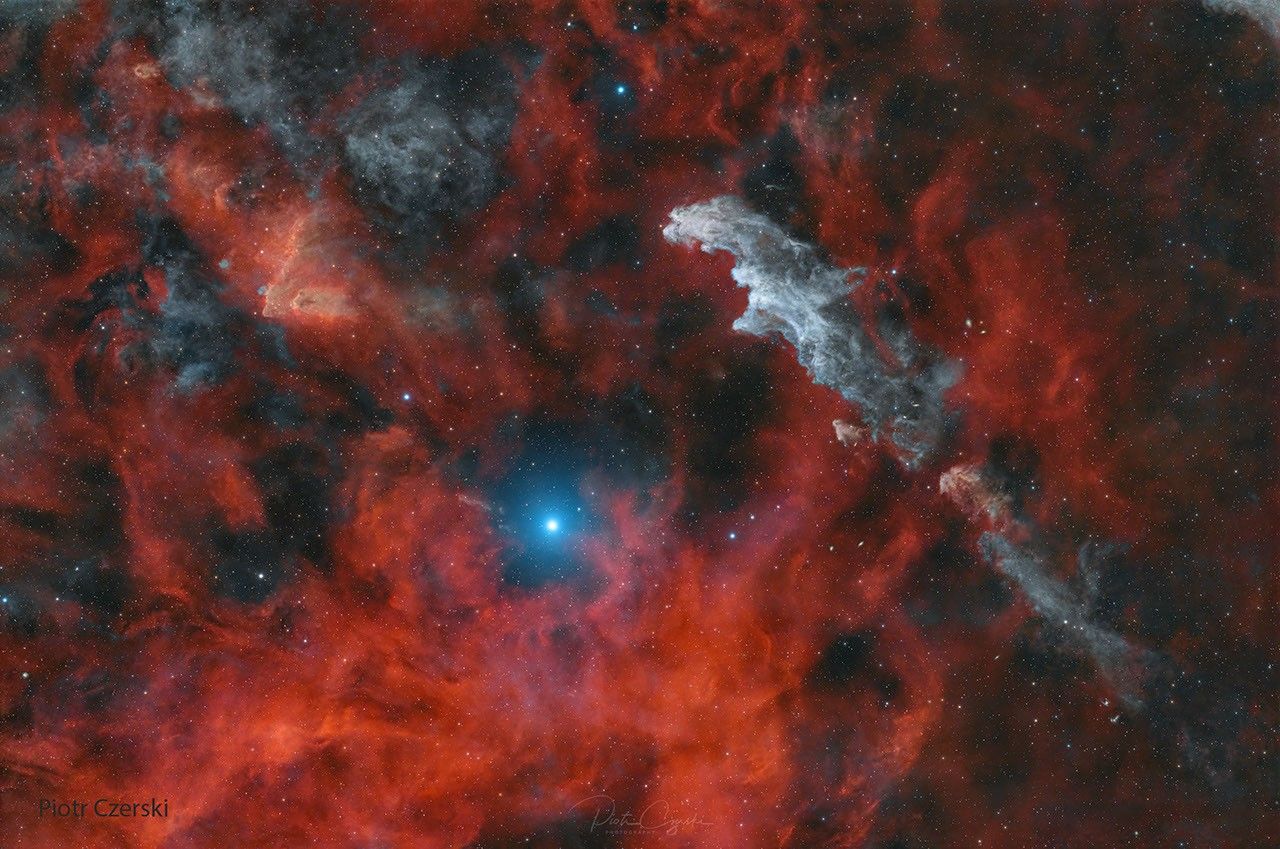
Witch Head Nebula: Does the Witch Head Nebula look like a witch’s head? That depends on your imagination—and perhaps how much Halloween candy you’ve had. The blue cloud, officially catalogued as IC 2118, is said to resemble a spooky, storybook caricature. The resemblance is open to debate; the nebula’s dramatic name is not.
IC 2118: The hooked profile is an act of pattern recognition, not a boundary drawn in the cloud. Dust filaments happen to produce a forehead, nose and chin when the image is oriented in the familiar way. Rotate the frame or change the processing and the witch weakens. Astronomers use the nickname because it is memorable, while the catalog designation IC 2118 avoids pretending morphology has a single storybook interpretation. Pareidolia brings viewers into the image; measurement explains what the light actually records.
Rigel: The nebula lies near Eridanus in the sky even though Rigel belongs to Orion’s familiar outline. Constellation borders are human mapping conventions drawn on the celestial sphere; physical clouds and stars do not obey them. This is why the Witch Head can be described as associated with Rigel while catalogued in a neighboring constellation. The apparent neighborhood is useful for locating the object, but it should not be mistaken for a tidy three-dimensional address.
Reflection Nebula: The nickname creates a useful editorial trap. Once told to see a witch, viewers search for the nose and chin and often stop examining the rest of the cloud. Looking without the label reveals arcs, knots and broad gradients that connect to questions about dust structure and star formation. The joke about a cosmic profile opens the door, but the object earns attention because scattered light maps an enormous interstellar environment that the unaided eye would miss.
🔵 Rigel Paints Interstellar Dust in Blue
Astrophotography: About 50 light-years across, IC 2118 is made of gas and dust. Its shape points toward the nearby star Rigel, which has helped sculpt and erode the cloud. One of the brightest stars in Orion, Rigel sits just below the center of this image—like a celestial spotlight aimed at the scene.
Orion: IC 2118 is a reflection nebula. It does not glow mainly because its gas is ionized like the red regions around hot newborn stars. Instead, dust scatters light from nearby Rigel, the blue supergiant marking Orion’s foot. Shorter blue wavelengths scatter efficiently from the small grains, helping create the nebula’s color. The comparison with Earth’s blue sky is useful at a broad level, although the particles and geometry differ. Rigel is outside or near the frame in many compositions but remains the essential lamp.
Interstellar Dust: Rigel’s luminosity makes it capable of illuminating dust across a large region, yet the exact spatial relationship is harder to infer than a two-dimensional image suggests. Distance estimates for diffuse clouds are challenging, and different filaments may occupy different depths. Astronomers combine stellar distances, infrared observations and the behavior of scattered light to constrain the geometry. The familiar portrait is therefore a projection of a complex volume, not a thin blue veil hanging behind one star.
NASA APOD: The cloud’s faintness also explains why casual telescope viewing rarely resembles processed photographs. Human night vision is sensitive to contrast but poor at perceiving color in very dim extended objects. A dark site, adapted eyes and the right field of view help, yet the full blue profile remains primarily a photographic achievement. Setting that expectation protects observers from assuming either that their equipment failed or that every published nebula image is fraudulent.
📏 A Vast Cloud Appears Faint and Elusive
Rigel also helps give the nebula its striking blue color. Its intense blue light illuminates the dust, whose tiny grains scatter blue light more efficiently than red. It’s a bit like the reason Earth’s daytime sky looks blue—though here the scatterers are dust grains, while our atmosphere’s nitrogen and oxygen molecules do the scattering.
The cloud spans roughly fifty light-years and stretches across several degrees of sky, yet it is extremely faint. Large angular size does not guarantee naked-eye visibility because its light is spread over a broad area. Distance estimates and the three-dimensional relation between Rigel and the dust carry uncertainties, so a flat photograph should not be mistaken for a precise physical map. Research has also identified young stellar objects in the region, supporting investigation of whether external radiation and cloud structure influenced star formation.
Infrared observations reveal material that visible-light photographs emphasize differently. Warm dust and embedded young objects can appear through wavelengths that penetrate obscuring material more effectively, while optical images excel at showing reflected starlight. Comparing bands helps separate illumination effects from actual density. A dramatic blue exposure is scientifically useful, but it is one view of the cloud’s matter and activity rather than the nebula’s single true appearance.
Young stars associated with the region make IC 2118 more than reflected decoration. Infrared surveys can identify disks, temperatures and spectral signatures that help researchers distinguish genuine young stellar objects from unrelated background sources. Mapping their positions against molecular material tests whether star formation is dispersed or concentrated near compressed structures. The Witch Head nickname describes the cloud’s outline; stellar populations reveal what is happening inside and around it.
📷 Long Exposures Build the Familiar Portrait
So is it a witch? Maybe. But even if you can’t spot the nose, the cosmic lighting is spellbinding.
Astrophotographers reveal the nebula by collecting many long exposures, calibrating detector noise and combining frames. Processing must separate weak dust signal from gradients, scattered light and artifacts without inventing structure. Color balance, contrast and framing therefore shape the witch viewers recognize. The final image is both evidence and interpretation: photons left Rigel, scattered from dust and reached a detector, but human choices made that fragile signal legible. The cosmic bad-hair day is real dust illuminated by real starlight; the hairstyle belongs to us.
Dark-sky conditions help photographers control gradients from artificial light, airglow and moonlight. Wide fields are needed because IC 2118 covers a surprisingly large angle, and mosaics may be required at longer focal lengths. Calibration frames correct sensor response and optical artifacts before stretching makes the weak signal visible. Those technical steps are not cosmetic excuses; without them, dust lanes can be confused with uneven illumination or processing noise.
🔗 Sources and Further Reading
- NASA Astronomy Picture of the Day
- NASA APOD archive: IC 2118
- Planetary Society: Witch Head Nebula
- Spitzer study of IC 2118
Copyright Notice: The image and referenced content remain the property of their respective creators and rights holders. They are used here solely for commentary, discussion, and informational purposes. Please visit the original source links for attribution and additional information.
© 2026 ways4eu.wordpress.com – H.J. Sablotny. All rights reserved. The text content of this article is the intellectual property of H.J. Sablotny and may not be reproduced, distributed, or republished without permission. Images remain the property of their respective copyright holders and are used for illustrative and commentary purposes only.