Ways4eu WordPress.com Blog
SPA View of ways4eu.wordpress.com
Saturn Slips Behind the Moon
By JohnTheWordWhirlwind
on Tue Nov 10 2026
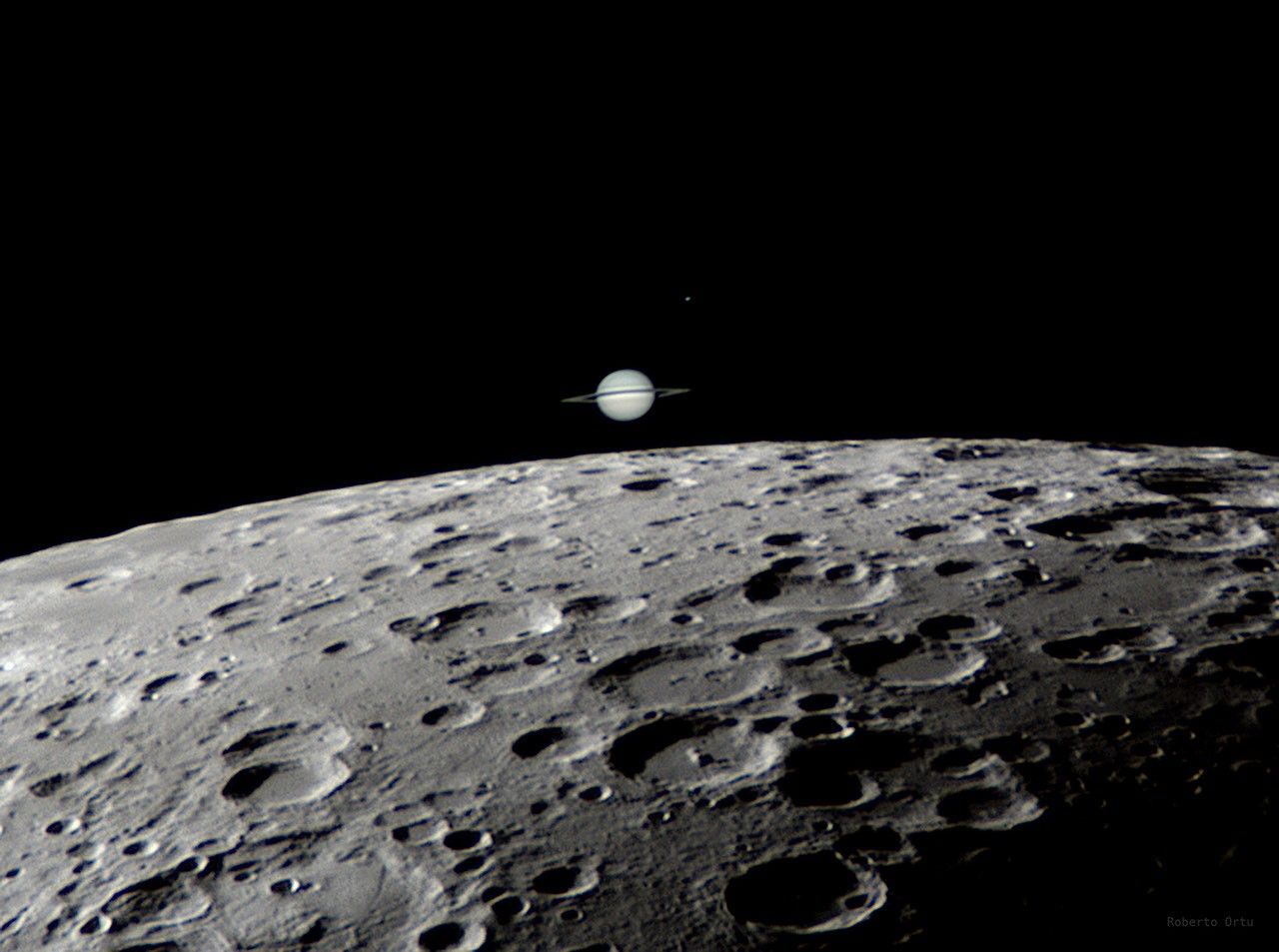
🌒 The Moon Briefly Erases a Distant Planet
Saturn: Don’t worry: the ringed planet hasn’t packed up and left the Solar System. It simply slips out of sight when our Moon passes in front of it. Astronomers call this a lunar occultation—a rather grand name for the Moon briefly playing keep-away with a planet.
Lunar Occultation: A lunar occultation occurs when the Moon passes directly between an observer and a more distant object. Saturn does not dim, change course or move behind the Moon in any physical encounter; the disappearance is produced entirely by geometry along one line of sight. Because the Moon is relatively close to Earth, a small change in the observer’s location changes its apparent position against the background sky. The event can therefore be visible from one region while observers elsewhere see Saturn pass beside the lunar limb.
Moon: Atmospheric steadiness, telescope focal length, tracking and accurate focus all affect the result. The Moon moves noticeably against the stars, while Earth’s rotation carries the whole field across the detector. A photographer must plan not only where the occultation is visible but when Saturn reaches the lunar limb at that exact location. Predictions are therefore local: a timetable copied from another city can be wrong by minutes or describe a near miss instead of a disappearance.
Astrophotography: An occultation differs from an eclipse in ordinary astronomical usage. An eclipse usually describes one body entering another’s shadow or one luminous disk being covered in a system such as the Sun and Moon. Occultation emphasizes a nearer object hiding a more distant one from a particular viewpoint. The categories can overlap conceptually, but the term tells observers to expect a line-of-sight event whose visibility footprint changes strongly with location.
📐 Three Distances Share One Narrow Sightline
85 Aquarii: In early 2025, the event was visible along a narrow path stretching from Greenland through central Europe and into northern Africa. The featured image, captured after sunset in Sardinia, Italy, combines three photographs: one showing Saturn before it disappeared, and two of the Moon taken with different exposure times. The result brings out both the bright planet and the Moon’s more subtle details.
Planetary Astronomy: The Moon averages about 384,400 kilometers from Earth, Saturn was more than a billion kilometers away during the event, and 85 Aquarii lies vastly farther still. A photograph compresses those separations into a flat arrangement of bright forms. The star appearing near Saturn is not a Saturnian moon and is not physically close to the planet. It is simply projected into the same small patch of sky. Occultations make depth visible indirectly: the nearer body is the one capable of hiding everything behind it.
Sardinia: The event’s narrow visibility path is a practical lesson in parallax. Observers separated by hundreds of kilometers look past the Moon along slightly different directions, enough to shift Saturn relative to the lunar edge. Near the boundary of the path, the planet may skim behind mountains and valleys on the Moon’s silhouette, producing a grazing occultation. Such observations can record multiple brief disappearances as the rings or planetary disk pass behind irregular lunar terrain.
NASA APOD: Saturn’s rings add a recognizable scale that makes the approach especially photogenic. Near the lunar limb, the planet appears tiny beside craters that are themselves hundreds of kilometers wide. That visual comparison is deceptive in distance but useful in angular size: the Moon covers about half a degree of sky, while Saturn’s disk and rings occupy only arcseconds. The Moon needs no dramatic maneuver to hide the planet; its ordinary orbital motion is sufficient.
📷 Exposure Bracketing Preserves Moon and Saturn
That bright dot beside Saturn isn’t one of its moons. It’s the star 85 Aquarii, much farther away than Saturn—and even farther behind the Moon from our point of view. Space is excellent at making a simple line of sight feel like a cosmic traffic jam.
The disappearance and reappearance happen at the Moon’s edge, or limb. Unlike a planet with a thick atmosphere, the Moon has no substantial global atmosphere to soften the transition, so a pointlike star can wink out abruptly. Saturn is an extended object, and its rings give the event a more gradual, structured profile through a telescope. Careful timing of contacts can test predicted lunar positions and historically helped astronomers refine knowledge of the Moon’s limb and motion.
Occultations are predictable because the orbits of the Moon, Earth and Saturn are measured with great precision, yet each event still depends on weather and geography. A forecast can identify the path and contact times, but clouds can erase the spectacle for an entire region. That combination of exact celestial mechanics and ordinary atmospheric luck is part of the appeal. The heavens keep the appointment; the local sky decides whether anyone gets through the door.
For visual observers, ingress and egress offer two different experiments in attention. Watching Saturn approach the bright lunar edge is harder because glare reduces contrast; reappearance from the darker limb can feel startling. Telescope magnification must still leave enough field to track the scene comfortably. Recording the exact site and time makes an observation useful beyond the photograph.
🗺️ Occultation Paths Reward Precise Local Timing
Missed the show? The Moon’s next Saturn-hiding act visible from somewhere on Earth is expected in 2031. Until then, Saturn will remain right where it is: gloriously ringed and, for the most part, in plain view.
The Sardinian composite solves a difficult photographic problem. The illuminated Moon is much brighter than Saturn and the Earth-lit part of the lunar disk. One exposure that preserves bright lunar detail can leave the planet too faint; an exposure long enough for Saturn may wash out the Moon. Combining frames made with different exposure times can represent details that the eye perceives across a wider brightness range, provided the method is disclosed rather than presented as one untouched instant.
The next Saturn occultation visible from a particular place may be years away even though occultations occur somewhere on Earth more often. Readers should check location-specific tables from established astronomy organizations rather than treating a global date as a universal showtime. Binoculars or a small telescope can reveal Saturn close to the lunar limb, but safe viewing practices still apply whenever an event occurs near daylight. The photograph records how precisely three-dimensional space can line up for one observer.
🔗 Sources and Further Reading
- NASA Astronomy Picture of the Day
- NASA Solar System: Saturn overview
- International Occultation Timing Association
- NASA Moon facts
Copyright Notice: The image and referenced content remain the property of their respective creators and rights holders. They are used here solely for commentary, discussion, and informational purposes. Please visit the original source links for attribution and additional information.
© 2026 ways4eu.wordpress.com – H.J. Sablotny. All rights reserved. The text content of this article is the intellectual property of H.J. Sablotny and may not be reproduced, distributed, or republished without permission. Images remain the property of their respective copyright holders and are used for illustrative and commentary purposes only.